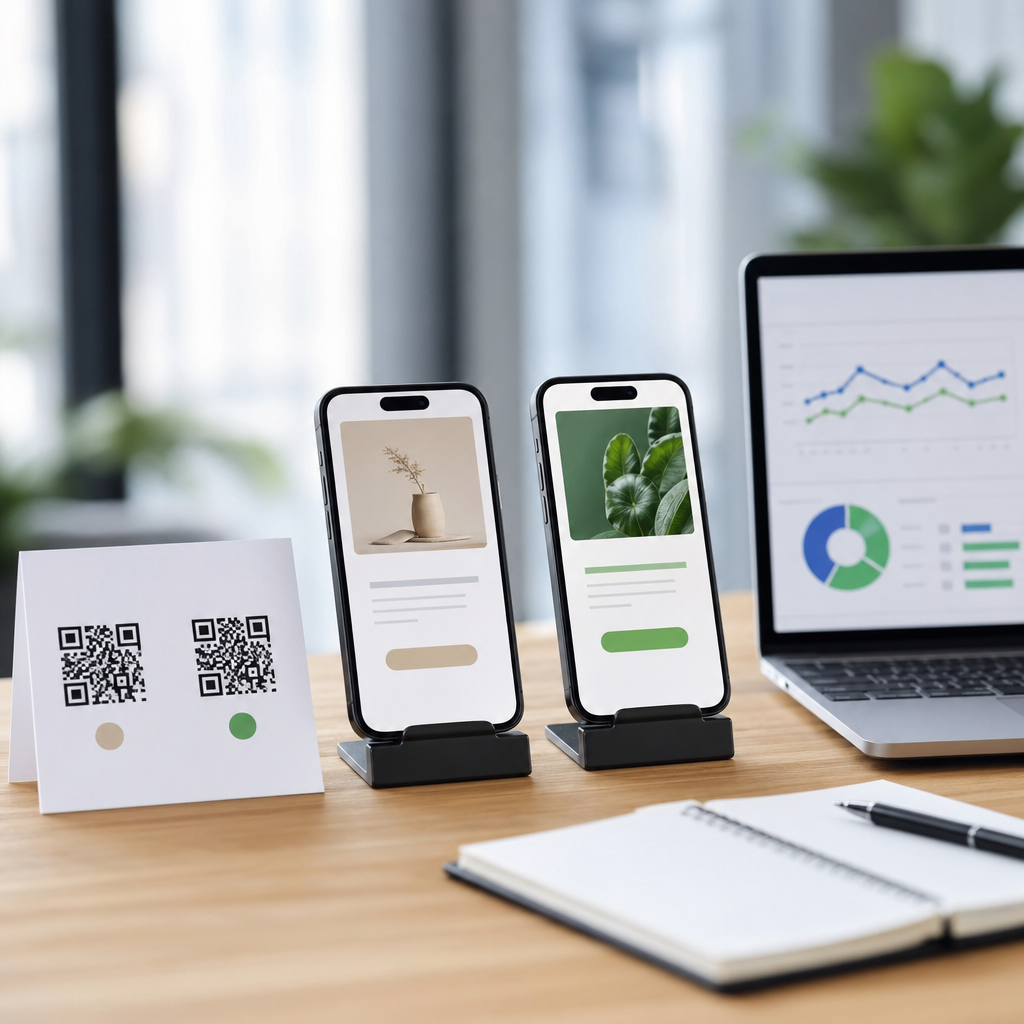

QR code conversion rate optimization starts with a simple truth: scans are not the goal, actions are. A QR code converts only when the person who scans it completes the intended next step, whether that is buying a product, booking a table, downloading an app, claiming an offer, joining a loyalty program, or submitting a lead form. In practice, I have seen campaigns celebrate scan volume while missing the harder metric that matters to revenue: post-scan completion rate. A code on a poster that earns 2,000 scans but only 12 purchases is weaker than a code on packaging that earns 300 scans and 60 repeat orders.
To understand what makes a QR code convert, define the full path. A scan is the entry event. Conversion is the desired business outcome. Conversion rate is conversions divided by scans, usually expressed as a percentage. Micro-conversions, such as page views, add-to-cart actions, coupon saves, menu opens, or account creations, help diagnose where friction appears before the final result. This matters because QR codes sit at the intersection of offline attention and digital action. They bridge packaging, signage, direct mail, retail displays, receipts, events, and out-of-home media with measurable online behavior.
Why does this topic matter now? Smartphone cameras read codes instantly, dynamic QR platforms allow destination changes without reprinting, and analytics tools can track behavior from first scan to final purchase. At the same time, consumer attention is thin, page speed expectations are high, and privacy rules limit sloppy attribution. That combination means conversion does not happen by accident. It comes from strong intent matching, clean design, trustworthy messaging, fast destinations, and disciplined measurement. This hub article explains the conversion principles behind high-performing QR campaigns, shows where most failures occur, and gives a practical framework for improving scan-to-action performance across print, packaging, point-of-sale, and in-person experiences.
Start with intent, context, and a single desired action
The strongest converting QR codes are built around one clear user intent. People scan for a reason that makes sense in the moment. On restaurant tables, they want a menu or to pay quickly. On product packaging, they want instructions, authenticity verification, recipes, warranties, or replenishment. On event badges, they want schedules, check-in, networking, or lead capture. When the destination matches that immediate need, conversion rises because the code removes effort rather than creating a new task.
Context determines whether a call to action feels useful or distracting. A commuter walking past transit advertising has seconds, weak patience, and variable connectivity, so the destination must open fast and present a lightweight next step such as saving an offer or viewing store directions. A shopper standing in an aisle has higher product intent, so comparison pages, reviews, stock lookup, and coupons can perform well. A customer opening shipped packaging is already invested, which makes onboarding flows, how-to videos, registration, and upsell recommendations convert at a higher rate than broad brand pages.
The practical rule is simple: each code should have one primary action. When a landing page offers too many choices, conversion drops because decision cost rises. I have repeatedly improved performance by reducing destinations from crowded mobile pages to a single focused page with one button, one promise, and one outcome. A QR code that says “Scan to claim your 15% in-store coupon today” should not land on a generic homepage. It should open directly to a coupon page with redemption terms, nearest location information, and a wallet-save option. Relevance beats creativity every time.
Design the code and the call to action for trust and usability
A QR code must first be scannable, then believable. Technical readability depends on contrast, quiet zone, error correction, module clarity, and print quality. Dark code on a light background remains the safest standard. Distorting shapes heavily, shrinking the quiet zone, or placing the code over reflective, textured, or low-contrast surfaces reduces successful scans. In print environments, size should reflect expected scanning distance. A practical field rule many designers use is roughly one inch of code size for every ten inches of scanning distance, then validating with actual device testing.
Usability also depends on placement. Codes should sit where people naturally pause: product backs, checkout counters, table tents, shelf talkers, posters near eye level, receipts, and confirmation screens. Avoid curves, folds, glare, and hard-to-reach surfaces such as lower shelves or moving vehicles. If the environment is dark, outdoors, or exposed to weather, durable material and contrast become even more important.
Trust comes from the surrounding message. People are more willing to scan when they understand what happens next and why it is worth their time. Good calls to action are explicit: “Scan to reorder in 30 seconds,” “Scan for ingredients and allergens,” or “Scan to register your warranty.” Weak prompts like “Scan me” underperform because they hide the value exchange. Brand cues matter too. A recognizable logo, coherent packaging design, and a visible domain on the landing page reduce suspicion. Since phishing awareness is higher than it was a few years ago, transparent intent is now part of conversion optimization, not just compliance.
Build mobile landing pages that remove friction after the scan
Most QR code conversion problems happen after the scan. The camera opens, the code resolves, and then the page loads too slowly, asks for too much information, or forces the visitor to hunt for the next step. Mobile landing page quality is therefore the center of QR code conversion rate optimization. The destination must load quickly on cellular connections, present the offer above the fold, and make the primary action obvious without pinching, zooming, or navigating a menu.
Core Web Vitals are relevant here. Largest Contentful Paint, Interaction to Next Paint, and Cumulative Layout Shift directly shape post-scan abandonment. A page cluttered with heavy scripts, pop-ups, auto-playing media, and multiple third-party tags will lose visitors before they act. In my own audits, moving QR traffic from general web pages to lightweight campaign pages consistently increased completion rates because the pages removed navigation distractions, compressed assets, and shortened forms.
Form friction deserves special attention. Every field costs conversions. If the campaign goal is lead capture, ask only for what is needed at that stage. Name and email may be enough. If a coupon is the objective, let users save it first and profile them later. Payment flows should support digital wallets such as Apple Pay and Google Pay where possible because fewer taps usually means higher completion. For app destinations, smart banners and deferred deep linking outperform sending every scanner into an app store blind. The destination should feel like a continuation of the physical experience, not a disconnected website detour.
Measure the full funnel, not just scan counts
Effective optimization depends on analytics that connect offline placement to online outcomes. Scan count is only the top of the funnel. You also need unique scans, repeat scans, device type, location, time of day, destination load success, bounce rate, click-through rate, form start, form completion, add-to-cart, purchase, coupon redemption, and revenue per scan. Dynamic QR code platforms such as Bitly, Flowcode, QR Code Generator PRO, Beaconstac, and Uniqode can record scan events and redirect users to controlled destinations. Web analytics platforms such as Google Analytics 4 then track what happens next.
UTM parameters remain useful when applied consistently. A disciplined naming structure can separate packaging from direct mail, stores from events, and one creative variant from another. In GA4, event-based tracking lets teams create funnels for qr_scan_landing, cta_click, begin_checkout, purchase, or lead_submit. CRM integration adds another layer by connecting scans to customer records, lead quality, and downstream revenue. For retail and restaurant environments, point-of-sale redemption codes can close the offline loop when a digital offer is claimed in person.
The most valuable metric is often not raw conversion rate but conversion rate by context. A code on a receipt may get fewer scans than a code on a product insert yet drive higher repeat purchase value. A trade show badge code may produce fewer immediate form fills than a booth display but create stronger sales-qualified leads later. Looking at channel, placement, creative, and audience segment separately reveals which scans have intent and which are just curiosity.
| Metric | What it shows | Optimization use |
|---|---|---|
| Scan rate | How often people notice and attempt interaction | Improve placement, size, design, and call to action |
| Landing page bounce rate | Whether the destination matches expectation | Tighten message match and speed |
| CTA click-through rate | How persuasive the page is | Refine copy, hierarchy, and button design |
| Form completion rate | How much friction exists in data capture | Reduce fields and simplify validation |
| Revenue per scan | Commercial value of traffic | Prioritize placements and offers with profitable intent |
Run structured tests on offer, placement, and destination
QR code optimization works best when treated like any other conversion program: form a hypothesis, isolate a variable, test at meaningful volume, and keep a control. The main testing levers are the offer, the surrounding message, the physical placement, the code design, and the landing page. Dynamic QR codes are especially useful because they allow destination changes while preserving the printed asset. That makes continuous improvement practical in packaging, direct mail, posters, and retail displays.
Offer testing is usually the highest-impact starting point. A “scan for more information” prompt may underperform against “scan for installation video” on electronics packaging or “scan for 10% off your next order” on a receipt. Placement testing often surprises teams. In one retail setup, moving the code from the bottom-right of a shelf sign to the center near the price claim improved scans because customers saw it during product comparison, not after deciding. Message testing can be equally powerful: specific benefits outperform generic invitations.
Destination testing should focus on one change at a time. Compare a product detail page with a short campaign page. Compare one-step checkout with add-to-cart first. Compare a menu PDF with a responsive menu page. Avoid changing creative, placement, and destination all at once or the result becomes impossible to interpret. Also account for operational constraints. A strong coupon may boost conversions but reduce margin. A lead form may collect more names if it is shorter, yet lower qualification. High conversion is only good when it aligns with the business outcome you actually need.
Use channel-specific tactics for packaging, retail, restaurants, events, and direct mail
Different environments produce different conversion patterns, so the best tactics are channel specific. On packaging, QR codes convert well when they add utility after purchase or reduce uncertainty before repeat purchase. Common wins include setup guides, refill subscriptions, authenticity checks, ingredient detail, and care instructions. Because packaging stays with the customer, it can support repeat scans over time. That makes lifecycle metrics important, not just first-session conversion.
In retail, shelf-edge and endcap codes should help a shopper decide now. Reviews, comparison charts, coupon activation, and stock lookup are strong use cases. Staff training matters too. If associates can explain the benefit, scan confidence rises. Restaurants usually see the best performance when QR flows save time: mobile menus, ordering, payment, loyalty enrollment, and feedback. Here, reliability matters more than novelty. If the code opens a heavy PDF on weak guest Wi-Fi, usage drops immediately.
Events reward speed and relevance. Booth signage, speaker slides, badges, and handouts can route attendees to session material, contact exchange, giveaways, or meeting bookings. The destination should be short, mobile first, and tailored to attendee intent at that moment. Direct mail remains effective because the scan happens in a focused setting. Personalized URLs combined with QR codes can connect offline identity to digital action, but data handling must respect consent and privacy expectations. Across every channel, the conversion principle stays constant: give people the fastest path from curiosity to value.
Common mistakes that suppress QR code conversion rates
The same problems appear repeatedly in underperforming campaigns. The first is sending traffic to a homepage. Homepages serve many audiences and almost never provide the single-task focus QR traffic needs. The second is hiding the benefit. If users cannot tell why they should scan, many will not start. Third is weak mobile experience: slow load times, intrusive pop-ups, tiny buttons, PDF menus, and forms that are painful on phones. Fourth is poor scannability caused by low contrast, cramped quiet zones, glossy surfaces, or decorative overdesign.
Another mistake is ignoring attribution. Without UTM standards, event tracking, and campaign naming discipline, teams cannot tell which placements or creatives produce revenue. Many also stop at scan reporting and never analyze post-scan behavior. That creates false confidence. Security concerns are another suppressor. Anonymous codes in public spaces can look risky. Clear branding, plain-language context, and trustworthy landing domains reduce hesitation. Finally, many organizations launch once and never optimize. The best-performing QR programs are iterative. They monitor performance weekly, test regularly, and retire low-intent placements quickly.
What makes a QR code convert is not the code alone but the system around it: user intent, physical context, clear value, trustworthy design, fast mobile experience, and complete measurement. High-performing QR campaigns connect an offline moment to one useful digital action with as little friction as possible. They are specific about the benefit, disciplined about analytics, and willing to test offers, placements, and landing pages until the scan-to-action path feels effortless.
As the hub for conversion rate optimization within QR code analytics, tracking, and optimization, the main lesson is straightforward. Treat every QR code like a measurable conversion funnel, not a static graphic. Define the goal, instrument the journey, improve the post-scan experience, and evaluate success by completed outcomes and revenue, not curiosity scans. If you are auditing your current program, start with three questions: does the code promise a clear benefit, does the landing page remove friction, and can you trace each scan to business value? Improve those three areas first, and conversion rates usually follow.
Frequently Asked Questions
What does it really mean for a QR code to convert?
A QR code converts when the scan leads to the specific business outcome you want, not simply when someone points a phone at it. That outcome could be a purchase, a reservation, an app install, a coupon redemption, a form submission, a loyalty signup, or any other measurable next step tied to revenue or customer acquisition. This distinction matters because scan count is only a top-of-funnel signal. It shows interest, but it does not prove performance. A campaign can generate thousands of scans and still underperform if the landing page is confusing, the offer is weak, or the form is too long.
In practical terms, conversion is about post-scan completion rate. If 1,000 people scan a code and 150 complete the desired action, that QR code is far more effective than one that gets 3,000 scans but only 30 completions. The most successful QR campaigns are built backwards from the action. They ask: what do we want the user to do immediately after scanning, what could stop them from doing it, and how can we remove friction? That is why the highest-converting QR codes are rarely just visually appealing. They are placed in the right context, paired with a clear call to action, and connected to a fast, relevant, mobile-optimized destination that makes the next step obvious.
Why are scans alone a misleading metric for QR code performance?
Scans are useful, but they can be dangerously incomplete if they are treated as the main measure of success. A scan tells you that a person was curious enough to engage. It does not tell you whether they found what they expected, trusted the destination, stayed long enough to evaluate the offer, or completed the goal. This is why campaigns that celebrate scan volume without tracking behavior after the scan often misread what is actually happening. High scans paired with low completion usually indicate a disconnect somewhere in the journey.
That disconnect can happen for many reasons. The QR code might be placed in a high-traffic location that generates impulse scans, but the landing page may load slowly or feel unrelated to the message beside the code. The offer may sound compelling on the poster, but lose clarity once the user arrives on the page. The page might ask for too much information too soon, or force users through multiple steps that are difficult on mobile. In some cases, the code is doing its job perfectly and the post-scan experience is where conversion breaks down.
A better approach is to evaluate the entire funnel: impressions, scans, landing page visits, engagement, completions, and in some cases downstream revenue or repeat behavior. When you measure performance this way, you can identify whether your issue is visibility, motivation, message match, trust, or usability. That is the difference between optimizing for attention and optimizing for results.
What factors have the biggest impact on whether a QR code converts?
Several variables influence QR code conversion, but the biggest ones usually fall into five categories: intent, context, clarity, destination experience, and friction. Intent refers to why the person would scan in the first place. If there is no strong reason to act now, conversion will suffer. Context is where the code appears and what the user is doing in that moment. A code on restaurant table signage can perform very differently from one on a billboard because the user’s time, environment, and readiness to act are completely different.
Clarity is equally important. People need to know exactly what they will get when they scan. Generic prompts like “Scan me” rarely perform as well as specific calls to action such as “Scan to book your table in 30 seconds” or “Scan to claim 15% off today.” Specificity reduces hesitation and sets expectations. It also helps qualify scanners, which often improves conversion quality even if raw scan volume drops.
The destination experience is where many campaigns win or lose. A QR code should send users to a mobile-friendly page that loads quickly, aligns with the promise made before the scan, and makes the next action easy. If the QR code invites users to claim an offer, the landing page should immediately show that offer and a simple redemption path. If the goal is lead generation, the form should be short, intuitive, and relevant to the user’s level of interest. Every extra click, field, delay, or distraction lowers the chance of completion.
Finally, friction must be minimized throughout the journey. This includes technical friction, such as broken links or slow pages, and psychological friction, such as uncertainty, lack of trust, weak social proof, or vague instructions. Strong conversion comes from reducing both. The best QR campaigns feel seamless: the user scans, instantly understands the value, and completes the action with almost no resistance.
How can you improve a QR code campaign’s conversion rate after people scan?
The fastest way to improve conversion rate is to focus on what happens immediately after the scan. Start by reviewing message match. The landing page should reflect the exact promise made next to the QR code. If the code says “Scan to get a free appetizer,” the page should open directly to that offer, not a generic homepage. Every mismatch creates doubt and drop-off. Users should never have to hunt for what they were promised.
Next, simplify the path to completion. Remove unnecessary navigation, reduce the number of form fields, shorten checkout or booking flows, and make the primary action prominent. On mobile, even small usability issues can have outsized effects. Buttons should be easy to tap, text should be readable without zooming, and the page should load quickly on average cellular connections. Speed is especially important because QR interactions often happen in real-world situations where people are distracted, in motion, or making fast decisions.
It is also worth strengthening trust signals. Add clear branding, concise copy, reviews or testimonials where relevant, secure payment indicators, and transparent information about what happens next. If you are asking for personal information, explain why. If the user is redeeming an offer, make the terms easy to understand. Confidence drives action.
Finally, test systematically. Try different calls to action, incentive structures, page layouts, and levels of form friction. Segment by placement, device type, time of day, or campaign source to find where completions are strongest. In many cases, modest refinements to the post-scan flow can dramatically outperform large increases in scan volume. That is why conversion optimization is less about getting more people to scan and more about making it easier for the right people to finish.
What are common reasons a QR code gets scanned but fails to drive action?
The most common reason is a gap between curiosity and commitment. People may scan because the code catches their attention, but that attention is fragile. If the landing page loads slowly, looks untrustworthy, feels irrelevant, or asks too much too quickly, many users will leave before converting. This is especially true in mobile environments, where distractions are constant and patience is limited.
Another frequent issue is weak or ambiguous positioning before the scan. If users do not understand the benefit, they may scan casually rather than with real intent. That can inflate scan numbers while lowering completion quality. Similarly, poor placement can work against conversion. A code in a location where users cannot comfortably complete the next step, such as while walking, driving, or standing in a crowded public space, may generate interest without producing action.
Technical problems also play a major role. Broken destinations, redirects that take too long, pages that are not mobile-optimized, and forms that do not work well on certain devices can all kill conversion. On top of that, some campaigns fail because they send users into a generic digital experience instead of a purpose-built one. A QR code should not feel like a random entry point into a website. It should feel like a direct bridge to one clear, immediate action.
In many underperforming campaigns, the root problem is simple: the code was treated as the strategy instead of the trigger. The QR code itself is only the access point. The real conversion engine is the full experience around it: the offer, the audience, the environment, the message, the mobile journey, and the ease of completing the intended next step. When those elements work together, QR codes convert. When they do not, scan volume becomes little more than vanity data.