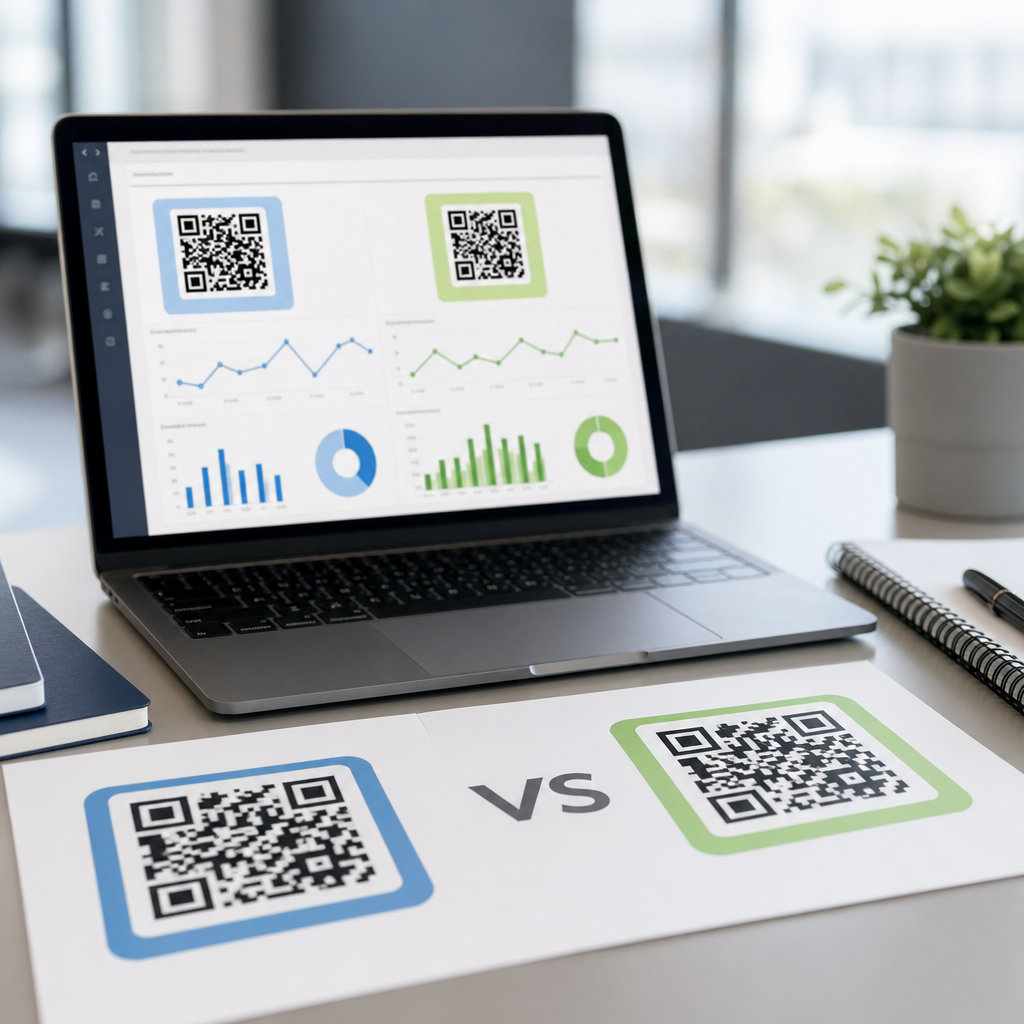
A/B testing QR codes is the fastest reliable way to improve scan rate, landing-page engagement, and downstream conversions without relying on guesswork. In practical terms, A/B testing means creating two controlled variants of a QR code campaign, changing one meaningful variable, and measuring which version produces better results. For QR code marketing, those variables can include code size, placement, surrounding call to action, destination URL, incentive, design treatment, error correction level, or even the audience segment receiving the code. This matters because a QR code is not a marketing asset by itself; it is a bridge between a physical or visual touchpoint and a digital experience, and every weakness on either side of that bridge reduces performance.
I have seen teams spend heavily on packaging, direct mail, retail signage, and event collateral, then treat the QR code as a small black-and-white afterthought. The result is predictable: low scan volume, weak session quality, and no clear explanation for underperformance. A disciplined A/B testing program changes that. Instead of asking, “Do people use QR codes?” you start answering sharper questions: Which flyer layout drives more scans? Does a short benefit-driven prompt outperform a generic “Scan me”? Does a dynamic QR code tied to a faster mobile page improve conversions enough to justify the software cost? Those are measurable questions, and the answers compound over time.
To test QR codes properly, you need a few key definitions. A scan rate is the percentage of people exposed to the code who scan it. Conversion rate is the percentage of visitors who complete the target action after scanning, such as purchasing, registering, downloading, or redeeming an offer. A control is the existing version; a variant is the challenger. Statistical significance is the threshold that helps you distinguish a real performance difference from random variation. Dynamic QR codes are especially useful because they let you change the destination or tracking parameters without reprinting the code, making iteration far easier than with static codes.
As a hub topic within QR code analytics, tracking, and optimization, A/B testing connects several disciplines: campaign measurement, attribution, mobile UX, creative testing, and channel strategy. The strongest programs combine QR code generators that support dynamic redirects, analytics platforms such as Google Analytics 4, campaign tagging with UTM parameters, and event-based reporting tied to business outcomes. When these systems are configured well, QR code tests stop being surface-level design exercises and become a source of commercial insight. You learn not just what gets scanned, but what drives qualified traffic and revenue.
What to test in a QR code campaign
The most effective QR code tests isolate variables that strongly influence either the decision to scan or the experience after scanning. On the scan side, common test elements include size, contrast, quiet zone, placement, and surrounding copy. ISO/IEC 18004 defines the QR code symbology itself, but real-world performance depends on context. A technically valid code can still underperform if it is too small for the viewing distance, placed on a reflective surface, printed with low contrast, or surrounded by clutter. In retail, for example, I have seen shelf wobblers outperform packaging codes simply because the code sat at eye level with a clearer instruction and less visual competition.
Call-to-action copy is often the highest-leverage variable. “Scan for details” is weaker than “Scan to get 15% off today” because the second version communicates a concrete benefit and urgency. Destination type also matters. A code that opens a homepage usually loses to one that opens a focused landing page aligned with the message on the physical asset. If a restaurant table tent promises a free dessert for joining a loyalty program, the QR code should open the signup form directly, not the general website. Friction is the enemy of QR performance, and testing should expose where it appears.
Design customization deserves careful handling. Branded QR codes with logos and colored modules can improve trust and recognition, but excessive styling can reduce scan reliability, especially in poor lighting or on lower-quality phone cameras. Error correction levels allow some visual modification, yet they are not permission to overdesign. Test customized codes against simpler ones under actual conditions, not just on a desktop monitor. A version that looks better to stakeholders may scan worse in a store aisle or on corrugated packaging.
The landing-page experience must also be tested as part of the QR journey. A high scan rate is not a win if users bounce because the page loads slowly, the form is too long, or the content fails to match the promised value. Mobile page speed, form length, checkout flow, and message match all belong in the test plan. In many campaigns, the biggest gain does not come from changing the code image at all; it comes from reducing post-scan friction.
How to design a valid A/B test for QR codes
A valid A/B test starts with a single hypothesis tied to a measurable outcome. For example: “Adding a benefit-led call to action next to the QR code will increase scan rate by 20% on in-store posters.” That statement identifies the variable, the expected effect, the channel, and the metric. Weak tests change too many things at once. If you alter the code color, placement, offer, and landing page simultaneously, you may get a better result, but you will not know why. Controlled testing protects learning, not just outcomes.
Randomization is more difficult in physical environments than in digital ads, but it is still possible. In direct mail, split your mailing list randomly so half receive version A and half receive version B. In retail, rotate poster variants by matched locations with similar foot traffic, demographics, and staffing patterns. At events, alternate handouts by time blocks if attendee flow is relatively stable. The goal is to prevent outside factors from biasing the result. A variant placed only in your highest-performing store is not a true winner; it is just better positioned.
Measurement planning should happen before anything goes live. Use distinct dynamic QR codes or redirect rules so every variant has clean attribution. Apply consistent UTM parameters that identify source, medium, campaign, content, and test cell. In GA4, define events for key post-scan actions such as page_view, sign_up, add_to_cart, purchase, or lead_submit. If sales happen offline, connect scans to CRM or POS records where possible. Otherwise, your test may optimize for scans while missing actual revenue impact.
Sample size and test duration matter. A tiny difference over a few dozen scans is rarely actionable. While exact requirements depend on baseline conversion and desired confidence level, most marketers should avoid calling winners too early. Let the test run through normal business cycles, including weekdays and weekends where relevant. For seasonal products or event-based promotions, ensure each variant receives comparable exposure windows. Premature conclusions are one of the most common failures in QR experimentation.
Metrics that actually define QR code performance
Many teams focus on scans alone because scan volume is easy to report, but the best QR code performance metrics move down the funnel. Start with exposure, estimated reach, and scan rate to understand whether the physical asset and call to action are working. Then review engaged sessions, bounce rate or engagement rate, time to key action, form completion, cart initiation, purchase rate, and revenue per scan. If the campaign supports support content or education, metrics like video completion or document downloads may also matter.
Context is essential when interpreting those numbers. A poster in a subway station may generate many accidental or low-intent scans, while a QR code on product packaging often attracts fewer but more qualified users. A variant with lower scan volume can still be superior if it yields higher lead quality or order value. I have seen this with B2B trade show badges: a broad “scan for brochure” prompt attracted casual visitors, while “scan for implementation checklist” pulled fewer scans but significantly better sales follow-up rates.
| Metric | What it tells you | Best use in A/B testing |
|---|---|---|
| Scan rate | How persuasive and visible the code placement is | Compare creative, size, placement, and CTA variants |
| Engaged sessions | Whether scans turn into meaningful visits | Evaluate destination relevance and traffic quality |
| Conversion rate | How well the post-scan experience drives action | Test landing pages, offers, and form friction |
| Revenue per scan | Commercial value of each scan | Prioritize variants that create profit, not just traffic |
| Scan-to-conversion time | How quickly users complete the desired action | Assess urgency, usability, and purchase intent |
Use primary and secondary metrics together. If conversion rate is your primary metric, watch scan rate as a secondary one so you do not accidentally create a landing page winner attached to a code nobody scans. Balanced scorecards prevent local optimization. The right winner is the variant that improves the business objective while maintaining acceptable performance across the full journey.
Common A/B test ideas with real-world impact
One proven test category is placement. On product packaging, front-panel codes often increase discovery, but side-panel codes sometimes generate higher-intent scans because the user is already examining details. In restaurants, table-tent placement usually beats wall signage because it reduces effort. In direct mail, placing the QR code above the fold near the main offer often lifts scans compared with burying it near legal copy. These gains sound simple, but they can materially improve campaign efficiency when multiplied across large print runs.
Another high-impact category is message framing. Benefit-led prompts, social proof, and urgency can each affect scan behavior. “Scan for setup instructions” may work better for electronics packaging, while “Scan to register your warranty in 30 seconds” can outperform it if the value is clearer. For healthcare or public sector communication, clarity and trust signals often matter more than excitement. A municipal utility insert that says “Scan to verify your bill and payment options” may outperform a more promotional tone because users want legitimacy and reassurance.
Offer testing is especially powerful in lead generation and retail. Compare percentage discounts against fixed-value discounts, instant rewards against prize draws, or educational assets against demos. Make sure the offer aligns with customer intent. Someone scanning a QR code on a wine bottle in a store may respond better to pairing suggestions than to a generic newsletter signup. Someone scanning at a conference may prefer a benchmark report over a sales consultation. Relevance routinely beats volume-driven incentives.
Finally, test the destination architecture. A smart QR strategy often uses dynamic redirects to send different audiences to tailored experiences while preserving the same printed asset. For multilingual environments, location-aware or browser-language-based routing can improve conversion. For repeat campaigns, returning users can be redirected to the next logical action instead of the original landing page. These are not gimmicks; they are mature optimization methods when used transparently and measured correctly.
Tools, pitfalls, and how to scale a testing program
Most mature teams use a stack rather than a single tool. Dynamic QR platforms such as Bitly, QR Code Generator Pro, Beaconstac, or Uniqode can manage redirects, scan analytics, and asset versioning. GA4 handles behavioral analysis after the scan. A/B testing on the landing page may run through tools like Optimizely, VWO, or native CMS experimentation features. For enterprise campaigns, dashboards in Looker Studio or Tableau help combine scan data, media distribution, and conversion outcomes into one operating view.
The biggest pitfalls are poor attribution, inconsistent print quality, and confounded variables. If field teams resize codes differently, tape them to different materials, or place them under different lighting, your “creative test” quickly becomes a distribution test. Standardize production specs, including minimum size, contrast ratio, bleed, quiet zone, and material finish. Test scanability with multiple devices, operating systems, and camera apps before launch. A code that scans easily on a new iPhone but struggles on older Android hardware can distort results in mass-market campaigns.
Privacy and compliance also deserve attention. If QR codes connect to personal data collection, ensure consent language, cookie handling, and data retention practices align with applicable regulations such as GDPR or CCPA. Use secure destinations with HTTPS and avoid redirects that create suspicion. Trust directly affects scan behavior. Consumers are more likely to scan when the brand, destination, and purpose are clear.
To scale, build a repeatable testing roadmap. Document hypotheses, variables, audience, distribution method, metrics, and outcomes. Keep a learning archive so winning patterns can inform future campaigns across packaging, retail, events, and print. Link this hub to deeper resources on QR code tracking setup, dynamic versus static QR codes, UTM strategy, landing-page optimization, and QR code placement best practices. Over time, A/B testing turns QR codes from passive utilities into measurable acquisition and conversion assets.
A/B testing QR codes works because it replaces assumption with evidence at every stage of the scan journey. You identify what prompts the scan, what improves the mobile experience, and what produces the strongest business result. The discipline is straightforward: define one hypothesis, isolate one variable, tag every variant correctly, measure beyond scans, and run the test long enough to trust the outcome. When teams follow that process, QR performance becomes predictable and improvable instead of mysterious.
The main benefit is not simply a higher scan count. It is a better connection between physical media and digital conversion. Strong tests reveal whether your issue is visibility, messaging, destination relevance, page speed, or offer quality. That clarity helps you spend more intelligently on print, packaging, retail displays, and event materials. It also creates reusable knowledge, because lessons from one campaign often transfer to other QR code placements and audiences.
For marketers building a stronger analytics and optimization program, this topic should be treated as a core operating practice, not a one-off experiment. Start with your highest-volume QR asset, choose a single variable with a clear hypothesis, and measure scan rate, engaged sessions, and conversion value together. Then document the result and launch the next test. Small, disciplined improvements stack quickly. If you want better QR code performance, begin testing now and let the data tell you what earns the next scan.
Frequently Asked Questions
1. What does A/B testing a QR code campaign actually involve?
A/B testing a QR code campaign means comparing two controlled versions of the same campaign to see which one performs better based on real user behavior. Instead of changing several elements at once, you create two variants and adjust one meaningful variable so you can isolate what caused the difference in results. For example, you might keep the offer, audience, timing, and landing page the same, but test a larger QR code against a smaller one, or compare one call to action against another. The goal is to remove guesswork and make decisions using measurable outcomes.
In practice, the process starts with a clear hypothesis. You might believe that adding a stronger instruction such as “Scan to get 20% off” will increase scan rate compared with a generic “Scan me” prompt. You then build version A and version B, distribute them under comparable conditions, and track performance. Key metrics often include scan rate, unique scans, click-throughs after the scan, landing-page engagement, form completions, purchases, coupon redemptions, or any other conversion event that matters to your campaign.
What makes QR code A/B testing especially useful is that performance depends on more than just whether someone notices the code. A successful test can reveal where friction exists across the full journey, from visibility and motivation to landing-page experience and conversion. In other words, one version may generate more scans, while another produces fewer scans but more qualified traffic and stronger downstream results. That is why it is important to define success before you start and evaluate both top-of-funnel and bottom-of-funnel metrics.
2. Which QR code elements should I test first to improve performance?
The best variables to test first are the ones most likely to affect user behavior in a significant way. For most campaigns, that starts with factors tied directly to visibility, clarity, and motivation. Strong early test candidates include QR code size, placement, surrounding white space, call-to-action wording, destination URL, landing-page design, and incentive. If people are not scanning in the first place, start with physical or visual factors such as size and placement. If scans are happening but conversions are weak, shift your attention to the landing page, offer, or post-scan experience.
Call to action is often one of the highest-impact variables because many users still need a reason to act. A QR code without context can be ignored, while a code paired with a specific benefit like “Scan to watch the demo,” “Scan for the menu,” or “Scan to claim today’s offer” gives people immediate clarity. Placement also matters enormously. A code printed too low, too high, too far from foot traffic, or in a visually cluttered area may underperform even if the offer is strong. Similarly, if the code is too small or lacks enough contrast with the background, scan rate can drop quickly.
More advanced tests can include design treatment, frame shape, branded styling, color choices, and error correction level, but these should usually come after you have validated the fundamentals. A stylized QR code may look better, but if it reduces readability or distracts from the value proposition, performance can suffer. In general, test the biggest behavioral levers first: can people see it, understand it, trust it, and feel motivated to scan it? Once those basics are optimized, then refine aesthetics and technical details.
3. How long should a QR code A/B test run, and how do I know if the results are reliable?
A QR code A/B test should run long enough to collect a meaningful amount of data under stable conditions. There is no universal timeline because the right duration depends on traffic volume, audience size, campaign format, and how often people encounter the code. A flyer handed out at a trade show may generate enough data in a day or two, while packaging, in-store signage, or direct mail may require several weeks. The key is not choosing an arbitrary end date too early, especially if the sample size is still small or one version had an unfair exposure advantage.
Reliable results come from consistency and enough observations to reduce randomness. If one QR code version appears in a busier location, at a better time of day, or alongside stronger promotional messaging, the outcome may reflect those differences rather than the variable you meant to test. That is why controlled conditions matter. Keep the audience, timing, channel, and surrounding context as similar as possible. If complete control is not possible, document those variables and interpret results cautiously.
You also want to avoid ending the test the moment one version appears to be ahead. Early spikes can be misleading. Let the test run until both variants have accumulated enough scans and conversions to show a stable pattern. In many cases, looking at conversion rates rather than raw totals helps clarify performance. A smaller total number of scans can still represent a stronger-performing version if a larger percentage of those users complete the intended action. When possible, use analytics tools or testing platforms that help assess statistical confidence so you are not making decisions based on noise.
4. What metrics matter most when evaluating QR code A/B test results?
The most important metrics depend on the campaign goal, but scan rate is only the starting point. Many marketers focus on how many people scan the code, which is useful, but it does not tell the full story. A version that attracts curiosity scans may look successful at first while producing weak engagement or low-quality traffic. To evaluate QR code performance properly, you should look at the entire conversion path, from scan to final action.
Core metrics often include total scans, unique scans, scan-through rate relative to impressions or distribution volume, landing-page bounce rate, time on page, click-through rate, form submissions, purchases, bookings, app downloads, coupon redemptions, or any conversion event tied to campaign objectives. If the purpose of the QR code is awareness, scan volume and engagement may matter most. If the purpose is lead generation or sales, then downstream conversion metrics should carry more weight than scan count alone.
It is also helpful to compare cost efficiency where relevant. For example, if one QR code variation requires premium placement or more expensive printing treatments, you should measure whether the lift in performance justifies the added cost. Another smart practice is segmenting results by device type, location, channel, or audience group. Sometimes one version performs better overall, but another wins with a high-value segment. The strongest analysis does not stop at “which got more scans?” It asks “which version produced the best business outcome, and why?”
5. What are the most common mistakes to avoid when A/B testing QR codes?
The biggest mistake is testing too many variables at once. If you change the code size, placement, CTA, design, and landing page all in one experiment, you may see a difference in results but have no idea what caused it. Effective A/B testing works because it isolates one meaningful change. That discipline lets you build reliable insights over time instead of collecting confusing data that cannot guide future decisions.
Another common problem is ignoring the post-scan experience. Marketers sometimes optimize the QR code itself but send users to a page that loads slowly, is not mobile-friendly, or does not match the promise made next to the code. That breaks trust and weakens conversions. A QR code campaign should be treated as a connected journey: the code must be easy to notice and scan, the CTA must be compelling, and the destination must deliver a smooth, relevant next step. If any part of that chain fails, the test results can be misleading.
Other frequent mistakes include using static QR codes when dynamic codes would allow better tracking and updates, failing to label variants clearly in analytics, ending tests too early, running tests under unequal conditions, and prioritizing aesthetics over usability. Overdesigned QR codes, low contrast, poor print quality, and insufficient white space can all reduce scanability. Finally, many teams forget to document what was tested and what they learned. Keeping a simple testing log with hypotheses, setup details, results, and next actions helps turn one-off experiments into a repeatable optimization process that steadily improves scan rate, engagement, and conversions.