QR codes for healthcare marketing campaigns give hospitals, clinics, insurers, and health brands a fast way to connect offline audiences with useful digital experiences while staying sensitive to privacy, trust, and regulatory expectations. In practice, a healthcare QR code is simply a scannable image that sends a patient, caregiver, or community member to a landing page, video, appointment form, event registration, app download, or educational resource. What makes healthcare different from retail or hospitality is not the technology itself but the environment around it: patient decision-making is higher stakes, information must be accurate, access barriers are real, and every touchpoint can influence confidence in a provider.
I have used QR codes in campaigns for specialty practices, multi-location clinics, and public health outreach, and the lesson is consistent: success comes from pairing convenience with clarity. A poster in an urgent care waiting room can reduce front-desk questions by linking to after-hours guidance. A direct mail piece for a mammography campaign can route women by ZIP code to the nearest imaging center. A pharmacy handout can lead to vaccine scheduling in two taps. When the destination matches the context, scan rates rise and staff workload falls.
Healthcare marketers care about QR codes because they bridge physical and digital channels at a low cost. Print ads, brochures, exam-room signage, outdoor banners, prescription bag inserts, community event booths, and even ambulance sponsorships often struggle to prove performance. A dynamic QR code adds measurability through scan counts, timestamps, device types, campaign-level tracking parameters, and location trends. That data helps teams understand what messaging, placements, and service lines generate attention. It also supports budget decisions across service lines such as primary care, orthopedics, cardiology, dentistry, mental health, and telehealth.
There is also a patient access benefit. Many people first engage with a provider on mobile, not desktop. A QR code removes the need to type a long URL, search for a doctor name, or navigate a crowded site menu. In healthcare, reducing friction matters because delays can become drop-offs. If someone is comparing pediatricians after work, trying to schedule a flu shot during a lunch break, or seeking behavioral health support privately, one less step can materially improve conversion.
Why QR codes fit healthcare marketing especially well
Healthcare campaigns often depend on local intent, trust signals, and service-specific education, which makes QR codes unusually effective. Most provider decisions still begin in the physical world: a physician referral slip, a postcard from an insurer, a rack card at a senior center, a hospital billboard, or a flyer at a school sports physical event. A QR code captures that moment and moves the audience into a structured digital journey. Unlike a general homepage link, the scan can send each audience segment to a dedicated page with relevant clinicians, insurance information, FAQs, testimonials, and a clear next action.
Use cases span the full funnel. At the awareness stage, hospitals use QR codes on transit ads to introduce new service lines or announce facility expansions. During consideration, specialty practices place codes on brochures that explain procedures, recovery expectations, and financing options. At conversion, imaging centers and urgent care brands use QR codes for appointment scheduling, wait-time checks, and pre-registration. After the visit, providers include codes on discharge packets linking to care instructions, satisfaction surveys, and follow-up booking. The strongest programs view QR as an access layer across the patient journey, not a novelty.
Healthcare also benefits from the flexibility of dynamic codes. If a campaign landing page changes, the printed piece does not have to be discarded. Teams can redirect scans from a seasonal flu campaign to an updated respiratory clinic page, from a physician recruiting fair to a career microsite, or from a one-time webinar registration page to an on-demand video archive. That agility matters in organizations where approvals, service availability, and staffing can shift quickly.
High-value healthcare campaign use cases by audience
The best healthcare marketing campaigns define the audience first, then match the QR destination to a specific need. For prospective patients, common goals include finding a provider, checking insurance acceptance, understanding symptoms, estimating cost, or scheduling care. A dental group can place QR codes on neighborhood mailers that open a pediatric dentistry page for families and a cosmetic dentistry page for adults, improving message relevance. A fertility clinic can use event signage codes to register attendees for educational seminars, then nurture them by email with physician videos and financing information.
For existing patients, QR codes support retention and service line expansion. Primary care groups often include codes in office signage for annual wellness visits, patient portal enrollment, vaccine reminders, or nutrition classes. Orthopedic practices can use post-visit printouts with QR links to physical therapy exercises, brace instructions, and online bill pay. In my experience, retention campaigns perform best when the code solves an immediate task rather than asking for generic engagement.
Community health and public health organizations have another strong use case: outreach to populations that may not respond to standard digital advertising. A county health department can put bilingual QR posters in libraries, churches, buses, and grocery stores, linking residents to clinic hours, immunization calendars, or lead screening information. A nonprofit cancer center can place codes at screening events that route people to eligibility details, transportation assistance, and charity care information.
| Healthcare setting | Best QR destination | Main campaign goal |
|---|---|---|
| Hospital billboard | Service line landing page with location finder | Awareness and appointment intent |
| Direct mail postcard | Doctor scheduling page with tracking parameters | New patient acquisition |
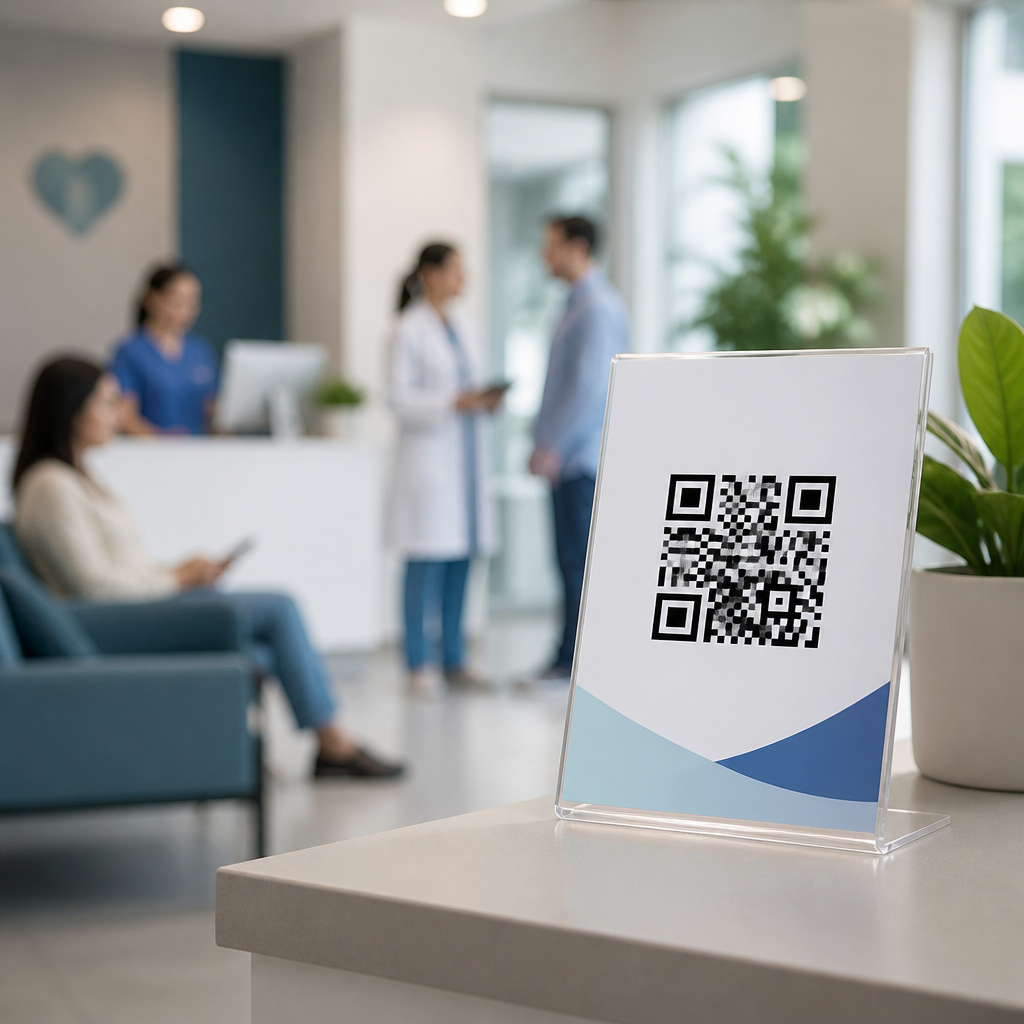
| Clinic waiting room sign | Portal signup, forms, or patient education | Operational efficiency |
| Community health fair booth | Event registration or screening information | Lead capture and outreach |
| Discharge packet | Follow-up care instructions and survey | Retention and adherence |
Compliance, privacy, and trust considerations
Healthcare marketers must treat QR campaigns as regulated communications, not generic promotional assets. The first principle is simple: a QR code itself does not create a privacy issue, but the destination and data flow can. If the scan opens a page that collects symptoms, appointment reasons, insurance details, or contact information tied to care, teams must understand whether that workflow falls under HIPAA obligations and how vendors handle protected health information. Compliance review should cover landing pages, forms, analytics configurations, cookies, consent language, and any integrations with scheduling or CRM platforms.
Trust is just as important as legal review. Patients hesitate when a code appears on low-quality print, points to an unfamiliar URL, or asks for too much information too quickly. Branded short domains, clear calls to action, and concise explanations improve confidence. Instead of “Scan now,” say “Scan to find a same-day appointment near you” or “Scan to download knee replacement recovery instructions.” The user should know what happens next before opening a camera app.
Accessibility deserves equal attention. QR codes should never be the only path to critical information. Include a short URL, phone number, and plain-language instructions nearby. Use strong color contrast, adequate white space, and sufficient print size; a code buried in a dense paragraph often goes unscanned. For multilingual communities, link to language selection or geo-targeted pages. Providers serving older populations should test codes on printed materials viewed at arm’s length under ordinary lighting, not just on polished proofs.
How to build a healthcare QR code campaign that converts
Effective execution starts with a narrow objective. Choose one primary conversion per asset: book a visit, register for an event, call a nurse line, download an app, watch a procedure video, or complete pre-registration. When marketers overload a single QR landing page with six competing actions, results decline. A cardiology postcard should not send users to a hospital homepage featuring careers, news, donor appeals, and unrelated specialties.
Next, create destination pages designed for mobile completion. Keep forms short, place the value proposition near the top, and confirm essential operational details such as insurance plans, clinic hours, parking, virtual care availability, and average response time. Include physician credentials when relevant, but prioritize user tasks over institutional messaging. For elective procedures, add testimonials, expected timelines, and financing information. For preventive care, add eligibility criteria and preparation instructions. Every page should answer the immediate question that caused the scan.
Tracking should be planned before printing. Use dynamic QR platforms, campaign naming conventions, and analytics parameters that distinguish channel, location, audience, and creative version. Common tools include Google Analytics 4, Adobe Analytics, Bitly, QRCode Monkey for asset creation, and enterprise QR platforms with redirect management. In larger systems, connect scans to call tracking, online scheduling, CRM records, or customer data platforms where permitted. Useful metrics include scan-through rate by placement, bounce rate, appointment conversion rate, assisted conversions, cost per acquisition, and no-show rate for QR-driven bookings.
Testing is not optional. Print samples at actual size, scan them on older phones, test them in low light, and validate every redirect. I have seen high-budget healthcare mailers fail because codes were too small, pages loaded slowly on cellular connections, or forms required desktop-only interactions. A fifteen-minute field test catches problems that analytics will only reveal after budget is spent.
Examples across healthcare specialties and organizations
Different specialties use QR codes differently because patient motivations vary. A dermatology clinic promoting skin cancer screenings may use local print ads with a code leading to a page that shows suspicious lesion photos, explains risk factors, and offers online booking. A bariatric program can place QR codes in seminar flyers that route prospects to BMI criteria, surgeon bios, support group schedules, and insurance guidance. A behavioral health provider might use discreet QR stickers in campus counseling centers linking students to confidential intake options and crisis resources.
Hospitals often gain the most value when QR codes support decentralized service line marketing. A women’s health department can run separate codes for obstetrics classes, mammograms, menopause care, and pelvic floor therapy, each with its own attribution. Multi-location urgent care brands use roadside signs and in-store displays to show current wait times by center. Senior living and home health organizations use QR-enabled brochures to offer family caregivers assessment tools, care navigation guides, and contact forms for consultations.
Pharmaceutical, device, and wellness brands within healthcare can also benefit, but they face distinct scrutiny. A medical device company exhibiting at a clinical conference may use QR codes on booth materials to deliver product specifications, reimbursement resources, and demo scheduling. A supplement brand sold through clinics can link package inserts to clinician-authored education and usage instructions. In all cases, promotional claims must align with approved labeling, fair balance expectations, and internal medical-legal review.
Common mistakes and what strong teams do instead
The most common mistake is treating the QR code as the campaign rather than the connector. A code cannot rescue weak targeting, unclear value, or a poor landing page. Another frequent error is sending every scan to the homepage. Users scanning a postcard about physical therapy should arrive at physical therapy content, not a generic hospital masthead.
Teams also underestimate placement context. A code on a highway billboard gets seconds of attention and should support memorable follow-up, often with a short URL as the primary response path. A code in an exam room allows more detailed actions, such as downloading prep instructions or enrolling in the portal. Print environment matters too. Glossy surfaces can create glare, curved prescription bottles distort scanning, and low-contrast designs reduce readability.
Strong healthcare marketers document governance. They maintain redirect inventories, expiration dates, owner names, and destination audits so old campaigns do not lead to dead pages or retired physicians. They coordinate with compliance, IT, access teams, and operations before launch. Most importantly, they review results by downstream outcomes, not vanity metrics alone. A campaign with fewer scans but more completed appointments is better than one with high scan volume and weak intent.
QR codes for healthcare marketing campaigns work best when they reduce friction, respect privacy, and answer a specific patient need in the moment it appears. They are most effective not on flashy creative alone but on disciplined campaign design: clear audience segmentation, mobile-first landing pages, compliant data handling, accurate attribution, and operational follow-through. In healthcare, convenience must always support trust.
For organizations building a hub around healthcare use cases, the strategic opportunity is broad. QR codes can support acquisition, education, event promotion, scheduling, retention, community outreach, and post-visit engagement across nearly every specialty. The key is matching each code to a single purpose and measuring what happens after the scan. When teams do that well, print becomes trackable, local outreach becomes scalable, and patient access becomes easier.
Start with one service line, one audience, and one conversion goal. Launch a tightly scoped pilot, test every touchpoint, and expand only after reviewing real outcomes. That approach turns QR codes from a tactical add-on into a reliable healthcare marketing channel.
Frequently Asked Questions
1. How can QR codes be used effectively in healthcare marketing campaigns?
QR codes can play a highly effective role in healthcare marketing because they bridge the gap between physical outreach and digital engagement in a fast, convenient way. A hospital, clinic, insurer, pharmacy, or wellness brand can place a QR code on brochures, waiting room signage, direct mail pieces, event banners, prescription inserts, community flyers, or even out-of-home advertising, then guide people instantly to a digital destination that supports a specific campaign goal. That destination might be an appointment request page, physician directory, service line overview, health screening signup, telehealth information page, app download, educational video, vaccine registration form, maternity tour page, or insurance enrollment resource.
The most successful healthcare QR code campaigns start with a clear purpose. For example, if the campaign is focused on preventive care, the QR code might lead to a landing page about annual screenings, risk assessments, and next-step scheduling. If the goal is community education, it could direct users to trusted content about chronic disease management, nutrition, mental health, or seasonal illness prevention. If the campaign supports patient acquisition, the code might connect users to a location finder, online booking form, or a page introducing providers and specialties. In each case, the QR code should remove friction and make it easier for the audience to take immediate action.
Healthcare marketers also benefit when they tailor QR code placements to specific audiences. A code displayed at a senior health fair should likely lead to a simple, mobile-friendly page with large text and clear navigation. A code used in a pediatric clinic campaign may work best when it points parents to immunization schedules, after-hours care information, or online check-in tools. A code included in employer wellness materials may be more appropriate for health plan education, biometric screening signups, or wellness challenge enrollment. Matching the QR code experience to the audience’s needs and context is what turns a generic scan into meaningful engagement.
To be effective, the landing experience must be just as well designed as the code itself. The page should load quickly, display clearly on mobile devices, explain what the visitor will find, and provide a strong call to action. In healthcare, trust matters enormously, so branding should be consistent, language should be plain and reassuring, and content should feel credible and current. A QR code is not valuable simply because it is scannable; it is valuable when it connects people to relevant, useful, and trustworthy healthcare information or services with minimal effort.
2. Are QR codes safe and compliant for healthcare marketing?
QR codes can be safe and compliant for healthcare marketing, but they must be planned carefully. The code itself is simply a scannable link, so the compliance and privacy considerations depend largely on where it leads, what data is collected, how that data is stored, and how the organization communicates with users. In healthcare, marketers need to be especially thoughtful because audiences are often sharing sensitive concerns, and organizations may operate under strict privacy, advertising, and regulatory expectations. That means QR code campaigns should be reviewed with the same seriousness as landing pages, forms, and digital advertising programs.
One core best practice is to avoid using QR codes in ways that unnecessarily expose or imply protected health information. For example, if a printed piece includes a code for a very specific condition-related program, the surrounding context should be handled carefully so that users do not feel singled out or publicly identified. In many cases, broad, educational, and opt-in experiences are safer and more appropriate than highly personalized assumptions. If the code leads to a form, the organization should only collect information that is truly necessary and should clearly explain how that information will be used.
It is also important to ensure that the linked destination is secure, especially if the user may submit personal details, request appointments, access patient tools, or download an app tied to healthcare services. Secure web protocols, trusted domains, clear branding, and internal legal or compliance review all help reduce risk. Organizations should be transparent about whether users are being directed to an educational site, a lead form, a patient portal, or a third-party platform. If third-party tools are involved, those relationships should be evaluated to make sure they align with the organization’s privacy and governance standards.
From a trust perspective, marketers should remember that many people are cautious when scanning codes. To reassure users, the callout next to the QR code should explain exactly what will happen after scanning, such as “Scan to find a doctor,” “Scan to register for the health fair,” or “Scan to download our prenatal care guide.” This clarity reduces hesitation and improves campaign performance. In short, QR codes can absolutely fit within healthcare marketing, but only when privacy, security, transparency, and internal review are built into the process from the beginning.
3. What are the best practices for designing a healthcare QR code campaign that patients will actually use?
Designing a healthcare QR code campaign that earns real engagement requires more than placing a code on a poster and hoping people scan it. Patients, caregivers, and community members respond best when the campaign is easy to understand, immediately useful, and respectful of their time and concerns. The first best practice is to define a single, focused objective for each QR code. If one code tries to promote too many services or direct users to a cluttered homepage, the experience often feels confusing. A stronger approach is to make the path direct: one campaign, one audience, one action.
Placement and context are equally important. A QR code should appear where the audience has both the motivation and the time to scan it. In a waiting room, users may be open to accessing pre-visit forms, provider bios, patient education resources, or follow-up instructions. At a community event, they may be more interested in screenings, service information, or registration for future programs. On printed mailers, they may want a simple way to schedule, verify insurance acceptance, or learn about a local care option. The surrounding message should tell them exactly why scanning is worthwhile.
Visual design matters as well. The QR code should be large enough to scan easily, placed in a clean area with strong contrast, and accompanied by a short explanation and clear call to action. In healthcare, plain language is especially valuable. Instead of vague prompts like “Learn more,” marketers often get better results with specific language such as “Scan to book a same-day visit,” “Scan for flu shot locations,” or “Scan to watch our joint replacement seminar.” When users know the value upfront, they are much more likely to engage.
Once scanned, the mobile experience should be frictionless. The landing page should load quickly, match the campaign message, and avoid unnecessary steps. If the campaign includes a form, keep it short and user-friendly. If the goal is education, organize information clearly and make it easy to navigate. If the campaign supports conversion, include a prominent next step such as call, book, register, download, or locate. Finally, test the campaign thoroughly before launch. Scan the code on multiple devices, review load times, verify tracking, and confirm that the experience feels trustworthy and intuitive. In healthcare marketing, usability is not a minor detail; it is central to performance.
4. What types of healthcare marketing campaigns work best with QR codes?
QR codes are especially effective in healthcare marketing campaigns where immediate action, education, or convenience are important. One of the strongest use cases is patient acquisition and service line promotion. For example, a hospital advertising urgent care, primary care, orthopedics, cardiology, women’s health, or imaging services can place QR codes on print ads, transit signage, event materials, or local sponsorship assets that drive directly to scheduling pages, provider listings, or service-specific landing pages. This shortens the path from awareness to conversion and helps people take action while interest is still high.
Community outreach and public health education campaigns also work well with QR codes. Healthcare organizations often need to distribute timely, credible information about screenings, immunizations, health fairs, wellness classes, chronic disease management, or seasonal health alerts. A QR code can instantly connect someone from a poster, flyer, or handout to a trusted digital resource that offers more depth than the printed space allows. This is particularly useful when information may need to be updated over time, since the digital destination can evolve without requiring all printed materials to be replaced.
Event-based campaigns are another strong fit. Hospitals and clinics frequently host webinars, support groups, physician seminars, maternity tours, blood drives, and community education sessions. A QR code can simplify registration, provide event details, and support reminders or follow-up engagement. Similarly, healthcare insurers and employer wellness programs can use QR codes to promote benefits education, enrollment support, wellness incentives, preventive screenings, and mobile app adoption. In these cases, convenience is a major advantage because users can move from awareness to participation in seconds.
QR codes can also enhance patient experience campaigns, not just traditional advertising. They can support onboarding materials, discharge instructions, medication education, care navigation, and digital resource hubs. While these applications may sit closer to communications or patient engagement than pure promotion, they still strengthen the brand by improving access and usefulness. Ultimately, the best campaigns are those where the audience benefits from a quick, mobile-friendly next step. In healthcare, that often means helping people learn, register, locate, schedule, or prepare with as little friction as possible.