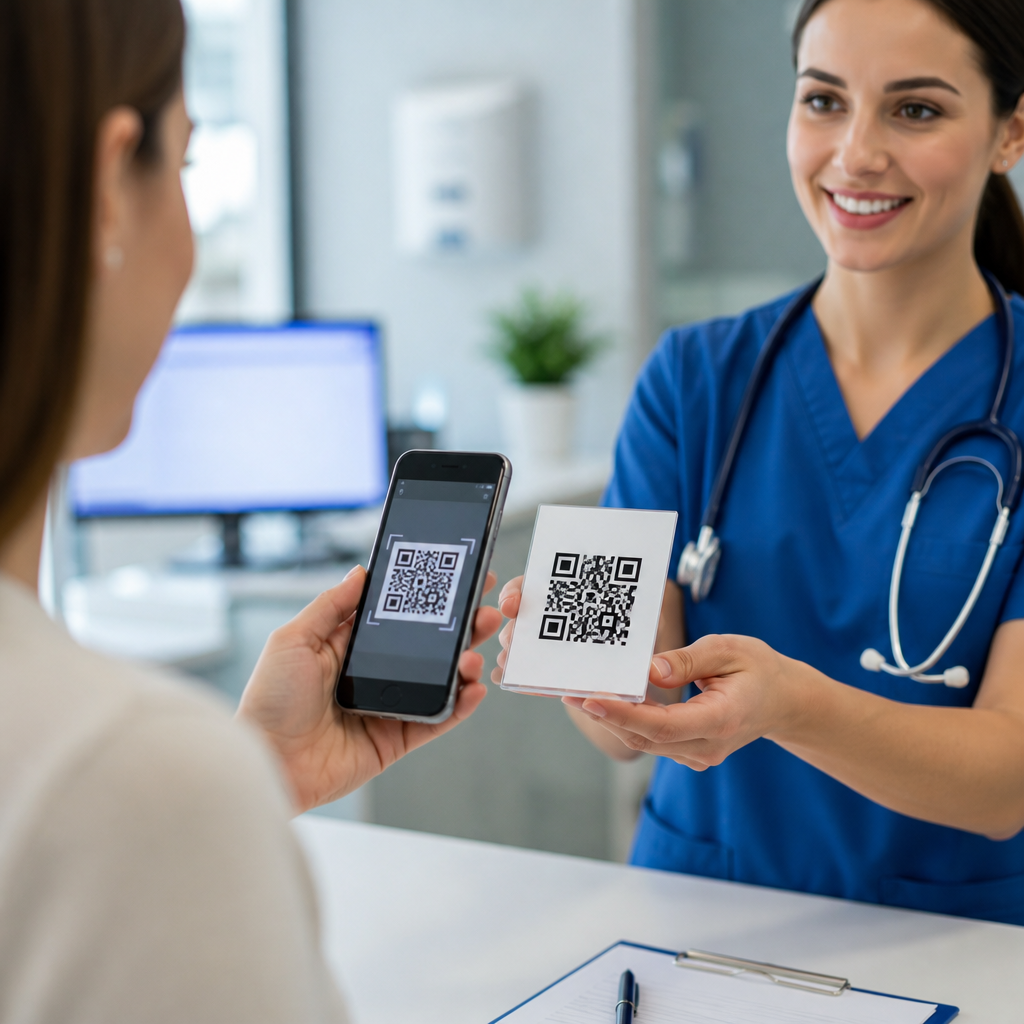
Healthcare communication breaks down when patients cannot find instructions, clinicians cannot share updates quickly, and organizations rely on paper that goes missing or becomes outdated. QR codes improve healthcare communication by connecting physical materials to digital information instantly with a smartphone scan, reducing friction at the exact moments when clarity matters most. In hospitals, clinics, pharmacies, laboratories, dental offices, and public health settings, a QR code can turn a poster, wristband, discharge packet, prescription label, or appointment reminder into a direct gateway to instructions, forms, maps, videos, and secure messages.
A QR code, or Quick Response code, is a two-dimensional barcode that stores a destination such as a web page, PDF, video, app link, text string, or contact card. Static codes point to fixed information, while dynamic codes redirect through a managed URL and can be updated without reprinting the code. That distinction matters in healthcare because content changes frequently. Visiting hours shift, vaccine guidance evolves, forms are revised, and educational materials need multiple languages. In my work with communication teams, dynamic QR codes consistently outperform printed-only materials because they preserve the usefulness of signs and handouts long after policies change.
This matters because healthcare communication is not just about convenience; it affects safety, adherence, experience, equity, and operational efficiency. The Joint Commission emphasizes effective communication as a core patient safety issue, and federal privacy expectations under HIPAA shape how information can be shared digitally. Patients also expect consumer-grade access. They want directions on the way to an appointment, plain-language preparation instructions before a procedure, and trusted follow-up information after they leave. When used carefully, QR codes meet those expectations without forcing organizations to build a new app for every interaction. They work across the patient journey, from outreach and intake to treatment, discharge, billing, and long-term engagement.
As a hub for healthcare use cases, this article explains where QR codes fit, what problems they solve, how to deploy them safely, and which communication outcomes to measure. It covers patient education, appointment workflows, wayfinding, medication support, staff coordination, public health campaigns, and privacy controls. It also addresses practical realities: not every patient wants to scan, not every workflow should link to protected data, and not every code placement will perform well. The strongest programs pair clear design, governance, and analytics with content patients actually need. Done well, QR codes make healthcare communication faster, clearer, and easier to act on.
Why QR codes work in healthcare communication
QR codes work because they close the gap between a moment of need and the information required to act. A patient reading a discharge sheet may have one urgent question: when should I call if symptoms worsen? A parent in a pediatric clinic may need a dosage video in Spanish. A visitor at a large medical campus may need the fastest route to cardiology. Instead of asking someone to type a long URL or download a portal app on the spot, the code provides one-step access. Fewer steps mean fewer drop-offs, which is critical in healthcare, where delay often turns into confusion.
The format is flexible enough to support nearly every communication channel. Printed signs can link to registration forms, parking maps, or estimated wait-time pages. Prescription labels can link to counseling videos and side-effect guidance. Bedside materials can link to dietary restrictions, fall prevention instructions, and care team introductions. In outpatient settings, I have seen practices use QR codes on reminder cards to reduce no-shows by sending patients to one mobile page with directions, check-in links, insurance requirements, and reschedule options. That single page often replaces multiple phone calls and duplicated front-desk explanations.
Healthcare organizations also benefit because QR codes are measurable. Dynamic platforms can report scans by location, time, device type, and campaign. That makes communication performance visible. If a flu clinic poster gets heavy scans but low appointment conversions, the issue may be the landing page, not the poster. If discharge packet scans spike after hours, patients may need a simpler evening support pathway. These insights help communication, patient access, and digital teams improve service with real evidence rather than assumptions.
Patient education and discharge instructions
Patient education is one of the strongest healthcare QR code use cases because printed handouts alone rarely match how people absorb information. Literacy levels vary, stress affects comprehension, and instructions are often reviewed only after the patient gets home. A QR code on discharge paperwork can link to condition-specific content in plain language, short videos, recovery timelines, warning signs, and contact options. For example, an orthopedic clinic can place separate codes for knee replacement, rotator cuff repair, and ACL rehabilitation on the same packet, guiding each patient to the correct exercise library and postoperative milestones.
This approach works especially well when education must be reinforced over time. A patient recovering from cataract surgery may need eye-drop instructions immediately, activity restrictions for several days, and follow-up scheduling within a week. Rather than overloading one sheet with dense text, a code can direct them to a mobile care guide organized by day. In my experience, this reduces avoidable calls that begin with “I lost the paper” or “I’m not sure which instruction applies to me.” It also improves consistency because every patient sees the same approved content rather than relying on memory from a rushed verbal explanation.
Hospitals should still provide non-digital alternatives. The best implementation is layered communication: verbal teaching, printed summary, and QR-linked digital reinforcement. Accessibility matters too. Videos need captions, pages should support screen readers, and content should be available in major community languages. Readability should aim for plain-language standards commonly recommended in patient education, often around a sixth-grade reading level, without stripping away critical clinical nuance.
Appointment access, intake, and pre-visit preparation
Missed appointments and poorly prepared visits create downstream communication problems across the care continuum. QR codes can simplify the pre-visit journey by linking patients to scheduling tools, digital forms, insurance checklists, consent documents, fasting instructions, transportation details, and telehealth setup steps. A gastroenterology practice, for example, can place a code on mailed colonoscopy prep materials that opens a page with bowel preparation instructions, medication restrictions, a countdown checklist, and a number to call if the prep is not going as planned. That is far more usable than a multipage insert with a tiny printed URL.
These workflows also reduce administrative burden. Front desks spend significant time repeating directions, explaining where to upload documents, and chasing incomplete forms. A single pre-visit QR code on reminders, signage, and statement inserts can direct patients to a centralized intake hub. For mobile-first populations, this is often the fastest route to completion. The key is to avoid sending patients into fragmented systems. If scanning launches one page but forms live elsewhere, authentication fails, or the page is not mobile optimized, confidence drops quickly.
| Healthcare use case | What the QR code links to | Communication benefit |
|---|---|---|
| Discharge packet | Recovery instructions, symptom alerts, nurse call line | Improves understanding after the visit |
| Appointment reminder | Check-in, directions, forms, telehealth setup | Reduces no-shows and confusion |
| Medication label | Dose video, side effects, refill page | Supports safe medication use |
| Campus signage | Interactive map and department locator | Improves wayfinding and arrival experience |
| Public health poster | Vaccine booking or screening guidance | Turns awareness into action quickly |
Wayfinding, visitor updates, and on-site service information
Large healthcare campuses are difficult to navigate, and poor wayfinding creates stress before care even begins. QR codes placed at entrances, elevators, parking areas, and clinic crossroads can link to interactive maps, department directories, construction alerts, accessibility routes, and current visitor policies. This is especially useful in hospitals where services move temporarily during renovation or seasonal surges. Replacing every sign each time a route changes is expensive; updating a dynamic destination is not.
Visitor communication has become more complex as policies change based on infection control, patient acuity, and unit type. Maternity, ICU, behavioral health, and pediatric areas often have different rules. A code at the hospital entrance can route visitors to the specific policy page for their destination, reducing conflict at check-in desks and improving compliance. The same principle applies to amenities. Cafeteria hours, gift shop updates, chapel information, interpreter services, and patient relations contact details can all live behind one scan rather than crowding lobby signage with dense text.
For wayfinding, precision matters. The landing page should default to current location context when possible, provide plain-language directions like “take elevator C to floor 4,” and include accessibility options such as wheelchair-friendly routes. Healthcare organizations that treat QR wayfinding as a genuine navigation tool, not just a digital brochure, see better adoption and fewer lost visitors.
Medication counseling, pharmacy communication, and adherence support
Medication communication is a high-impact area because misunderstanding dose, timing, storage, and side effects can lead to avoidable harm. QR codes on pharmacy bags, prescription inserts, blister packaging, or medication administration records can connect patients and caregivers to counseling videos, refill instructions, manufacturer information, and monitoring guidance. Community pharmacies increasingly use codes to supplement brief in-person counseling, especially for inhalers, injectables, anticoagulants, and complex pediatric medications where technique matters as much as the drug itself.
Consider a patient starting insulin. A small printed leaflet cannot easily demonstrate pen priming, injection-site rotation, hypoglycemia response, and safe sharps disposal. A QR code can open a step-by-step video library with visual demonstrations and a printable log. For anticoagulants, the code can link to bleeding warning signs and interaction guidance. For antibiotics, it can reinforce completion of the full course and address common side effects. These are not marketing extras; they are practical communication supports tied directly to adherence and safety.
Pharmacy teams must be careful not to place protected information in the QR code itself. Best practice is to link to general education or a secure authenticated page, not to encode patient identifiers. Labels should also state clearly what the scan provides, such as “Watch how to use your inhaler” or “View refill and side-effect information,” so patients know why the code is worth using.
Internal communication, staff training, and clinical operations
Although most discussion focuses on patients, QR codes also improve communication inside healthcare organizations. Staff often need instant access to updated protocols, equipment instructions, escalation pathways, safety checklists, and training modules. A code on a crash cart can link to restocking standards. A code near a wound care supply area can open the current dressing protocol. A code in an imaging suite can direct float staff to room turnover steps or MRI safety screening guidance. In busy settings, reducing the time needed to hunt for the right document improves reliability.
I have seen the biggest gains when QR codes are used for frontline microlearning. Instead of asking staff to search an intranet, organizations place codes where the work occurs. Environmental services teams can scan cleaning standards by room type. New nurses can scan unit-specific orientation boards. Laboratory teams can access specimen collection updates at the draw station. Because the content sits behind dynamic links, managers can update procedures without replacing laminated sheets throughout the facility.
Operationally, this matters during change. During respiratory virus surges, screening scripts, PPE guidance, and visitor rules can change rapidly. QR codes provide a lightweight distribution method that complements email and huddles. They are not a substitute for formal training or controlled documents, but they are an effective communication bridge between policy revision and frontline adoption.
Privacy, security, and implementation best practices
Healthcare organizations should not treat QR codes as inherently risky, but they do need governance. The central rule is simple: use codes to guide access, not to expose protected health information. Public-facing codes should usually point to general information, secure portals, or authenticated resources. Avoid embedding names, medical record numbers, appointment details, or direct file links containing sensitive data. HIPAA risk analysis should consider what the code links to, who can access it, how traffic is logged, and whether vendors handling redirects or analytics qualify as business associates.
Usability standards matter just as much as privacy. Codes must be large enough to scan easily, placed where lighting supports phone cameras, and paired with concise instructions. Include a short fallback URL and an offline option for people without smartphones. Test on iPhone and Android devices, on hospital guest Wi-Fi and cellular networks, and in real environmental conditions such as glossy posters, curved bottles, or low-light hallways. Error correction levels, quiet zones, and color contrast should follow standard QR code design practices so aesthetic choices do not break functionality.
Measurement should focus on communication outcomes, not scans alone. Useful metrics include form completion, appointment attendance, patient education engagement, refill requests, reduced call volume on repetitive questions, and patient satisfaction comments about clarity. Governance should define who owns each code, who approves destination content, how expired campaigns are retired, and how broken links are monitored. Without ownership, QR programs decay quickly.
Building a scalable healthcare QR code strategy
The most effective healthcare QR code programs start with high-friction communication points rather than novelty. Audit where patients and staff repeatedly ask the same question, lose paperwork, arrive unprepared, or struggle to find information after hours. Those moments usually deliver the fastest return. Standardize templates for landing pages, translation workflows, accessibility reviews, and analytics naming conventions. Use dynamic codes, maintain a content inventory, and connect each deployment to a measurable purpose.
As this healthcare hub expands, deeper articles should branch into topics such as QR codes for patient education, hospital wayfinding, pharmacy labeling, telehealth onboarding, dental office communication, laboratory results workflows, and public health outreach. Each use case deserves its own operational guidance, but the principle is consistent: reduce friction, improve clarity, and put trusted information within one scan of the user’s immediate need. If your organization wants better healthcare communication, start with one patient journey, deploy QR codes where confusion happens most, and measure the difference carefully.
Frequently Asked Questions
How do QR codes improve communication between healthcare providers and patients?
QR codes improve healthcare communication by giving patients immediate access to the right information at the exact moment they need it. Instead of relying only on printed handouts, verbal instructions, or phone calls that may be forgotten or missed, a QR code can connect a patient directly to digital discharge instructions, medication guidance, appointment details, billing resources, educational videos, or language-specific materials with a simple smartphone scan. This reduces confusion and helps patients review important information on their own time, which is especially valuable after a stressful visit, procedure, or diagnosis.
For providers, QR codes make communication more consistent and easier to update. A hospital, clinic, dental office, pharmacy, or lab can place a code on forms, posters, prescription materials, specimen instructions, room signage, or follow-up paperwork. When scanned, that code can lead to current content without requiring staff to reprint every document each time something changes. This helps reduce outdated instructions, improves clarity, and supports a more reliable patient experience. In practical terms, QR codes help bridge the gap between physical care environments and digital information, making communication faster, simpler, and more accessible for everyone involved.
What types of healthcare information can be shared through QR codes?
QR codes can be used to share a wide range of healthcare information, making them one of the most flexible communication tools available to medical organizations. Common examples include appointment scheduling links, patient portal access, discharge instructions, medication directions, consent forms, pre-visit paperwork, insurance and billing guidance, test preparation steps, vaccination records, telehealth links, and post-treatment care instructions. In pharmacies, they can direct patients to dosage explanations and refill resources. In laboratories, they can link to specimen collection instructions, result portals, and frequently asked questions. In public health settings, they can provide access to multilingual updates, clinic locations, prevention guidance, and emergency alerts.
They are also valuable for educational communication. A QR code can link patients to videos that explain how to use an inhaler, prepare for surgery, manage wound care, or understand a new diagnosis. Because the destination is digital, healthcare organizations can present information in multiple formats, including text, audio, graphics, and translated content. That flexibility is especially important for improving comprehension across different literacy levels and language needs. Rather than overwhelming patients with a large stack of papers, providers can use QR codes to deliver organized, easy-to-navigate information in a format that is more likely to be used and remembered.
Are QR codes a secure and compliant way to communicate in healthcare?
QR codes themselves are simply a way to direct someone to information, so their security depends on how they are implemented. When used properly, they can absolutely support secure and compliant healthcare communication. For example, a QR code may send a patient to a secure portal login page, an encrypted telehealth room, or a protected results platform rather than displaying private health information openly. In these cases, the QR code acts as a convenient access point, while the actual data remains protected behind the organization’s existing authentication and privacy controls.
Healthcare organizations should still follow best practices. That includes using trusted domains, secure web pages, access controls, and clear labeling so patients know what they are scanning. Teams should avoid placing sensitive personal information directly inside a static QR code when privacy is a concern. Instead, it is usually better to route scans to secure systems that verify identity before revealing personal data. Organizations should also monitor linked content regularly to ensure links remain active, accurate, and protected. In short, QR codes can support HIPAA-conscious workflows and safer communication when paired with the same strong digital security standards used for any other healthcare technology.
Why are QR codes better than relying only on paper instructions in healthcare settings?
Paper still has a role in healthcare, but it often creates communication problems when used by itself. Printed materials can be lost, damaged, misunderstood, or become outdated quickly. Patients may leave an office with discharge instructions they never read, or they may misplace an important sheet before they need it. Staff may also spend significant time reprinting revised forms, updating educational packets, or answering repeat questions that stem from unclear paperwork. QR codes improve this process by turning paper into a gateway to current, digital information without forcing organizations to abandon physical materials entirely.
This hybrid approach is powerful because it keeps communication accessible while reducing friction. A patient can scan a code on a printed summary, prescription bag, exam room poster, wristband insert, or appointment card and instantly reach the latest instructions, follow-up steps, or contact options. If guidance changes, the linked content can often be updated without replacing every printed item. That makes communication more agile and reduces the risk of patients acting on outdated information. QR codes also support richer communication than paper alone, since they can connect to videos, forms, maps, chat tools, and translated resources. The result is a more modern, responsive way to share healthcare information without depending entirely on memory or static documents.
Where can healthcare organizations use QR codes to improve communication most effectively?
Healthcare organizations can use QR codes effectively across nearly every patient touchpoint. In hospitals, they can be placed on discharge packets, bedside materials, visitor signs, and department wayfinding posters to help patients and families find instructions, updates, and support resources quickly. In clinics and physician offices, QR codes work well on intake forms, waiting room signage, exam room posters, and after-visit summaries, making it easier to access portal links, educational materials, follow-up care instructions, and satisfaction surveys. Dental offices can use them for post-procedure care guidance, insurance forms, and oral hygiene education. Pharmacies can place them on prescription packaging or counters to link to medication directions, refill information, and counseling resources. Laboratories can use them for specimen preparation, check-in steps, and result access.
Public health organizations can also benefit significantly by using QR codes on flyers, posters, mailers, and event signage to distribute vaccination information, outbreak updates, screening resources, and multilingual education. The most effective use cases are usually the ones tied to moments of high urgency, high confusion, or high repetition. If patients frequently ask the same question, struggle to remember next steps, or need fast access to updated information, a QR code is often a practical solution. The key is to place the code where action naturally happens and make the destination genuinely useful. When that is done well, QR codes become more than a convenience feature; they become a scalable communication tool that helps patients, caregivers, and staff stay informed with less delay and less frustration.