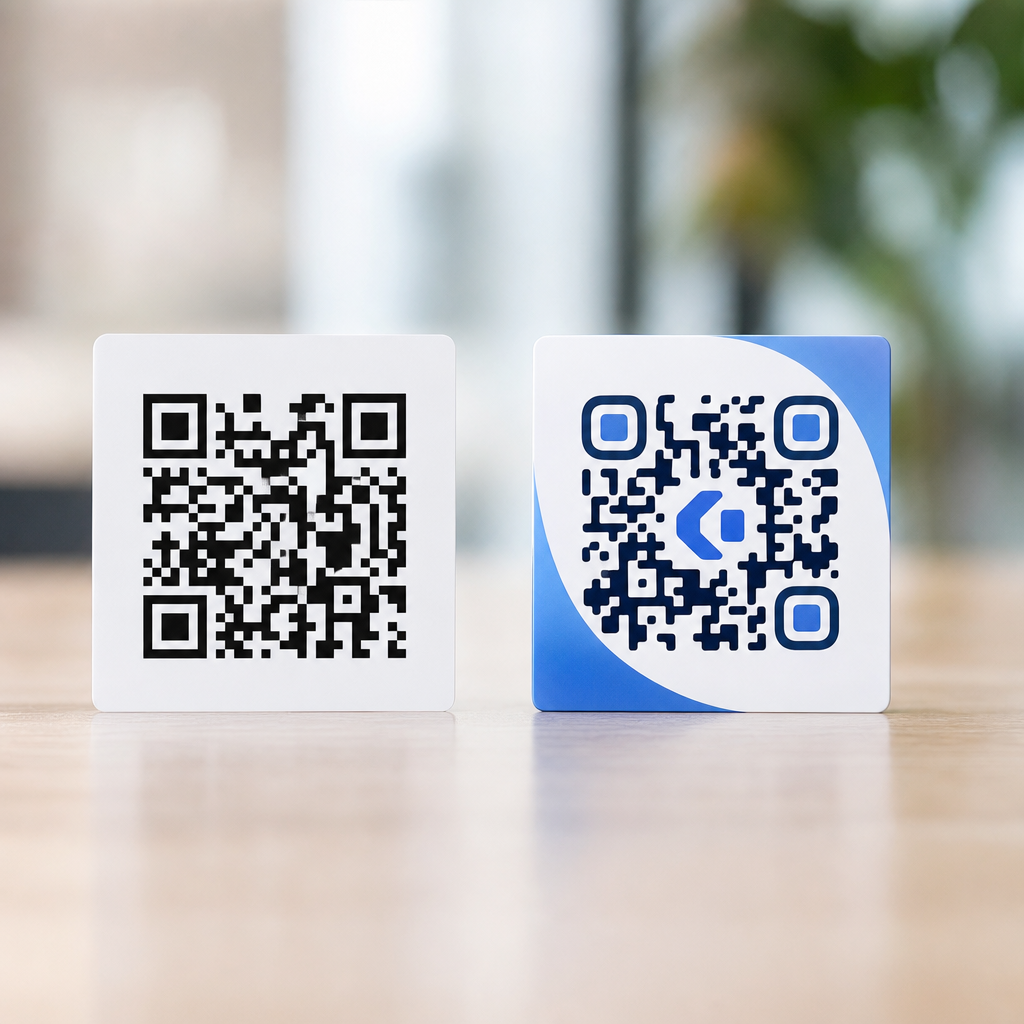

QR code design best practices determine whether a code is scanned instantly, ignored completely, or fails at the moment a customer is ready to act. For marketers, a QR code is not just a technical graphic. It is a conversion asset that connects print, packaging, retail displays, out-of-home media, direct mail, event signage, and product inserts to measurable digital outcomes. A well-designed code preserves scannability while reinforcing brand identity, campaign clarity, and trust. A poorly designed code may look stylish on a mockup yet break under real lighting, distance, or camera conditions.
A QR code, short for Quick Response code, is a two-dimensional matrix barcode that stores data such as a URL, vCard, coupon, Wi-Fi credential, app link, or payment instruction. Modern smartphone cameras can read most standard QR codes without a separate app, which is why adoption accelerated across restaurants, retail, healthcare, ticketing, logistics, and consumer packaging. Marketers now use QR codes for landing page traffic, lead capture, product education, review requests, loyalty enrollment, event check-in, and post-purchase retention. In campaign work, I have seen the same destination URL perform very differently depending on code size, contrast, placement, and call-to-action.
This makes a QR code design checklist essential. Marketers need a repeatable way to evaluate function before aesthetics, then layer in branding without undermining scan reliability. The core factors are straightforward: sufficient contrast, adequate quiet zone, correct sizing for scan distance, restrained logo treatment, tested error correction, and clear user instruction. But execution varies by medium. A mailer handled indoors behaves differently from a shop window facing glare, and a product label curved around a bottle presents different constraints than a flat trade show banner. The goal of this hub article is to give you a complete framework for QR code design decisions so every campaign starts from proven fundamentals.
Used properly, QR codes reduce friction between offline attention and online action. They also create attribution opportunities when paired with UTM parameters, dynamic redirects, and analytics platforms such as Google Analytics 4, Adobe Analytics, HubSpot, or Bitly. Because this page is the hub for QR Code Design & Branding, it focuses on durable principles you can apply across channels, then use to guide deeper implementation work on packaging, posters, menus, brochures, point-of-sale displays, and branded collateral.
Start with scannability before branding
The first rule of QR code design best practices is simple: if it does not scan quickly in normal conditions, nothing else matters. Marketers often begin with brand color palettes, rounded modules, custom frames, and embedded logos. In practice, the starting point should be scan performance across likely devices and environments. ISO/IEC 18004 defines the QR code standard, but standard compliance alone does not guarantee campaign performance. Real users scan while walking, under weak cellular connections, through reflective surfaces, or from awkward angles. Design choices must account for those realities.
High contrast is nonnegotiable. The safest combination remains a dark foreground on a light background, especially black on white. Many branded variants work, but low-contrast pairings such as light gray on pastel, metallic ink on gloss stock, or dark blue on black routinely fail. In retail tests, I have seen codes that pass desktop previews collapse on older phone cameras because the tonal separation is insufficient. Avoid gradients inside the data area unless they have been tested aggressively. Reverse codes, where modules are light and the background is dark, can work in some cases, but they are less forgiving and should not be treated as default.
The quiet zone matters just as much as contrast. This blank margin around the code tells scanners where the symbol begins and ends. A crowded layout, decorative border, or background pattern that intrudes into the quiet zone can prevent detection even when the code itself is technically valid. Leave generous clear space on all sides. Do not tuck the code against copy, edges, folds, perforations, or packaging seams. A QR code needs visual breathing room.
Branding should therefore enhance, not compete with, the symbol. If stakeholders want a more polished look, use a frame, short instruction, and destination cue around the code rather than excessive customization within it. That approach preserves readability while still making the asset feel intentional and on-brand.
Choose the right size, placement, and material for the environment
QR code size should be determined by scan distance, viewing angle, and material surface, not by available white space in a layout. A practical guideline used by print teams is the 10-to-1 rule: for every 10 units of scanning distance, provide at least 1 unit of code size. For example, a code intended to scan from 20 inches away should be roughly 2 inches square. That is a useful baseline, but it becomes conservative for low-end cameras, busy environments, or codes with dense data. When in doubt, go larger.
Placement affects both discoverability and usability. On a poster, the code should sit where a person can approach and scan without blocking foot traffic. On product packaging, place it on a panel that is visible when the item is on shelf and still reachable after purchase. On direct mail, avoid the fold, the envelope window area, and any region likely to be obscured by labels. For restaurant table tents and menus, test common use positions under mixed lighting. For outdoor signage, evaluate sun glare, shadows, weather exposure, and the angle from which pedestrians or drivers encounter the code.
Material choice influences scan reliability more than many marketers expect. Gloss coatings create reflections that confuse cameras. Curved surfaces distort module geometry, particularly on narrow cans and bottles. Textured substrates can break edges and reduce contrast. If you must print on challenging material, increase code size, simplify styling, and print proofs before final production. Matte finishes usually outperform gloss. On transparent packaging, never float the code over whatever product color happens to sit behind it; create a solid light patch beneath the symbol.
Digital placements need the same discipline. A QR code in a presentation slide, connected TV ad, or social graphic must remain on screen long enough to be noticed, interpreted, and scanned. In broadcast work, tiny corner placements vanish on smaller screens. For video, keep the code static, with enough dwell time for a viewer to raise a phone, focus, and complete the scan. Five seconds is often too short unless the code is large and the context is obvious.
Balance customization with technical tolerance
Custom QR codes can absolutely support brand recognition, but every modification consumes part of your technical tolerance. Error correction allows some damage or obstruction while maintaining readability. The common levels are L, M, Q, and H, with H providing the most redundancy. Marketers usually rely on higher error correction when adding a logo, reshaping modules, or styling finder patterns. That is sensible, but it is not permission to overdesign. More redundancy also means more complexity in the symbol, which can make smaller codes harder to scan.
Logo insertion is the most common branding request. Keep the logo modest and centered, and ensure the underlying code is regenerated with appropriate error correction rather than simply covered in a design file. Avoid placing logos near finder patterns, the three large corner markers that scanners use for orientation. Preserve the geometry of those finder patterns unless your generator specifically supports tested custom forms. Even then, validate on multiple devices.
Module styling also requires restraint. Rounded dots, soft corners, and custom eyes can look modern, but extreme treatments reduce edge definition. The same warning applies to gradients, shadows, bevels, embossing, and transparent overlays. If a stylistic effect would make a small text label harder to read, it can also make a QR symbol harder for a camera to interpret. My standard recommendation is to make one custom move at a time: logo, or color change, or module rounding. Stacking every possible effect in one code is where failures begin.
| Design choice | Marketing benefit | Primary risk | Best-practice safeguard |
|---|---|---|---|
| Brand color foreground | Visual consistency | Low contrast | Use dark color on very light background and test in dim light |
| Centered logo | Brand recognition | Obscured data area | Use higher error correction and keep logo small |
| Rounded modules | Softer visual style | Reduced edge clarity | Apply mildly, not aggressively |
| Decorative frame | Improved discoverability | Quiet zone intrusion | Keep clear margin outside the code intact |
| Gloss print finish | Premium look | Glare and reflections | Prefer matte or add larger symbol size |
The safest mindset is that customization should support campaign recognition without forcing the scanner to work harder. If your audience must try twice, your design is already too aggressive.
Write a clear call-to-action and align the landing experience
A QR code without context underperforms because people do not know what they will get, whether it is worth the effort, or whether the destination is safe. The highest-performing campaigns pair the code with a direct call-to-action that explains the benefit in plain language. “Scan to view the menu” is better than “Scan here.” “Scan for 15% off your first order” is better than leaving the value implied. In store audits, I consistently find that adding one line of clear benefit lifts scan volume more than cosmetic redesign alone.
Good calls-to-action answer three questions immediately: what happens after the scan, why it is useful, and how long it takes. Examples include “Scan to watch the 30-second setup video,” “Scan to register your warranty,” or “Scan to compare colors and stock availability.” This framing reduces uncertainty and sets expectation. It also helps qualify the click, improving downstream conversion rates because users arrive with the right intent.
The landing page must match the promise and the environment. If the code sits on packaging in a store aisle, the destination should load fast on mobile, foreground the key action, and avoid long forms. If the code is on an event badge, the destination may need instant check-in or networking functionality. If the code appears in a B2B brochure, a deeper resource page can work, but it still needs mobile-friendly layout, compressed assets, and concise copy above the fold. Marketers sometimes invest heavily in code styling and then send traffic to a generic homepage. That breaks the experience and weakens attribution.
Use dynamic QR codes when possible. They allow you to change the destination without reprinting the symbol, add tracking, and segment traffic by campaign, region, or asset type. This is particularly valuable for packaging, field marketing, and out-of-home placements with long shelf life. Static QR codes are appropriate for immutable destinations and lower-risk uses, but they offer less operational flexibility.
Test across devices, track performance, and govern at scale
Testing is where QR code design best practices become operational discipline. Before launch, scan every code on multiple iPhone and Android models, using both native camera apps and common third-party scanners if your audience may rely on them. Test under bright light, low light, glare, motion, and realistic distance. Print the code at final size on final material. On-screen proofs are not enough. I have seen a code pass perfectly in Figma, only to fail after a printer darkened the background by a small but critical amount.
Analytics should be planned before distribution. Add UTM parameters to destination URLs, standardize naming conventions, and define success metrics such as scan rate, landing page engagement, form completion, coupon redemption, or assisted conversion. In GA4, create campaign dimensions that distinguish packaging scans from event scans or direct mail scans. With dynamic platforms such as Bitly, QR Code Generator PRO, Beaconstac, Flowcode, or Uniqode, you can also monitor scan time, location, device type, and total activity. Those signals help marketers improve not only creative but placement and offer strategy.
Governance matters once teams scale QR usage across regions and channels. Establish a checklist covering destination ownership, redirect management, expiration policy, analytics tagging, brand rules, accessibility, and print approval. Keep a source-of-truth inventory so teams do not generate duplicate or outdated codes. Broken redirects on packaging are especially costly because the asset may remain in market for months. Set review intervals for long-lived campaigns and document who can update dynamic destinations.
Accessibility should also be part of governance. A QR code is not accessible by itself to every user or circumstance, so provide a short URL or alternate path nearby when practical. This supports users with older devices, damaged cameras, or low confidence in scanning. Trust also rises when the destination domain is recognizable. If possible, use branded short links rather than opaque redirect strings.
Conclusion
A strong QR code design checklist protects both campaign performance and brand credibility. The fundamentals are consistent: prioritize scannability, maintain contrast and quiet zone, size the code for real viewing distance, place it where people can comfortably scan, and adapt design choices to the material and environment. Customize carefully, using logos and brand colors only within tested limits. Then add the element many teams overlook: a clear call-to-action that tells the user exactly why the scan is worth making.
From there, the digital experience must carry the same discipline. Send users to a fast, mobile-friendly landing page that matches the promise on the printed asset. Use dynamic codes when flexibility and measurement matter. Tag links correctly, test on real devices, and maintain governance so redirects, analytics, and destination ownership do not drift over time. These steps turn QR codes from decorative add-ons into reliable conversion pathways across packaging, retail, events, direct mail, and signage.
If you want better results from QR Code Design & Branding, treat every code as a customer journey entry point, not a graphic element. Build your next campaign with this checklist, test it in the field, and use the data to refine future placements, offers, and creative decisions.
Frequently Asked Questions
What should marketers include in a QR code design checklist before launching a campaign?
A strong QR code design checklist should cover both scannability and marketing performance. At the most basic level, marketers should confirm that the code links to the correct destination, uses a mobile-friendly landing page, and is tested across multiple devices, camera apps, and lighting conditions. The design itself should maintain strong contrast between the foreground and background, preserve the required quiet zone around the code, and avoid excessive customization that interferes with readability. Size also matters. A QR code that looks fine on a desktop proof may fail on packaging, posters, shelf talkers, or event signage if it is too small for the expected scanning distance.
Beyond the technical basics, the checklist should also include campaign-specific elements that improve conversion. That means adding a clear call to action near the code, explaining what the user will get after scanning, and making sure the destination aligns with the context in which the code appears. For example, a code on a product insert may lead to setup instructions, while a code on out-of-home media may need a short, fast-loading offer page. Marketers should also review branding choices such as logo placement, colors, and frame styling to ensure the code still scans easily while supporting brand recognition. Finally, they should confirm tracking, analytics, and UTM parameters are in place so scans can be measured as part of the broader campaign funnel. A QR code should never be treated as a decorative afterthought. It should be reviewed like any other conversion asset.
How much can you customize a QR code without hurting scan performance?
Customization can improve visual appeal and brand consistency, but it has limits. The most effective rule is that scannability always comes before aesthetics. Marketers can often safely customize a QR code by using brand colors, rounded modules, a branded frame, or a small central logo, but each change introduces risk if it reduces contrast or interferes with the code’s structure. The finder patterns, alignment elements, and overall geometry must remain clear enough for phones to recognize the code quickly. If the code becomes too stylized, too light in color, or too crowded with graphic elements, users may experience slow scans or complete failures.
A practical approach is to customize in layers and test after every design decision. Keep a dark foreground on a light background whenever possible, maintain generous white space around the code, and avoid placing it over busy photos, gradients, or textured packaging. If a logo is added, it should be sized conservatively and supported by an error correction level that can tolerate partial obstruction without compromising readability. Marketers should also remember that a code may be scanned in poor real-world conditions, not just in ideal mockups. Glare, motion, distance, low lighting, and older phone cameras all reduce tolerance for weak design. A QR code that scans in the studio but struggles in-store is not truly campaign-ready. The best custom designs feel branded while still looking unmistakably functional.
What size and placement guidelines help QR codes get scanned more often?
Size and placement have a direct impact on scan rate because they determine whether people can notice the code, approach it comfortably, and scan it without friction. A common guideline is that the farther away the audience will be, the larger the code needs to be. A small code may work well on product packaging or direct mail held in the hand, but the same size can fail completely on a poster, window cling, transit ad, or trade show sign. Marketers should think about viewing distance, angle, and user movement. If someone is standing still in a retail aisle, the code can be smaller than one placed in a fast-moving public environment where the user has only a few seconds to react.
Placement should also support the natural path of attention. The code should be visible, unobstructed, and positioned near the related message, offer, or product. It should not be tucked into a corner, wrapped around a curved package seam, printed on reflective material without testing, or placed where folds, creases, shadows, or store fixtures interfere with access. Good placement also includes surrounding context. A brief instruction such as “Scan to get 15% off” or “Scan for installation guide” gives users a reason to act immediately. Marketers should also leave enough physical and visual space around the code so phone cameras can isolate it quickly. When in doubt, print prototypes at actual size and test them in the real environment. Effective QR placement is less about graphic balance alone and more about making the scan feel effortless.
Why do some branded QR codes fail even when they look professionally designed?
Many branded QR codes fail because they are designed to impress stakeholders more than to serve users. A code can look polished in a brand review and still perform poorly in the field if essential functional rules were compromised. Common causes include low color contrast, missing quiet zones, overlarge logos, distorted proportions, decorative backgrounds, and printing the code too small for the medium. In some cases, the design is technically valid but still weak under real conditions. For example, a dark code on a metallic package may scan in office lighting but struggle under retail glare. Similarly, a code embedded in a detailed campaign visual may get lost because users do not recognize it immediately as something scannable.
Another major reason for failure is disconnect between design and user intent. Even if the code scans correctly, people may ignore it if there is no clear call to action, no explanation of value, or no trust signal indicating where it leads. A QR code on packaging, signage, or direct mail must answer the user’s silent question: “Why should I scan this right now?” Professional appearance alone does not solve that. The best-performing branded QR codes combine strong visual presentation with technical discipline and conversion thinking. They are tested in realistic use cases, paired with relevant messaging, and deployed with a landing experience that fulfills the promise made next to the code. Design quality matters, but usefulness and reliability matter more.
How can marketers test QR codes properly before printing or publishing them at scale?
Proper QR code testing should go well beyond checking whether the code scans once on a designer’s phone. Marketers should test the code on multiple smartphone models, operating systems, and native camera apps because scan behavior can vary. They should also test in both ideal and imperfect conditions, including low light, bright light, glare, different distances, and slight viewing angles. If the code will appear on packaging, mailers, store displays, event materials, or outdoor signage, it should be tested on physical proofs at actual production size. Screen previews are useful, but they do not reveal problems caused by print finish, curvature, shadows, or environmental reflections.
Equally important, marketers should test the full user journey after the scan. That includes destination URL accuracy, page load speed, mobile responsiveness, form usability, analytics tracking, and campaign attribution. If the code leads to a coupon, video, app download, menu, registration page, or product tutorial, every step should be verified on mobile. Dynamic QR codes can add flexibility because they allow destination updates without reprinting, but they still require testing for redirect speed and tracking integrity. A final quality-control step should involve people outside the campaign team. Fresh testers often catch friction points that internal teams overlook, such as confusing calls to action or landing pages that do not match expectations. The goal is not simply to prove that the code works. It is to confirm that the code works quickly, clearly, and consistently in the exact situations where customers will use it.