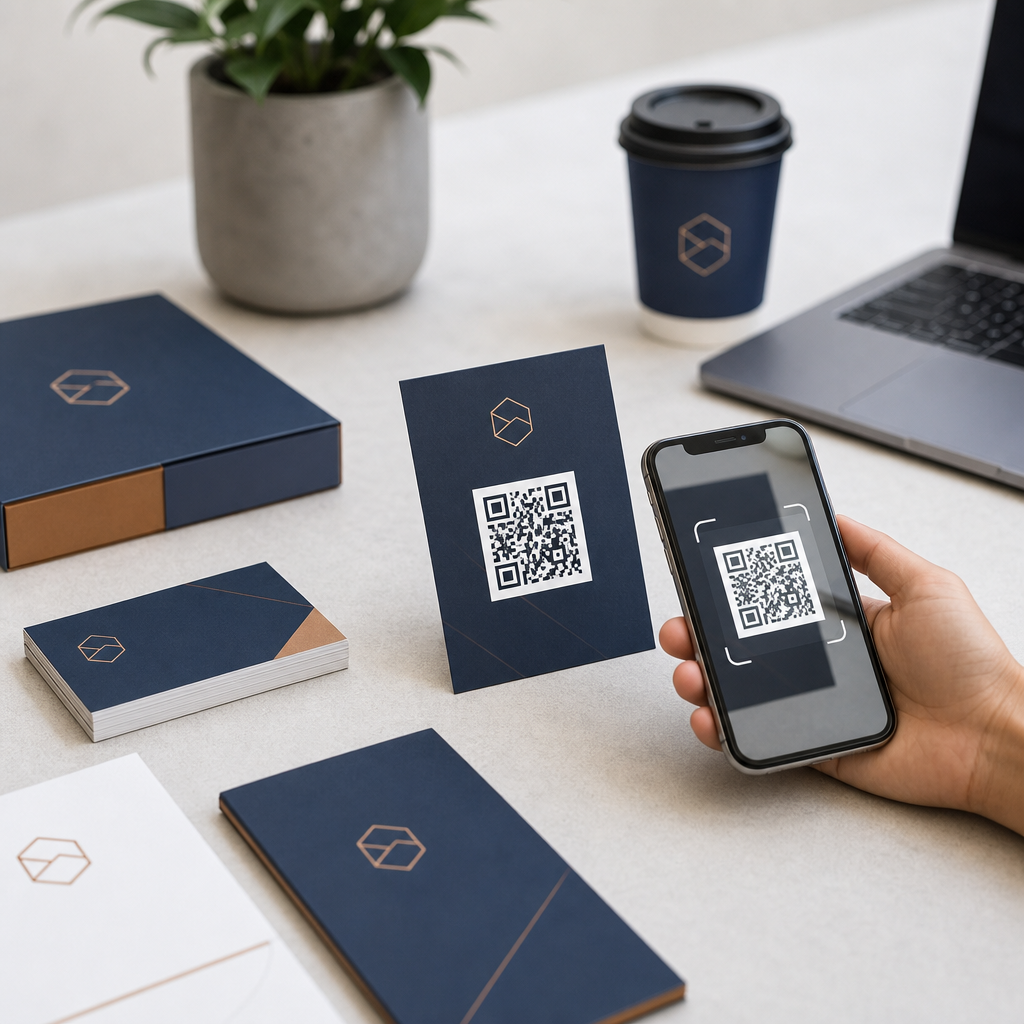
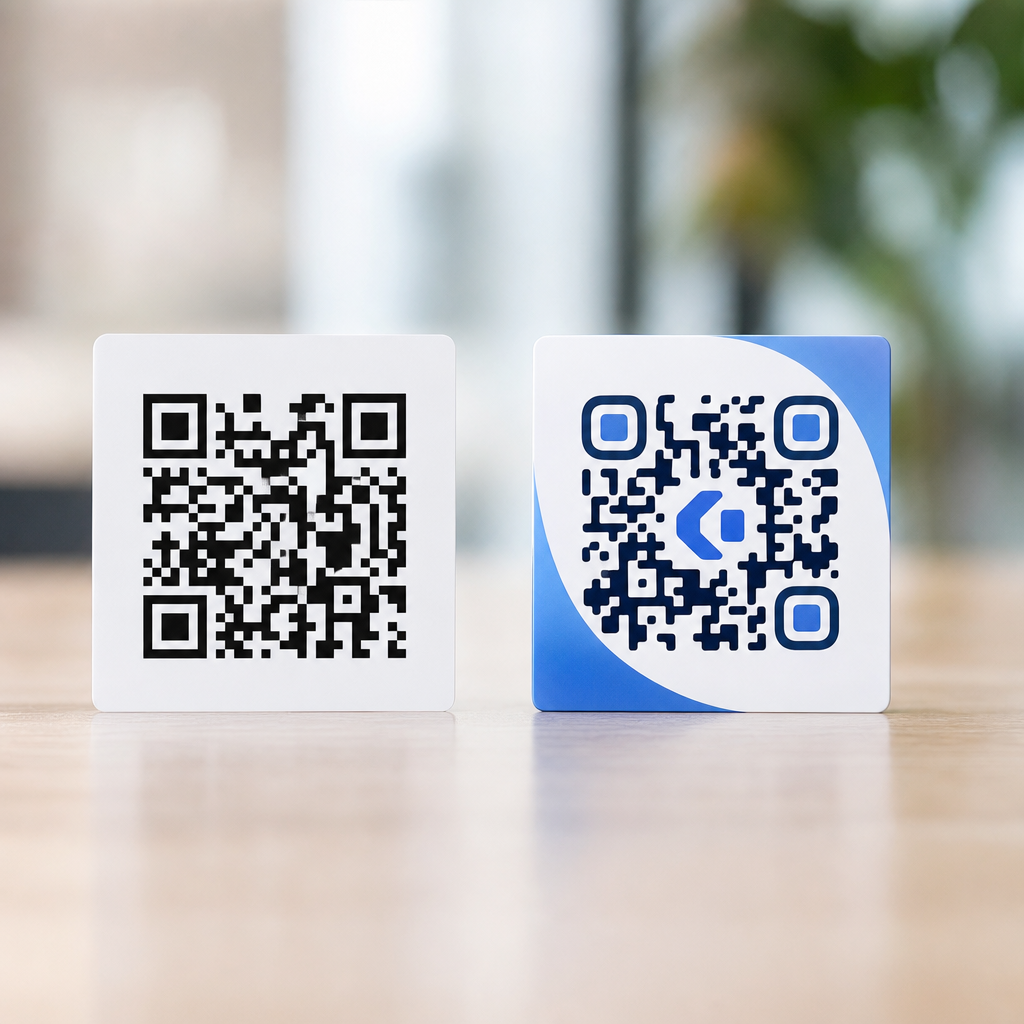
QR codes have moved from warehouse labels and airline boarding passes into storefront windows, product packaging, restaurant tables, event signage, and direct mail, making design decisions far more important than they were when black-and-white squares were treated as purely functional. In the context of marketing and customer experience, the question is no longer whether to use a QR code, but whether to use a standard QR code or a branded QR code.
A standard QR code is the familiar matrix barcode: black modules on a white background, usually generated quickly, printed as-is, and used with minimal customization. A branded QR code keeps the same underlying machine-readable structure but adds visual identity elements such as custom colors, a logo, a frame, a call to action, or altered eye shapes. In many cases it also sits on top of a dynamic QR platform that lets marketers edit the destination URL, track scans, segment campaigns, and manage design versions without changing the printed code.
This distinction matters because QR performance depends on two things at once: technical scannability and human trust. A code can be perfectly valid yet ignored because it looks generic, untrusted, or disconnected from the brand asking for the scan. I have seen this repeatedly in retail displays and trade show collateral. When the code includes a recognizable logo, a clear prompt such as “Scan to view sizes,” and colors that match the campaign, more people understand what they will get and feel safer opening it.
Branded QR codes are not just decorative versions of standard QR codes. They are a design-and-conversion tool. Used well, they help bridge offline and online journeys, improve campaign attribution, and make printed media measurable. Used poorly, they break scanning, reduce contrast, and create accessibility issues. This article explains the difference, where each approach works best, and how to choose the right format for packaging, signage, print, product labels, menus, business cards, and omnichannel campaigns.
What standard QR codes do well
Standard QR codes exist for a reason: they are simple, fast to produce, and highly reliable when basic printing rules are followed. If the goal is operational efficiency rather than brand expression, a plain code is often the right answer. Internal inventory systems, equipment tags, manufacturing workflows, visitor badges, and payment terminals commonly use standard QR codes because consistency and scan speed matter more than visual polish.
Technically, a standard code benefits from maximum contrast, quiet-zone clarity, and predictable scanner recognition. Most free generators output a square code with default finder patterns, no center logo, and a static destination such as a URL, Wi-Fi credential, vCard, or text string. For internal use cases, these defaults are usually enough. If a warehouse employee scans a rack label fifty times a day, adding gradients or logos gives little practical benefit.
Standard QR codes are also easier to scale across large volumes. A team can generate thousands of unique codes for asset tracking or serial-level packaging without design review. Print vendors already understand the format, quality control is straightforward, and there is less risk of a marketing team pushing the design too far. In short, standard QR codes win on speed, cost, and operational reliability.
What makes a QR code branded
A branded QR code uses the same ISO/IEC 18004 QR framework but intentionally changes the presentation layer so the code visually belongs to the business using it. The most common branding elements are a center logo, brand colors, a custom frame, rounded or stylized modules, and a written call to action. Some platforms also let teams use branded short domains in the redirect path, which strengthens trust because users see a recognizable link preview rather than an unfamiliar destination.
Good branded QR code design starts with error correction. QR codes include Reed-Solomon error correction, which allows part of the code to be obscured or altered while remaining scannable. That is what makes a center logo possible. In practice, marketers often use level Q or H when inserting a logo, but the safe setting depends on code density, print size, and scan distance. A short dynamic URL encoded into the code leaves more visual flexibility than a long static URL because fewer modules are needed.
Branding also changes user behavior. A code framed with “Scan to see ingredients,” “Scan for setup video,” or “Scan to join rewards” gives context before the camera opens. That simple instruction increases scan intent because it answers the user’s first question: what happens next? In campaigns I have audited, the strongest performing branded QR codes were not the most artistic ones. They were the ones that balanced clear value, obvious ownership, and easy scanning.
Branded vs standard QR codes: the practical differences
The biggest difference between branded and standard QR codes is not the pattern itself but the business outcome they are built to support. Standard codes prioritize utility. Branded codes prioritize utility plus recognition, trust, and measurable engagement. That distinction affects where they should be used and how success should be judged.
| Factor | Standard QR Code | Branded QR Code |
|---|---|---|
| Appearance | Default black-and-white, minimal styling | Custom colors, logo, frame, CTA, stylized shapes |
| Primary goal | Fast access to data or links | Higher trust, stronger response, campaign alignment |
| Best use cases | Operations, internal labels, utility-driven scans | Packaging, ads, events, retail, menus, direct mail |
| Risk profile | Low design risk, high reliability | More design flexibility, higher chance of scan failure if mishandled |
| Tracking potential | Often static and untracked | Often dynamic with analytics, redirects, and testing |
| User trust | Neutral; may feel generic | Higher when clearly tied to a known brand and purpose |
For example, a utility company mailing a service notice may use a standard QR code if the priority is simply getting customers to a bill-pay page. A premium skincare brand launching a new product line should use a branded QR code on carton packaging because packaging is part of the brand experience, and the scan may lead to tutorials, ingredient sourcing details, reviews, or loyalty enrollment. The code is no longer just a link; it is part of the product interface.
Why branded QR codes usually perform better in marketing
In customer-facing channels, branded QR codes typically outperform standard ones because they reduce ambiguity. People are more likely to scan when they can identify the sender and the expected outcome. This is especially true in physical environments where attention is limited and trust is uneven. A plain QR code on a poster asks for blind action. A branded QR code with a logo and a clear prompt explains the value exchange before the user commits.
There is also a memory effect. Consistent QR styling across packaging, in-store signage, print ads, and event materials reinforces the brand system the same way consistent typography and color do. Over time, customers learn that your QR codes lead to useful experiences rather than dead ends or generic homepages. That matters because repeat scan behavior is built on reliability. If the first scan sends users to a mobile-optimized landing page with the promised content, later scans face less resistance.
Analytics strengthen the case. Dynamic branded QR platforms such as QR Code Generator PRO, Bitly, Flowcode, Uniqode, and Scanova allow teams to monitor scans by date, device, geography, and campaign. That makes offline media measurable. A retailer can compare which window display drove more scans, which flyer version converted better, and which store region generated the most product-video views. Standard static codes can do some of this with tagged URLs, but they are less flexible once printed.
Where standard QR codes still make sense
Branded QR codes are not automatically better in every situation. Standard QR codes remain the smarter option when the scanning context is utilitarian, constrained, or highly technical. On factory floors, hospitals, back-of-house restaurant operations, and logistics networks, scan success under imperfect conditions matters more than aesthetics. Labels may be tiny, surfaces curved, lighting poor, and users rushed. In those settings, conservative design wins.
Standard codes are also useful when neutrality is important. Some payment flows, authentication steps, and cross-party workflows benefit from a plain visual treatment because it signals function rather than promotion. If the code must be reproduced by many partners, translated across markets, or embedded inside documentation with strict formatting rules, standardization can lower error rates and shorten approval cycles.
Budget and governance matter too. Branded codes require design review, testing across devices, and usually platform management. If a small organization lacks the process to test contrast, minimum size, logo placement, and destination behavior, a basic high-contrast QR code may be safer. The worst outcome is not an unattractive code; it is a code that people try to scan and cannot.
How to design branded QR codes without hurting scanability
The best branded QR codes respect scanner physics. Start with high contrast. Dark modules on a light background remain the safest choice, even when using brand colors. Pastel-on-white, metallic inks, and low-contrast gradients often fail in natural light or on older phone cameras. Keep the quiet zone clear around the code, avoid crowding it with text, and size it for the real scan distance. A common baseline for print is at least 2 x 2 centimeters, but posters, shelf talkers, and outdoor signs need substantially more.
Use a dynamic short URL so the symbol contains fewer modules. Lower density makes the code easier to scan and leaves more room for styling. Insert logos modestly and rely on appropriate error correction rather than oversized artwork. Test on both iPhone and Android devices, from multiple camera apps, under glare, at different distances, and on the actual material stock. Matte finishes usually scan better than glossy ones because reflections interfere with focus.
Finally, match destination and context. If the QR code is on a bottle label, the landing page should open quickly, fit mobile screens, and answer the exact need implied by the prompt: ingredients, refill instructions, authenticity verification, or reorder options. Design quality does not end at the code itself. The full scan journey determines whether branded QR codes create real value.
Choosing the right option for your brand hub strategy
For a business building a long-term QR Code Design & Branding program, branded QR codes should be treated as a governed system rather than one-off artwork. Create standards for approved colors, minimum sizes, logo usage, CTA language, redirect domains, analytics naming conventions, and testing procedures. Then decide where standard codes remain appropriate, such as internal operations and low-visibility technical contexts. That two-tier approach prevents brand inconsistency without forcing design where it is not needed.
The central decision is simple. If the QR code faces customers, reflects the brand, or supports marketing measurement, branded QR codes usually offer the better return. If the code exists mainly to move information efficiently between systems or staff, a standard QR code is often enough. The highest-performing organizations use both intentionally, not interchangeably.
Branded vs standard QR codes is ultimately a question of purpose, trust, and control. The right choice improves scan rates, protects usability, and turns offline touchpoints into measurable digital interactions. If you are developing packaging, signage, print, or event assets, audit every QR code against those criteria and build a clear design standard now. That single step will improve consistency across your entire QR branding program.
Frequently Asked Questions
What is the main difference between a standard QR code and a branded QR code?
The main difference comes down to appearance, brand alignment, and how the code fits into the customer experience. A standard QR code is the classic black-and-white square pattern most people recognize immediately. It is highly functional, simple to generate, and often used when speed, low cost, and universal readability are the top priorities. Standard QR codes are especially common in operational settings, internal workflows, tickets, labels, and other environments where design is secondary to utility.
A branded QR code, by contrast, is customized to reflect a company’s visual identity. That can include brand colors, a logo in the center, rounded modules instead of sharp squares, custom frames, or a call-to-action built into the design. While the core technology still works the same way, the presentation is much more intentional. Branded QR codes are typically used in customer-facing marketing materials such as packaging, posters, menus, direct mail, retail signage, and event promotions, where visual trust and consistency matter.
In practical terms, the choice is not just aesthetic. A branded QR code can make the code feel more credible, more noticeable, and more aligned with the surrounding campaign. A standard QR code may blend in or be overlooked, while a branded one can act as a visual extension of the brand itself. The key is that both types serve the same scanning function, but branded QR codes are designed to support stronger engagement and a more polished brand experience.
Are branded QR codes as scannable and reliable as standard QR codes?
Yes, branded QR codes can be just as scannable and reliable as standard QR codes, but only when they are designed correctly. QR codes have built-in error correction, which allows them to remain readable even if part of the code is obscured or stylized. That is what makes branding possible in the first place. A logo can often be placed in the center, colors can be adjusted, and shapes can be customized without breaking functionality, as long as the essential scanning structure remains intact.
Problems usually arise when design choices go too far. If contrast is too low, if the logo covers too much of the code, if the quiet zone around the edges is removed, or if the pattern is distorted beyond acceptable limits, scan performance can suffer. That means a branded QR code should never be treated like a purely decorative graphic. It needs to be tested across different devices, lighting conditions, print sizes, and surfaces before it goes live. A code that looks great on a designer’s screen may behave very differently on glossy packaging, outdoor signage, or a phone viewed in bright sunlight.
Standard QR codes are often considered the safest default because their simplicity leaves less room for error. However, a professionally created branded QR code can absolutely match that level of reliability. The best approach is to balance visual customization with technical discipline. If the code is generated and tested properly, branding does not have to come at the expense of usability.
Why do marketers and businesses choose branded QR codes over standard ones?
Marketers and businesses often choose branded QR codes because they do more than just direct someone to a link. They can increase trust, attract attention, and reinforce brand identity at the exact moment a customer is deciding whether to engage. In a marketing environment, that matters. People are more likely to scan a code when it looks intentional and connected to a recognizable business rather than a generic, context-free square that could lead anywhere.
Branded QR codes also help the code feel like part of the campaign instead of an afterthought. On product packaging, for example, a branded code can complement the label design and invite customers to learn more, register a product, watch a tutorial, or join a loyalty program. On restaurant tables, event signage, or direct mail pieces, the branded treatment can make the code easier to notice and more persuasive to scan. Even a simple visual cue like a logo or color-matched frame can communicate legitimacy and improve response rates.
Another reason businesses prefer branded QR codes is consistency. Modern marketing depends on creating a cohesive experience across physical and digital touchpoints. A branded QR code helps bridge that gap. It signals that the offline item in front of the customer is connected to the same brand they know online. While standard QR codes are still useful in many cases, branded versions are often chosen when the goal is not merely access, but engagement, trust, and stronger campaign performance.
When is a standard QR code the better choice than a branded QR code?
A standard QR code is often the better choice when practicality, speed, and maximum compatibility are more important than visual presentation. In operational environments such as inventory systems, warehouse labels, boarding passes, internal tracking, equipment tags, and forms, there is usually little benefit to investing in custom styling. In those cases, the code simply needs to scan quickly and consistently, often under less-than-ideal conditions. A standard black-and-white format is efficient, familiar, and easy to reproduce across a wide range of surfaces and devices.
Standard QR codes can also be a smart option when production constraints are tight. If materials are being printed at very small sizes, on low-quality surfaces, or in black and white only, a standard code reduces the risk of readability issues. The same is true for organizations that need to generate many codes quickly without design review. Simplicity can be an advantage when scale, reliability, and low overhead are the top priorities.
There are also situations where minimalism is appropriate from a brand perspective. Some campaigns may intentionally use a clean, neutral design, and a standard QR code may fit that look better than a customized one. Ultimately, standard QR codes are not outdated or inferior. They remain highly effective tools. The better choice depends on context: if the code is primarily functional and not central to the customer-facing experience, a standard QR code may be the most practical solution.
How should a business decide between using a standard QR code or a branded QR code?
The best way to decide is to start with the purpose of the QR code and the environment in which people will encounter it. If the code appears in a customer-facing setting where trust, visibility, and brand presentation matter, a branded QR code is often worth the extra effort. That includes packaging, point-of-sale displays, menus, brochures, event graphics, window decals, and direct mail. In these situations, the QR code is part of the communication strategy, not just a technical shortcut, so design can directly influence whether people engage.
If the code is being used behind the scenes for logistics, administration, or purely functional access, a standard QR code is usually sufficient. Businesses should also consider how important scan volume and conversion performance are. If the QR code plays a role in lead generation, customer education, product discovery, or sales, even a modest improvement in scan rates can justify the use of branding. On the other hand, if the audience is captive and already expects to scan, customization may add little value.
Testing is another important part of the decision. A business can compare performance across placements or campaigns to see whether branded QR codes drive more interaction. It is also wise to think about long-term management. If the code will be reused across multiple channels or campaigns, a consistent branded approach can strengthen recognition over time. In short, the decision should be guided by audience, use case, print conditions, and marketing goals. Standard QR codes are ideal for straightforward functionality, while branded QR codes are often the better choice when the code needs to earn attention and support the brand at the same time.