
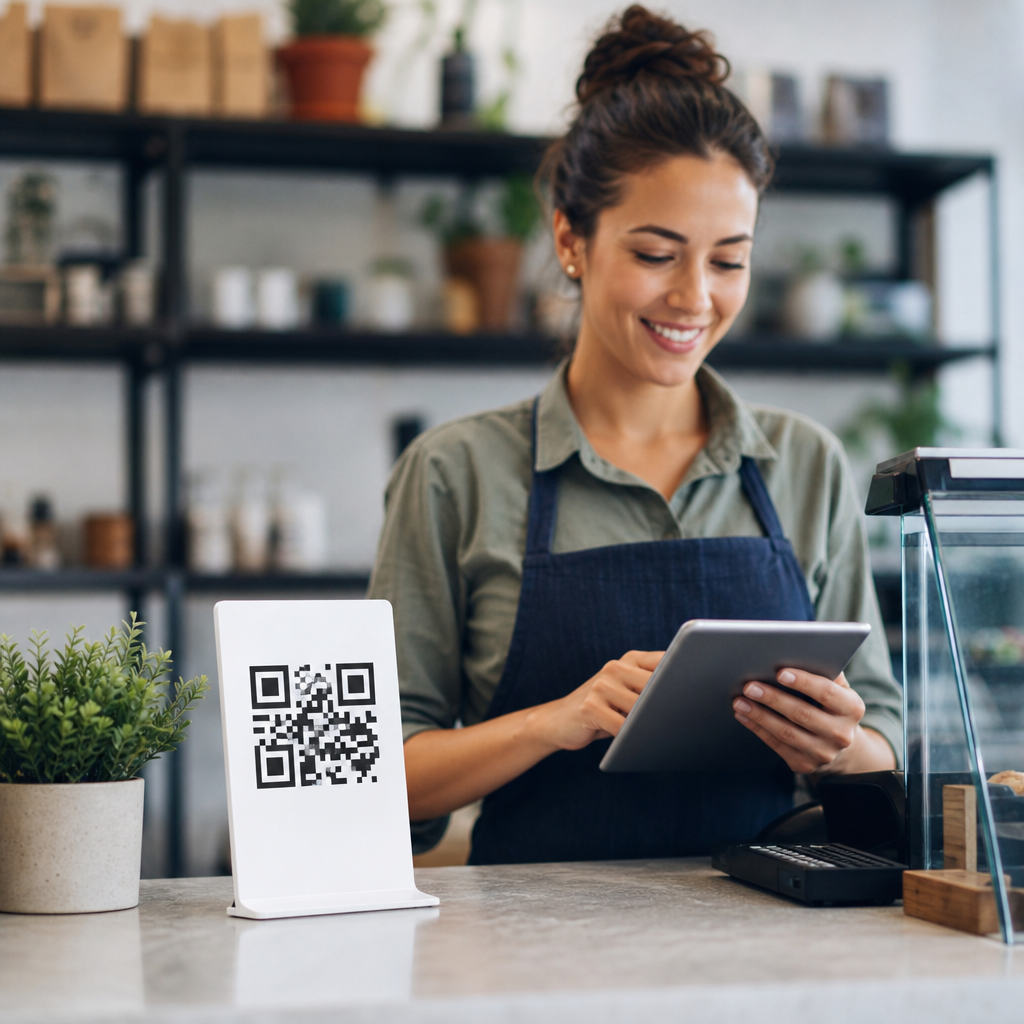
Pricing QR code services for small businesses starts with a simple truth: most owners do not want a QR code, they want a business result. They want more table orders, more Google reviews, faster payments, easier event check-in, cleaner lead capture, or better tracking on print materials. If you sell QR code services, your pricing has to reflect that outcome, not the few seconds it takes to generate a square pattern online. That distinction is what separates a commodity from a valuable recurring service.
In practice, pricing QR code services means deciding how to charge for creation, design, deployment, analytics, updates, hosting, support, and strategy. Small businesses usually buy one of three things: a one-time setup, an ongoing managed service, or a campaign-specific package tied to a marketing goal. Each option has different labor requirements, software costs, perceived value, and risk. If your price ignores any of those factors, margins disappear quickly.
A QR code service can include static codes, dynamic codes, branded landing pages, scan analytics, menu hosting, review generation flows, payment links, form capture, CRM integrations, and print coordination. The term dynamic QR code is especially important because it allows the destination URL to change without reprinting the code. For small businesses, that flexibility is often the difference between a disposable asset and a long-term marketing tool. It also creates a legitimate basis for monthly pricing, because the service depends on managed software and continued administration.
This topic matters because small business budgets are tight, expectations are practical, and trust is earned line by line on a proposal. I have priced QR services for restaurants, real estate agents, fitness studios, event organizers, and home service companies, and the same pattern repeats: owners are willing to pay when the offer is clear, implementation is easy, and the return feels measurable. They resist vague retainers, bloated feature lists, and anything that sounds like they are renting a free technology.
Done well, a pricing model for QR code services protects your profit, fits the client’s cash flow, and creates room for upsells such as landing page optimization, analytics reporting, local SEO support, review generation, and print asset management. This hub article explains the core pricing models, the cost drivers behind them, the numbers that small businesses accept most often, and the packaging logic that turns QR work into a sustainable service line.
What small businesses are really paying for
Small businesses pay for speed, clarity, reliability, and measurable use. The code itself is rarely the product. The product is the system around it. When I scope a QR project, I break the value into six parts: discovery, build, destination, testing, distribution, and reporting. Discovery covers the business goal and customer journey. Build covers code generation and account configuration. Destination covers the page, form, menu, review funnel, or payment link. Testing covers scan behavior across devices, lighting conditions, and print sizes. Distribution covers where the code appears physically or digitally. Reporting covers what happened after launch.
This framing helps clients understand why two QR code quotes can differ so widely. A $25 code from a gig marketplace may send traffic to a single link and include no analytics, no design adaptation, no update support, and no print guidance. A $500 setup may include branded graphics, UTM-tagged destinations, dynamic redirects, call tracking integration, staff instructions, and a launch checklist. To a small business owner, those are materially different offers.
Another overlooked factor is business risk. If a restaurant prints 5,000 menus with a broken link, the cost is not the code; it is the reprint, lost orders, and staff confusion. If a realtor places a yard sign QR code that loads slowly or sends visitors to a generic homepage, lead intent leaks away immediately. Strong pricing reflects the responsibility of getting these details right.
For that reason, anchor your pricing conversation around outcomes and avoided mistakes. Good examples include “reduce menu reprint costs,” “increase review volume from completed jobs,” “track postcard response by neighborhood,” and “capture leads from offline signage.” These are concrete reasons to invest, and they justify more than a one-time design fee.
Core pricing models for QR code services
There are four workable pricing models for most small business QR code services: one-time project pricing, monthly subscription pricing, campaign pricing, and hybrid pricing. One-time project pricing works best when the client needs a fixed deliverable, such as a menu QR setup, event signage, or a review stand for a front desk. Monthly subscription pricing works when you manage dynamic codes, hosted destinations, analytics dashboards, redirects, testing, and updates. Campaign pricing fits limited promotions, such as holiday flyers, trade show lead capture, or direct mail with trackable scans. Hybrid pricing combines setup plus recurring management and is usually the strongest long-term model.
One-time pricing is easiest to sell to price-sensitive owners because it feels tangible and finite. The danger is undercharging for future requests. If you choose this model, define exactly what is included: number of codes, number of revisions, destination setup, and testing scope. Monthly pricing creates predictable revenue and better aligns with dynamic QR platforms such as Bitly, Beaconstac, QR Code Generator Pro, Uniqode, or Flowcode. The challenge is proving ongoing value, which means clients must receive reports, updates, or optimization, not just access.
Campaign pricing is useful when a code is part of a larger funnel. For example, a gym might run a six-week referral promotion using posters, locker room signage, and front desk cards. You can price the QR portion based on campaign setup, asset versions, tracking structure, and closeout reporting. Hybrid pricing is often the sweet spot because it lowers the entry barrier while preserving margin over time. A restaurant might pay a setup fee for menu migration and tabletop design, then a monthly fee for hosting, seasonal updates, and scan reporting.
| Model | Best fit | Typical small business price | Main risk |
|---|---|---|---|
| One-time project | Single deployment, low change frequency | $100 to $750 | No recurring revenue |
| Monthly subscription | Dynamic links, analytics, ongoing support | $25 to $300 per month | Weak retention if reporting is poor |
| Campaign package | Promotions, events, direct mail | $250 to $1,500 per campaign | Scope creep during launch |
| Hybrid setup plus monthly | Most service businesses and restaurants | $150 to $1,000 setup plus $25 to $200 per month | Needs clear contract language |
As a rule, if the destination, tracking, or offer changes over time, do not rely on one-time pricing alone. That work creates continuous value and should be billed accordingly.
How to calculate price without guessing
The most reliable way to price QR code services is to combine cost-based math with value-based judgment. Start with your hard costs: software subscriptions, design time, landing page tools, call tracking, form software, payment processing setup, and support time. Then estimate labor by task, not by vague total hours. A realistic scope for a simple small business deployment might include 30 minutes of discovery, 45 minutes of setup, 30 minutes of design adaptation, 30 minutes of testing, and 15 minutes of client handoff. A managed deployment may add reporting, revisions, and account administration every month.
Next, apply a target hourly floor internally even if you never show hourly pricing. Many freelancers and small agencies use an internal floor between $75 and $150 per hour depending on market and skill level. If a restaurant menu setup takes three hours all-in and your floor is $100, a baseline price under $300 will compress margin before software and revisions. This is where many providers fail. They price the code as a graphic rather than the service as an implementation.
Then apply value logic. If a home services company closes one $2,000 job from a truck-wrap QR code linked to an estimate request form, a $350 setup does not feel expensive. If a café saves monthly printing costs by switching to dynamic menu QR codes, a recurring fee becomes easier to justify. Tie pricing to either revenue gain, cost savings, or operational efficiency. Small businesses respond well to these three lenses because they are immediate and understandable.
Finally, build guardrails into the quote. Limit revisions, define response times, specify whether print design is included, and clarify ownership of accounts and assets. If you host the dynamic codes under your master platform account, state what happens if the client cancels. Transparent terms improve close rates because they reduce uncertainty.
Packaging services for different small business types
Packaging works best when it matches a use case instead of generic bronze, silver, and gold labels. Restaurants often need menu QR codes, table tent ordering links, Wi-Fi access pages, and review requests. Realtors need sign riders, flyer codes, and open house lead capture. Fitness studios need class signup, waiver forms, and referral campaigns. Contractors need review collection, payment links, and jobsite signage. When the package reflects a familiar workflow, owners understand the price faster.
For restaurants, a practical package might include one dynamic menu code, one Google review code, tabletop artwork, window decal sizing guidance, and monthly menu link updates. For real estate, a package might include a branded listing landing page, property-specific codes, brochure tracking, and CRM form routing. For events, the offer may include registration redirect codes, on-site signage variations, and post-event scan analytics. Each package should specify quantity, destination type, update frequency, and reporting cadence.
I have found that simple names tied to outcomes outperform feature-heavy names. “Review Booster,” “Trackable Menu System,” and “Offline Lead Capture” communicate purpose immediately. You can still tier them by complexity, but the primary label should answer the buyer’s first question: what does this help me do?
Bundling also raises average order value. A single review QR card may be worth $99. A local reputation package with review cards, service-completion stickers, Google review funnel setup, and monthly reporting may be worth $249 setup plus $49 per month. The difference is not cosmetic. It reflects a complete process that a busy owner can actually implement.
Common price ranges and what clients expect at each level
At the low end, from about $50 to $150, clients usually expect a simple static code or a basic dynamic code with minimal branding. This tier is common for solo providers, template-driven setups, or one-off requests from microbusinesses. You can serve this market, but only if fulfillment is standardized and support is limited. Otherwise the margin disappears into emails and revisions.
In the mid-range, roughly $150 to $500 setup, expectations change. Clients expect branded visuals, destination advice, testing, and some level of analytics or update flexibility. This is the most active zone for small business QR code services because it feels affordable while still leaving room for professional execution. Most restaurant menus, review funnels, payment links, and local lead capture projects fit here.
Above $500 setup, buyers expect integration and strategy. They may need multiple locations, staff workflows, custom landing pages, CRM connections through Zapier, Google Analytics 4 event tracking, Meta Pixel support, or campaign segmentation with UTM parameters. At this level, reporting matters. Owners want to see scans by date, device, source, or location and understand what decisions those numbers support.
Monthly retainers usually land between $25 and $100 for light management and between $100 and $300 for active optimization, reporting, and multi-code environments. If you charge monthly, send something monthly. A brief report with scan trends, top-performing placements, broken-link checks, and recommended changes is often enough to justify the fee.
Avoiding underpricing, overselling, and scope creep
The fastest way to lose money in QR code services is to sell a cheap setup that turns into indefinite support. Underpricing usually comes from three mistakes: ignoring admin time, giving unlimited edits, and bundling custom landing pages without a template system. Fix all three early. Use standardized intake forms, build repeatable page templates, and write clear revision limits into every proposal.
Overselling is a different problem. Not every small business needs advanced dashboards, multi-touch attribution, or a custom microsite. A neighborhood café may only need a reliable menu code and a review prompt. If you force enterprise features into a local project, trust drops. Match the complexity to the business model and transaction size.
Scope creep often starts with innocent requests: “Can you also update the menu every week?” “Can you make three more versions for flyers?” “Can this connect to our CRM?” None of these are unreasonable, but each changes the economics. I prevent this by separating setup, change requests, and managed support. Clients appreciate the clarity because they can choose what they actually need.
One more safeguard is performance language. Promise what you control: setup quality, functionality, tracking integrity, and reporting. Do not promise a specific sales result unless the full marketing funnel is under your management. QR codes improve access and measurement; they do not rescue a weak offer on their own.
Building a profitable hub around pricing QR code services
As a hub topic, pricing QR code services should connect naturally to related offers such as dynamic versus static QR codes, restaurant QR code packages, QR code analytics, QR code lead generation, review funnel setup, QR code design best practices, and print placement strategy. In sales terms, pricing is the page that helps owners compare options and helps providers justify their model. It sits near the center of the buying journey because nearly every prospect asks the same questions: How much does a QR code service cost? What is included? Should I pay once or monthly? How do I know if it is worth it?
The best answer is specific and operational. Charge based on the business use case, the complexity of the destination, the need for dynamic management, and the reporting required after launch. Keep entry offers simple, reserve recurring fees for real ongoing value, and package services around outcomes that owners already care about. That approach makes your pricing easier to defend and easier for clients to approve.
For small businesses, the winning offer is rarely the cheapest QR code. It is the one that works reliably, fits the workflow, and produces a visible result without creating extra staff burden. For providers, the winning model is one that covers software, labor, support, and accountability while leaving enough margin to deliver consistently. If you are building or refining a QR code service business, audit your current packages, remove vague inclusions, and create pricing that reflects the full system behind the scan.
Frequently Asked Questions
1. How should small businesses think about pricing QR code services?
Small businesses should think about QR code pricing in terms of outcomes, not just the act of creating the code itself. A basic QR code can be generated in seconds, often for free, so charging only for the graphic usually turns the service into a low-value commodity. What business owners actually care about is what the QR code helps them achieve: more customer reviews, more menu orders, faster payments, smoother event check-in, better lead capture, or clearer campaign tracking. That is where the real value lives.
For example, a restaurant does not really want a QR code for its tables. It wants faster table turnover, easier ordering, and fewer staff bottlenecks. A contractor does not want a QR code on a truck magnet just to have one. They want more calls, quote requests, and trackable offline leads. A retailer does not want a code on packaging as a design element alone. They want repeat purchases, loyalty signups, and measurable engagement. When you price around the result, you move away from competing with free generators and toward offering a service with business impact.
That means pricing should account for more than the code image. It should include strategy, destination setup, call-to-action recommendations, landing page support, analytics, testing, placement guidance, and ongoing updates if needed. A static code that links to a homepage has limited value if no one scans it or if the destination does not convert. A well-planned QR implementation tied to a clear objective can become part of a revenue or efficiency system. Small businesses should ask not “How much is the QR code?” but “What problem is this solving, and what is that solution worth to my business?”
2. What is the difference between charging for a QR code and charging for a QR code service?
Charging for a QR code means billing for the creation of the image itself, which is usually the least valuable part of the process. In most cases, that alone is difficult to justify at a premium because business owners can find free tools online. Charging for a QR code service, on the other hand, means you are selling a solution that includes planning, implementation, optimization, and support around a specific business goal.
A true QR code service may include identifying the right use case, choosing between static and dynamic codes, writing or refining the destination content, designing branded codes, ensuring the scan works across devices, setting up tracking parameters, connecting scans to forms or payment tools, and advising on where and how the code should appear in the real world. It can also include maintenance, such as changing destination URLs without reprinting assets, reviewing scan performance, and making improvements over time. That combination is far more valuable than a downloadable PNG file.
This distinction matters because it changes both how the service is delivered and how it is perceived. If you sell “a QR code,” price pressure is almost guaranteed. If you sell “a QR-powered review system for local service businesses” or “a table-ordering QR setup for cafes,” clients understand they are buying expertise tied to a result. The more clearly you define the outcome and the process behind it, the easier it becomes to justify setup fees, monthly retainers, or packaged pricing. In short, the code is the tool, but the service is the product.
3. Should QR code services be priced as a one-time fee, a monthly subscription, or both?
In many cases, the strongest pricing model is a combination of a one-time setup fee and an ongoing monthly subscription. The setup fee covers the initial work: discovery, planning, code creation, branding, landing page or destination setup, testing, and launch support. The monthly fee covers the ongoing value the business continues to receive, especially when dynamic links, analytics, edits, optimization, or campaign management are involved.
A one-time fee makes sense when the project is simple and unlikely to change, such as a static code linked to a permanent page with no expectation of reporting or updates. However, many small business use cases are not truly one-and-done. Menus change, promotions rotate, events come and go, payment links get updated, and businesses often want to know whether people are actually scanning. That is where recurring pricing becomes logical and easier to defend. The client is not paying every month for the square graphic; they are paying for flexibility, continuity, and measurable performance.
Bundled pricing often works especially well. For instance, a business could pay an upfront implementation fee for strategy and deployment, then a monthly amount for hosting, dynamic redirects, scan tracking, destination changes, support, and quarterly optimization. This model aligns better with how businesses experience value over time. It also creates predictable revenue for the service provider, which is important if ongoing reporting, testing, and updates are part of the offer. The key is to tie the recurring fee to active benefits the business understands, not vague “maintenance” language that feels abstract.
4. What factors actually increase the value of a QR code service for a small business?
Several factors increase value, and most of them have nothing to do with the visual code itself. The first is strategic alignment. A QR code tied to a clear objective, such as increasing review volume, reducing front-desk friction, or improving offline attribution, is much more valuable than a generic code with no real plan behind it. Businesses pay more when the implementation supports a measurable result.
The second major factor is flexibility. Dynamic QR codes are often worth more than static ones because they allow the destination to be changed later without reprinting materials. That can save a business both money and operational hassle. If a restaurant updates its menu, an event organizer changes a registration link, or a retailer swaps seasonal promotions, a dynamic setup adds practical long-term value. The third factor is tracking. Businesses increasingly want to know what is working, and a QR campaign with scan data, source tagging, time-based performance insights, and conversion tracking is far more useful than a simple untracked link.
Design and user experience also matter. A branded QR code placed on the right asset with a strong call to action can perform substantially better than a plain code dropped into a layout with no context. The destination matters just as much. If users scan and land on a confusing page, the scan is wasted. If they scan and reach a fast, mobile-friendly, relevant experience, the code becomes an effective conversion tool. Additional value comes from consulting, testing, deployment advice, integrations with forms or CRM systems, multi-location management, and reporting that helps the business make better decisions. In other words, value rises when the QR code is part of a functioning business system rather than an isolated graphic.
5. How can service providers justify higher prices for QR code services without losing small business clients?
The best way to justify higher prices is to make the service easier to understand in business terms. Small business owners are usually not resistant to spending money when they believe the purchase will help them earn more, save time, reduce friction, or improve customer experience. What they resist is paying premium rates for something they believe is simple and replaceable. That means the provider’s job is to reframe the conversation away from code generation and toward business outcomes.
One effective approach is to package the service around use cases instead of technical features. A “Google review growth QR system,” “event check-in QR workflow,” or “print lead tracking QR package” is easier to value than “custom QR code creation.” It also helps to explain the hidden work involved: planning the conversion path, setting up dynamic routing, optimizing scan destinations, testing across devices, creating branded assets, and measuring performance. When clients see the service as implementation plus expertise, not just a downloadable image, the price becomes more reasonable.
It is also smart to present pricing in tiers. Not every business needs the same depth of service, and tiered options let smaller clients start at a manageable level while still seeing the difference between basic execution and strategic support. Include clear deliverables, expected outcomes, and optional add-ons such as analytics, landing pages, ongoing edits, or multi-location management. Case examples, projected ROI, and simple comparisons can further strengthen the offer. If a QR setup helps a business collect even a handful of extra leads, reviews, orders, or payments each month, the service can pay for itself quickly. Higher pricing becomes much easier to accept when it is attached to visible business value.