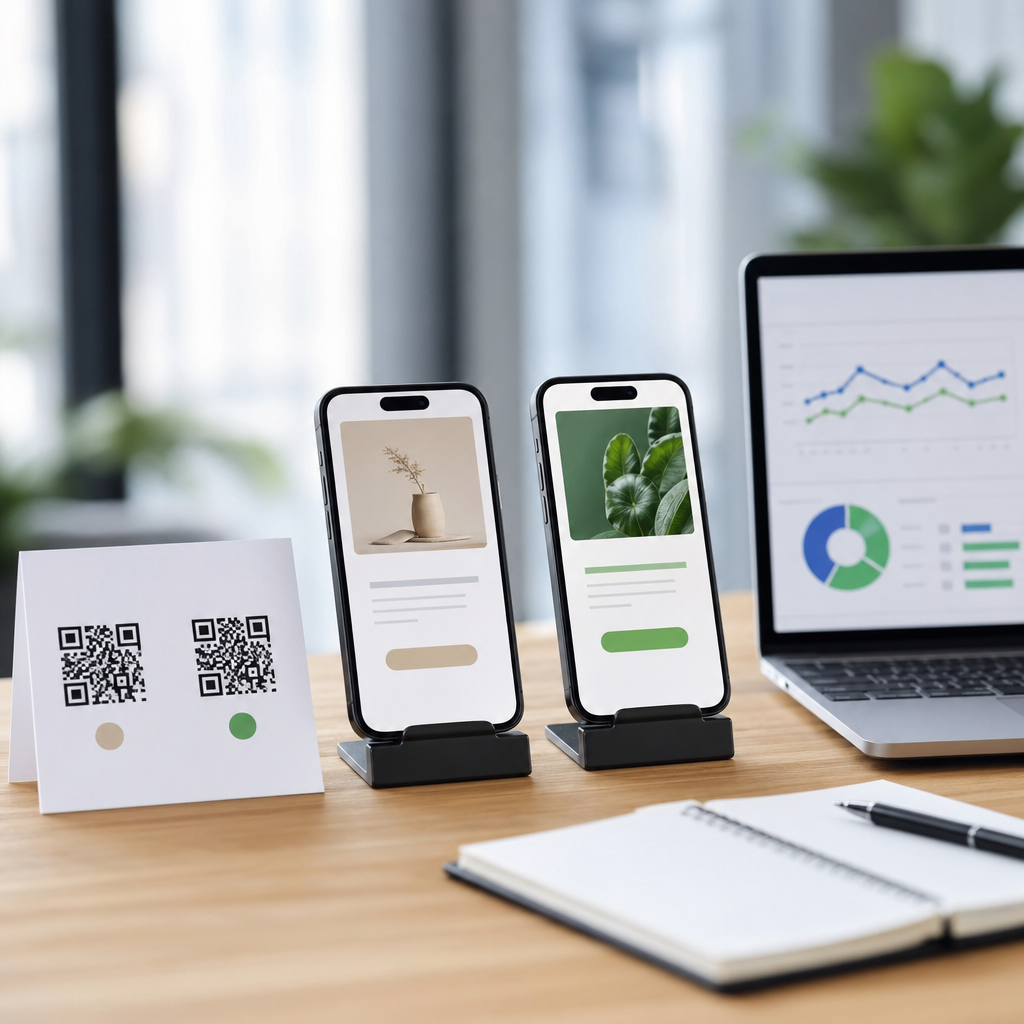
How long should you run QR code tests? In practice, long enough to reach a reliable decision, but not so long that seasonality, channel changes, or creative fatigue distort the result. For teams working on QR code analytics, tracking, and optimization, that answer needs precision. A QR code test is a controlled comparison between two or more versions of a code, destination, placement, call to action, or surrounding creative, measured by scans and downstream actions such as sessions, form fills, purchases, or app installs. The goal is not simply to see which code gets more scans. The goal is to identify the version that improves business outcomes while preserving measurement quality.
I have run QR campaigns across packaging, direct mail, out-of-home, retail signage, and event environments, and the same mistake appears repeatedly: teams stop too early after seeing an initial lift, or they leave a weak test running so long that the business misses an easy win. Duration matters because QR traffic is unusually sensitive to context. Scan behavior changes by daypart, foot traffic, weather, placement, mobile connectivity, and audience intent. A poster in a commuter station behaves differently on Monday morning than on Saturday afternoon. A package insert may accumulate scans slowly for weeks. A restaurant table tent can produce a lunch peak and a dinner peak every day.
That is why a hub article on A/B testing QR codes must start with test length. If you choose the wrong duration, every later decision about design, landing pages, offers, and attribution becomes less trustworthy. This guide explains how to determine the right run time, what minimum conditions should be met before calling a winner, which metrics matter most, and how to structure QR code experiments so results hold up in the real world. It also serves as a foundation for deeper work on QR code scan rate, conversion tracking, dynamic code management, and campaign reporting.
The short answer is that most QR code tests should run for at least one full business cycle and until they hit a pre-set sample threshold. For some campaigns, that means seven days. For others, especially packaging or lower-volume retail placements, it may mean several weeks. The right length depends on traffic volume, baseline conversion rate, expected lift, number of variants, and external volatility. Instead of choosing a calendar date first, smart teams define the decision rule first. Then they let the test run until the rule is satisfied.
What determines QR code test duration
QR code test duration is driven by four variables: exposure volume, scan rate, conversion rate, and the minimum detectable effect. Exposure volume is how many people realistically encounter the code. Scan rate is the percentage who scan after exposure. Conversion rate is the percentage who complete the target action after scanning. The minimum detectable effect is the smallest change worth acting on, such as a 10 percent lift in scans or a 15 percent lift in completed purchases. Higher traffic and bigger expected differences reduce the time required. Lower traffic and smaller expected differences extend it.
For example, imagine a retail endcap sign seen by 20,000 shoppers per week. If 1.5 percent scan, that produces 300 scans weekly. If 12 percent of scanners redeem an offer, you get 36 conversions per week. A test comparing two headlines may reach a decision in one to two weeks if the uplift is large. Now compare that with a B2B trade show leave-behind card distributed to 800 attendees, where only 4 percent scan and 20 percent book a demo. That is 32 scans and roughly 6 conversions. The same test may need several events or a longer aggregate period before any conclusion is defensible.
Environment matters just as much as math. Static packaging often has a long tail because products sit on shelves and in homes before anyone scans. Out-of-home media can vary sharply by weather, transit disruptions, and local events. Direct mail produces a burst after delivery, then a taper. In-store signage reflects weekday versus weekend traffic. If your QR code test runs across these contexts, the duration must be long enough to capture typical variation. Otherwise, you are not measuring the code or creative. You are measuring an unrepresentative slice of demand.
Use a minimum run window and a sample threshold
The most reliable way to answer how long should you run QR code tests is to use two gates at once: a minimum time window and a minimum sample threshold. The time window protects against day-of-week and daypart bias. The sample threshold protects against random noise. In my work, I rarely recommend ending a QR code A/B test before seven full days unless traffic is extraordinarily high and user behavior is stable across the week. For lower-volume channels, 14 to 28 days is common. But the calendar alone is not enough. You also need enough scans and enough downstream conversions to support a meaningful comparison.
A practical rule is to wait until each variant has at least 100 to 200 scans for top-of-funnel decisions and a healthy number of final conversions for bottom-of-funnel decisions. If the true business goal is purchase, lead submission, or app install, do not call the test on scans alone. Scans can rise while conversion quality falls. I have seen a stronger call to action increase scans by 30 percent but lower purchase completion because it attracted curiosity clicks instead of qualified intent. The winning QR code is the one that improves the metric that matters to revenue or pipeline, not the vanity metric that arrives first.
Another safeguard is to predefine the maximum run time. If a test cannot reach the required sample after a realistic period, the experiment may be underpowered. That is not a failure of analytics; it is a signal to simplify. Reduce the number of variants, increase exposure, or test a bigger change. Tiny creative differences on low-volume QR placements often waste time because the signal is too small to separate from the noise.
Recommended durations by QR channel
Different channels create different scanning patterns, so duration guidance should reflect where the code appears and how audiences interact with it.
| QR channel | Typical scan pattern | Suggested minimum test length | Primary caution |
|---|---|---|---|
| In-store signage | Daily peaks, weekend variation | 7 to 14 days | Store traffic shifts and promo timing |
| Direct mail | Strong delivery spike, then taper | 14 to 21 days | Postal timing and batch delivery differences |
| Product packaging | Slow accumulation, long tail | 21 to 42 days | Inventory turnover and household delay |
| Out-of-home posters | Location and weather sensitive | 14 to 28 days | Foot traffic volatility |
| Event materials | Compressed burst during event | Full event plus follow-up window | Lead quality may lag initial scans |
| Restaurant tables or menus | Meal-period repetition | 7 to 14 days | Lunch and dinner audiences differ |
These ranges are not arbitrary. They reflect the need to capture a representative usage cycle. A restaurant QR code test should include both weekdays and weekends. A direct mail test should account for staggered household delivery. A packaging test often needs several weeks because scans happen after purchase, not only at the shelf. When teams ask for a universal answer, I tell them there is none. There is only an answer that matches the mechanics of the channel.
How to know when a QR code test has enough data
A QR code test has enough data when three conditions are met. First, each variant has sufficient exposure and scans to reduce volatility. Second, the primary conversion metric has enough volume to compare outcomes with confidence. Third, the observed lift is stable over multiple days rather than swinging wildly with each new batch of scans. Stability is underrated. If variant B leads on Monday, loses on Tuesday, and leads again on Wednesday, the test is not mature. If B holds its advantage across several reporting intervals and the final conversion rate also supports it, you are much closer to a valid decision.
Use standard experimentation tools where possible. Google Analytics 4, Adobe Analytics, Mixpanel, Amplitude, and dedicated testing platforms can track sessions and conversions after scans, while dynamic QR code platforms record scan counts, timestamps, device types, and geographies. UTMs should be consistent across variants except for the parameter that identifies the test version. Without clean tagging, you cannot connect scan behavior to landing-page performance or revenue. I also recommend server-side event validation for high-value actions, because mobile browser privacy settings and app handoffs can create gaps if measurement relies only on client-side scripts.
Do not ignore practical significance. A statistically reliable lift of 2 percent may not justify reprinting packaging, replacing store materials, or updating every field asset. On the other hand, a 12 percent gain in completed checkouts usually deserves action even if the scan-rate increase looks modest. The right decision threshold combines confidence, business value, and implementation cost.
Common mistakes that make QR code tests run too short or too long
The first mistake is peeking too often and declaring a winner as soon as one variant looks ahead. Early results are noisy, especially when scan counts are low. The second mistake is changing other campaign elements mid-test. If you alter the landing page, offer, media placement, or targeting while the QR code variants are running, you no longer have a clean experiment. The third mistake is splitting traffic across too many versions. Testing four or five QR variants at once may sound efficient, but in low-volume environments it only delays learning.
Another common error is optimizing the wrong layer. Teams may test QR code color or frame style when the true constraint is the landing page load time, the incentive, or the placement height. In field audits, I have seen scan rates improve more from moving a code from knee height to chest height than from any design change inside the code itself. Likewise, adding a simple instruction such as “Scan for today’s menu” can outperform a purely visual refresh. If the dominant friction lies outside the code, the test will drag on without producing useful clarity.
Running too long creates its own problems. Audience composition can change, promotions expire, inventory fluctuates, and competitors launch new offers. After a point, extended duration reduces internal validity. If your code test started before a holiday period and ends after it, the demand context may be too different to compare cleanly. This is why predefining stop rules matters. End the test when the decision criteria are met or when the environment changes enough to require a fresh experiment.
Best practices for A/B testing QR codes effectively
Start with one meaningful hypothesis. For example: adding a benefit-led call to action under the QR code will increase completed sign-ups because users know exactly what they will get after scanning. Then isolate the variable. Keep placement, destination, and offer constant if you are testing the call to action. If you need to test the landing page too, run that separately unless your traffic is high enough for a factorial design.
Use dynamic QR codes during testing whenever possible. They let you preserve the printed asset while changing destinations, tagging variants, and monitoring scans in real time. Track scan-through rate, landing-page engagement, and final conversion. If your business has offline outcomes, such as in-store redemption or assisted sales, connect QR identifiers to POS or CRM records. This is where QR code analytics becomes genuinely useful. It moves from counting scans to measuring business impact.
Document the test setup carefully. Record placement details, dates, creative files, print runs, geographies, and any operational anomalies. When a variant wins, note why you believe it won. Over time, this creates an optimization memory that makes future QR code tests faster and more accurate. Finally, publish the winner thoughtfully. Validate it in another cohort or location if the rollout cost is significant. Replication is one of the strongest protections against acting on a false positive.
Conclusion: the right duration is the one that supports a trustworthy decision
So, how long should you run QR code tests? Run them until they cover a full behavior cycle, reach the required sample, and produce stable results on the metric that matters most. For many campaigns that means seven to fourteen days. For direct mail, packaging, and lower-volume placements, it often means several weeks. The exact number is less important than the discipline behind it: define the hypothesis, set the stop rules, tag everything correctly, and judge success on downstream outcomes rather than scans alone.
As the hub for A/B testing QR codes, this guidance should shape every related decision you make under QR code analytics, tracking, and optimization. Better duration choices lead to cleaner attribution, smarter creative updates, and more profitable rollouts. If you are planning your next QR experiment, start by estimating volume, deciding your minimum detectable lift, and choosing a run window that reflects the channel. Then let the data mature before you act. That is how QR testing becomes a repeatable growth practice instead of a guessing exercise.
Frequently Asked Questions
How long should you run a QR code test before making a decision?
You should run a QR code test until you have enough data to make a reliable decision, not until you hit an arbitrary number of days. In practical terms, that means letting the test collect enough scans and downstream conversions to reduce the chance that the winner is just random noise. For many teams, the right duration depends on scan volume, conversion rate, and how large a performance difference they are trying to detect between variants. A high-traffic QR code placed on packaging, signage, or direct mail with strong response volume may reach a decision quickly, while a lower-volume test may need considerably longer.
At the same time, there is a point where running a test too long becomes counterproductive. If a test stretches on for weeks or months, outside factors can begin to influence the result. Seasonality, campaign changes, media shifts, audience mix, promotions, and creative fatigue can all change behavior independently of the QR code variation you are testing. That is why the best rule is to run the test long enough to reach statistical confidence and practical confidence, but short enough to keep external conditions reasonably stable. For many use cases, that often means at least one full business cycle or customer behavior cycle, but not so long that the environment has materially changed.
A good decision framework is to define your stopping criteria before the test starts. Specify the primary metric, the minimum sample size, the confidence threshold, and the minimum detectable effect that would justify implementation. Once those conditions are met, review whether the result is both statistically meaningful and operationally useful. If one version wins by a tiny margin that does not matter to revenue, lead quality, or user experience, you may choose not to declare a practical winner even if the math says the difference is real.
What metrics should determine whether a QR code test has run long enough?
The first metric is usually scan volume, because scans represent the top of the funnel and tell you whether people are engaging with the QR code at all. However, scans alone are rarely enough to evaluate a test properly. A QR code may generate a higher number of scans but produce lower-quality traffic, weaker on-site engagement, fewer form fills, fewer purchases, or lower revenue per visitor. That is why strong QR code testing programs look at both the scan event and the downstream actions that matter to the business.
In most cases, your primary metric should be tied to the actual objective of the campaign. If the goal is awareness, scans or landing page sessions may be appropriate. If the goal is lead generation, form submissions or qualified leads are better. If the goal is ecommerce performance, purchases, conversion rate, revenue per scan, or average order value may be more useful. If the QR code is part of a multistep experience, you may also want to monitor bounce rate, page depth, time on site, click-through to the next step, or assisted conversions. A test has run long enough when the primary metric has enough volume to support a reliable comparison and the supporting metrics do not reveal hidden tradeoffs.
It is also important to distinguish between leading and lagging metrics. Scans happen immediately, but form fills, purchases, or offline follow-up conversions may occur later. If you stop the test the moment scans look favorable, you may miss the fact that one variant generates lower-quality traffic. For that reason, many teams use scans as an early directional signal but wait for downstream conversions to mature before making a final call. The more delayed your conversion path, the longer your observation window needs to be.
Can you end a QR code test too early, even if one version looks like the winner?
Yes, ending a test too early is one of the most common mistakes in QR code optimization. Early in a test, performance often swings dramatically because the sample size is still small. One version may appear to be far ahead after the first day or two, only for the gap to shrink or reverse once more scans and conversions accumulate. This is especially true when conversion rates are low or when traffic quality varies by day, placement, audience segment, or device type.
The danger of stopping early is that you may act on a false positive. That can lead you to roll out a version that does not actually perform better and may even underperform over time. It also creates inconsistency in your testing process, because decisions are then driven by impatience rather than a predefined standard. The best protection is to establish clear stopping rules before launch: a minimum number of scans, a minimum number of conversions, a target confidence level, and ideally a requirement to cover a full pattern of audience behavior such as weekdays and weekends or the full duration of a print or in-store exposure cycle.
Another reason not to stop too soon is attribution delay. People may scan a QR code immediately but convert later after revisiting the site, reading more information, or discussing the offer internally. If one variant attracts more thoughtful, higher-intent visitors, it may look weaker on same-day results but stronger over a longer conversion window. For authoritative testing, it is better to allow enough time for delayed outcomes to appear than to crown a winner based only on the fastest observable metric.
How do seasonality, channel changes, and creative fatigue affect QR code test duration?
These factors can distort results if a test runs too long. Seasonality changes user behavior over time, sometimes dramatically. A QR code campaign that begins during a high-interest promotional period and continues into a quieter period may see shifts in scan rate and conversion rate that have nothing to do with the tested variable. The same is true for day-of-week patterns, monthly budgeting cycles, holidays, weather, events, or industry-specific buying windows. If your audience behavior changes significantly across time, your test duration has to account for that pattern without stretching so long that the environment becomes unstable.
Channel changes create another problem. If the QR code appears in multiple environments, such as packaging, print ads, retail displays, emails, or out-of-home placements, the traffic mix can shift as campaigns are launched, paused, or reallocated. A test that starts with mostly retail exposure and ends with mostly direct mail exposure is no longer a clean comparison unless those distributions are balanced across variants. That is why teams should either hold channel conditions steady during the test or segment the analysis by source so they can see whether the result is consistent within each channel.
Creative fatigue matters because the surrounding context of the QR code can lose effectiveness over time. Audiences may respond strongly to a fresh call to action or design at first, then gradually ignore it as novelty wears off. If a test runs long enough for fatigue to emerge, the measured result may reflect declining audience attention rather than the true advantage of one QR code variation. The solution is not simply to shorten every test, but to choose a test window that is long enough for reliable data while remaining short enough to preserve comparability. In practice, that often means planning the test around a stable campaign period and monitoring whether exposure conditions remain materially similar from start to finish.
What is a practical testing framework for deciding the right QR code test length?
A practical framework starts before launch. First, define the exact variable you are testing, such as QR code design, destination URL, landing page, placement, call to action, incentive, or adjacent creative. Then identify one primary success metric and a small set of secondary metrics. Next, estimate your baseline scan rate and conversion rate so you can calculate how much traffic and how much time you will likely need to detect a meaningful difference. If your current response volume is low, you may need to increase distribution or simplify the test rather than just wait longer.
Second, set pretest rules. Decide the minimum sample size, the confidence threshold, the minimum detectable lift you care about, and the observation window for delayed conversions. Also define exclusions and segmentation rules in advance, such as whether internal scans, bot traffic, duplicate scans, or certain geographies should be filtered out. This step is essential because clean measurement determines how trustworthy the test duration really is. A long test with poor tracking is still a poor test.
Third, run the test through a complete behavior cycle while keeping conditions as stable as possible. For some teams, that means including both weekdays and weekends. For retail or event-driven activations, it may mean covering the full promotional period. For print or packaging, it may mean waiting until enough exposure has occurred in market to generate a representative sample. During the run, monitor data quality and major anomalies, but avoid repeatedly checking for an excuse to stop early.
Finally, evaluate both reliability and usefulness. Ask whether the winning variant has enough evidence behind it, whether the lift is large enough to matter, whether the result is consistent across important segments, and whether any external change may have biased the outcome. If the answer is yes, stop the test and implement the winner. If not, either continue until the preplanned threshold is reached or redesign the experiment so it can produce a clearer answer. The most effective QR code testing programs are disciplined: they do not rely on gut feel about duration, but on a repeatable method that balances speed, accuracy, and business relevance.