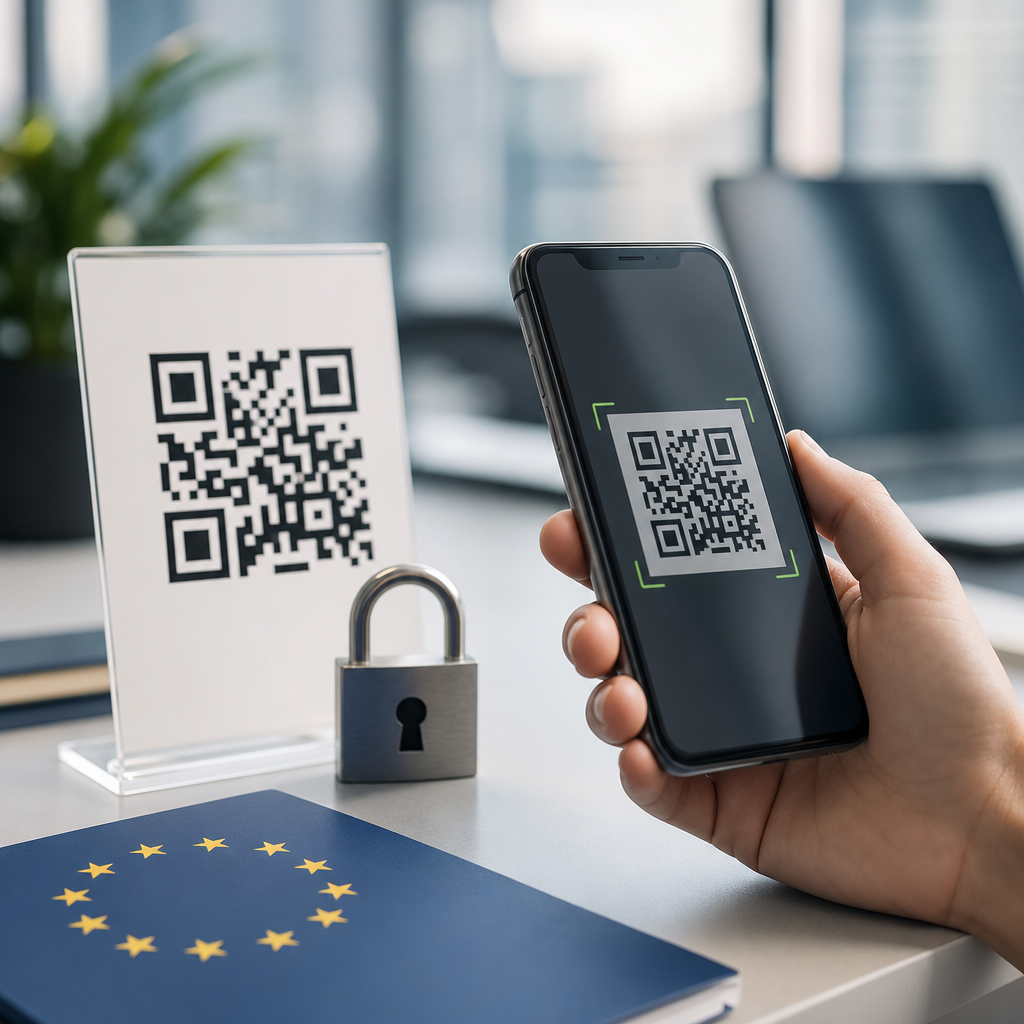
QR codes can be GDPR compliant, but only when the full data flow behind the code is designed, documented, and governed in line with European privacy law. A QR code is simply a machine-readable symbol that stores data or points a scanner to a destination, usually a URL. GDPR, the General Data Protection Regulation, applies when scanning that code leads to the collection, transmission, storage, or analysis of personal data relating to an identified or identifiable person. In practice, that means the printed square itself is rarely the compliance problem. The real issue is what happens before the scan, during the redirect, and after the landing page loads.
I have worked on QR code campaigns for retail packaging, event check-in, restaurant menus, and regulated consent workflows, and the same misunderstanding appears repeatedly: teams treat the code as a neutral object and ignore the surrounding processing. If a QR code opens a static PDF with no tracking, no cookies, no device fingerprinting, and no collection of names, emails, or identifiers, GDPR risk may be low. If the scan triggers analytics, personalized redirects, geolocation, CRM enrichment, or retargeting pixels, GDPR obligations become immediate and specific.
This matters because QR codes now sit at the intersection of offline and digital behavior. They connect a poster, package, badge, or invoice to a web experience that often captures IP addresses, timestamps, user agents, campaign parameters, and form submissions. Those data points can be personal data under GDPR, especially when combined. Organizations also use dynamic QR platforms that log scan events, create user profiles, and integrate with marketing automation tools. That convenience improves measurement, but it raises questions about lawful basis, transparency, vendor contracts, cross-border transfers, retention, and security.
For a business building a privacy-conscious QR strategy, the right question is not whether QR codes are legal. The right question is: under what conditions is a QR code deployment compliant, proportionate, and defensible? The answer depends on purpose, architecture, and governance.
When GDPR applies to QR codes
GDPR applies whenever a QR code workflow processes personal data in the context of an establishment in the European Economic Area, or targets people in the EEA. Personal data includes obvious identifiers such as names and email addresses, but it also includes online identifiers like IP addresses and cookie IDs where they can relate to a person. If your QR code opens a website that places analytics cookies, logs an IP address, or pre-fills a form with a unique token tied to an individual, you are processing personal data.
A useful rule is to map the scan journey end to end. Start with the printed code or digital display. Then identify the encoded content, such as a direct URL or short redirect. Next, review the landing domain, the hosting provider, any analytics tags, consent management platform, embedded media, forms, chat widgets, and downstream integrations with systems like Salesforce, HubSpot, Mailchimp, or Microsoft Dynamics. Each component can change the compliance analysis.
Consider three common examples. A museum uses a QR code beside an exhibit to open a static information page with server logs retained briefly for security. That may rely on legitimate interests with minimal privacy impact. A restaurant uses QR codes for menu access but loads Google Analytics 4 and Meta Pixel before consent. That creates cookie and transparency issues. An employer issues individualized QR badges for attendance and links scans to employee records. That is much more intrusive and requires a clear lawful basis, strict access controls, and a documented necessity assessment.
The central point is simple: GDPR usually applies not because of the black-and-white pattern itself, but because QR codes act as a gateway into data processing operations.
What personal data a QR code campaign can collect
Many teams underestimate the amount of personal data generated by a scan. Even without a visible form, a web server commonly receives an IP address, date and time, referrer, requested resource, browser details, and operating system information. A dynamic QR service may additionally log scan counts, approximate location inferred from IP, device type, language, and campaign source. If the destination includes UTM parameters tied to a customer segment or a unique identifier in the URL, that scan can become attributable very quickly.
Once a user lands on a page, the data footprint often expands. Consent banners may create consent records. Analytics tools may set client IDs. Marketing platforms may capture email addresses, lead source, pages viewed, or purchase behavior. Event registration forms may request name, company, dietary needs, and job title. In healthcare, hospitality, education, and employment contexts, the data can become sensitive even if the QR code looked harmless on the surface.
It helps to separate direct and indirect identifiers. Direct identifiers include data fields such as a name, phone number, membership number, or employee ID. Indirect identifiers include IP addresses, cookie IDs, or a unique QR token that becomes identifying when linked with another database. Under GDPR, both categories matter. So does purpose limitation: collecting broad analytics from a simple informational scan is harder to justify than collecting only what is necessary to deliver the requested content.
| QR code use case | Typical data collected | Main GDPR concern |
|---|---|---|
| Restaurant menu | IP address, device data, analytics cookies | Consent for non-essential tracking |
| Event check-in | Name, ticket ID, timestamp, location | Lawful basis and access control |
| Product packaging | Scan metrics, geolocation by IP, CRM linkage | Transparency and profiling |
| Employee workflow | Staff ID, attendance records, device logs | Necessity and power imbalance |
| Healthcare intake | Contact details, appointment data, health context | Special category safeguards |
This is why data minimization should be your default design principle. If the business goal is content delivery, avoid collecting data that exists only because a vendor turned on tracking by default.
Lawful basis, transparency, and consent requirements
To make QR codes GDPR compliant, you need a lawful basis for each processing purpose. The basis for delivering the requested page may differ from the basis for analytics, retargeting, or follow-up marketing. Consent is often required for non-essential cookies and similar tracking under ePrivacy rules, which operate alongside GDPR. Legitimate interests may support limited server logging for security, fraud prevention, or basic service delivery, but that basis is not a free pass for behavioral advertising.
Transparency starts before the scan whenever possible. If a printed code on packaging says only “Scan me,” users have no clue whether they are opening a static page or entering a tracked lead funnel. Better practice is to add a short disclosure near the code, such as “Scan to view product instructions” or “Scan to register; privacy notice applies.” The landing page should then provide layered notice: a concise explanation up front and a full privacy notice accessible immediately.
Where consent is needed, it must be specific, informed, freely given, and recorded. Pre-ticked boxes, bundled consent, or trackers firing before user choice undermine compliance. I have seen brands print QR codes on event signage, then route users through pages that loaded five marketing tags before the banner displayed. That is a preventable failure. A consent management platform should block non-essential scripts until the user opts in, and the banner language must match the actual processing.
Individualized QR codes deserve special attention. If a code is unique to a customer, patient, or employee, you may not be able to rely on implied understanding. The notice should explain what the identifier does, how long logs are kept, who receives the data, and whether scans contribute to profiling, attendance, loyalty scoring, or service personalization.
Controllers, processors, vendors, and international transfers
Most QR code programs involve multiple parties, and compliance depends on assigning roles correctly. The organization deciding why the QR code exists and what data will be collected is usually the controller. The QR code generator platform, hosting provider, analytics vendor, CRM provider, and email platform are often processors, though some analytics or ad platforms may act as independent controllers for their own purposes. You cannot manage compliance well if contracts and role descriptions are vague.
At minimum, controllers should maintain a record of processing activities, sign data processing agreements where required, and vet vendors for security and transfer risk. If a QR platform stores scan logs in the United States or allows support access from outside the EEA, you need to assess international transfers. Since Schrems II, transfer impact assessments and supplementary measures matter when personal data moves to jurisdictions with different surveillance laws. Standard Contractual Clauses remain common, but they are not enough if the practical risk has not been examined.
Vendor due diligence should cover sub-processors, log retention, encryption, access management, breach notification timelines, and deletion support. Ask whether scan analytics can be anonymized or aggregated, whether IP truncation is available, whether custom domains are supported, and whether redirect logs can be disabled. Tools differ sharply. Some enterprise QR management platforms prioritize governance features, while low-cost generators often provide little visibility into data handling.
Internal linking across your broader security and privacy resources should support procurement teams here: one page on vendor assessments, another on cookie compliance, another on data retention. As a hub topic, QR code GDPR compliance only works when connected to those operational controls.
Privacy by design for QR code deployments
The most reliable path to compliance is privacy by design. In QR code projects, that means building the experience so the least amount of personal data is processed for the shortest necessary time, with the strongest practical safeguards. Start by deciding whether you need a dynamic QR code at all. Dynamic codes are useful because they allow destination changes and scan reporting, but they also introduce an intermediary service and more logging. If a static code meets the business need, it can significantly reduce complexity.
Next, use destination pages that are lean by default. Remove unnecessary third-party scripts. Delay marketing tags until consent. Prefer first-party analytics configurations with reduced retention and no ad personalization. Configure server logs for security rather than marketing insight. If collecting form data, limit fields to what is necessary. Do not ask for a date of birth or phone number if an email address alone is enough.
Security controls are equally important. Use HTTPS everywhere, including redirects. Protect admin accounts for QR management platforms with multifactor authentication. Restrict who can edit destinations, because a compromised code can become both a privacy incident and a phishing vector. In sectors with high risk, sign destination URLs, use allowlists, and monitor for unexpected redirect changes. If a QR code is printed permanently on packaging or equipment, maintain a change-control process because that code may remain active for years.
Data protection impact assessments are not required for every campaign, but they are appropriate where scans are systematic, large scale, or tied to sensitive contexts. Employee monitoring, health-related workflows, child-focused services, and location-heavy profiling are strong candidates for formal assessment.
Common compliance mistakes and how to avoid them
The first common mistake is assuming a QR code is anonymous because no form appears on the first page. Server logs, analytics cookies, and ad tags can still make the scan personal data processing. The second mistake is failing to disclose the destination clearly. Users should know what they are scanning and why. The third is over-collecting through default settings in tools such as Google Tag Manager, Meta Pixel, Hotjar, or broad CRM forms.
A fourth mistake is reusing one code for incompatible purposes. For example, a code first introduced for warranty information may later be repurposed for promotional tracking without updating notices or consent mechanisms. A fifth is retaining scan logs indefinitely. GDPR requires storage limitation. Retention periods should be defined by purpose, documented, and technically enforced where possible.
Another recurring problem is weak governance over printed assets. Teams distribute QR codes across packaging, posters, invoices, and trade-show booths, then forget where each code points. Months later, links redirect to expired domains, vendor placeholders, or pages with outdated privacy terms. Maintain an inventory of every active code, its owner, destination, purpose, lawful basis, and retirement date.
Finally, do not ignore data subject rights. If scans are linked to individuals, your systems must support access, deletion, correction, objection, and restriction requests where applicable. If you cannot find a person’s scan records across vendors and platforms, your compliance posture is weaker than it appears.
A practical GDPR checklist for QR code programs
Use a simple operational checklist. Define the purpose of the QR code. Identify all data collected from scan to storage. Determine the lawful basis for each purpose. Publish a clear, accessible privacy notice. Implement consent for non-essential tracking. Review vendors and sign processor agreements. Assess international transfers. Minimize fields, cookies, and retention. Secure redirects, admin access, and hosting. Document everything in your processing records and update materials when the purpose changes.
For mature teams, add governance routines: quarterly audits of active codes, tag reviews on landing pages, penetration testing for high-risk destinations, and legal review for individualized or sensitive use cases. Also train marketing, events, and packaging teams. Most QR privacy failures are not malicious; they happen because one department launches quickly and assumes another has handled compliance.
So, are QR codes GDPR compliant? Yes, when they are treated as part of a controlled data processing system rather than a simple graphic. Compliance depends on what the scan does, what data it triggers, which vendors are involved, and whether users receive honest notice and real choice. Organizations that map the data flow, minimize collection, govern vendors, and secure the redirect chain can use QR codes effectively without creating avoidable privacy risk.
If you manage QR campaigns, audit your current codes today. Review every destination, every tracker, every vendor, and every notice. That one exercise will reveal whether your QR strategy supports privacy by design or merely assumes it.
Frequently Asked Questions
Are QR codes themselves covered by GDPR?
A QR code on its own is not automatically a GDPR issue. It is simply a machine-readable symbol that stores information or directs a device to a destination, often a webpage, app, form, or download. GDPR becomes relevant when scanning that code results in the collection, use, transmission, storage, or analysis of personal data. That can include obvious identifiers such as names, email addresses, phone numbers, and customer IDs, but it can also include online identifiers like IP addresses, device data, location information, or tracking data tied to an individual.
In other words, the legal question is not just “Is there a QR code?” but “What happens after someone scans it?” If the scan opens a landing page with analytics, a registration form, a payment page, a loyalty program, a check-in system, or a personalized account area, then GDPR may apply because personal data is likely being processed somewhere in that workflow. Even a static QR code that contains personal data directly, such as a digital business card or health-related identifier, can raise GDPR concerns if it reveals information about an identifiable person.
The safest way to think about compliance is to evaluate the full data chain behind the code. That includes the destination URL, any redirects, cookies and tracking technologies, CRM integrations, third-party processors, hosting arrangements, retention periods, and security controls. A QR code can absolutely be used in a GDPR-compliant way, but compliance depends on the surrounding system design, not the visual code itself.
When does scanning a QR code count as personal data processing under GDPR?
Scanning a QR code counts as personal data processing when the action leads to data about an identified or identifiable person being collected or handled in any way. Under GDPR, “processing” is interpreted very broadly. It includes collecting, recording, organizing, storing, adapting, retrieving, sharing, analyzing, and deleting personal data. That means the threshold is lower than many businesses expect.
For example, if a QR code directs users to a form where they submit their contact details, the processing is obvious. But processing can also occur more indirectly. If the landing page captures IP addresses, uses analytics tools, drops advertising cookies, logs device identifiers, records event attendance, connects scan behavior to a customer profile, or tracks employee or visitor movement, that is still personal data processing. If the QR code is unique to a particular user, campaign recipient, product purchaser, or ticket holder, then the scan itself may be traceable back to a person and therefore fall within GDPR.
Context matters as well. A generic QR code linking to a plain informational page with no tracking may involve little or no personal data risk. By contrast, a personalized QR code used for patient intake, workplace access, event admission, discount redemption, or customer authentication is much more likely to trigger GDPR obligations. In these situations, organizations need to identify a lawful basis for processing, provide clear privacy information, limit data collection to what is necessary, secure the data appropriately, and document how the system operates. The scan is often just the first step in a broader regulated process.
What makes a QR code workflow GDPR compliant in practice?
A GDPR-compliant QR code workflow is built around privacy by design rather than added as an afterthought. The first step is understanding exactly what the code does. Does it open a public webpage, prefill a form, identify a user, trigger tracking, connect to an internal system, or transfer information to vendors? Once that mapping is complete, the organization should determine whether personal data is involved, what categories of data are being processed, who has access to it, how long it is retained, and where it is stored.
Compliance in practice usually includes several core elements. You need a valid lawful basis for the processing, such as consent, contract, legitimate interests, legal obligation, or another basis recognized by GDPR. You need a privacy notice that explains what data is collected, why it is collected, how it is used, who receives it, and what rights individuals have. You should apply data minimization, meaning the QR code process should collect only the personal data necessary for the specific purpose. Security is also essential, including HTTPS, secure hosting, access controls, encryption where appropriate, and controls over any third-party integrations.
Organizations should also think about accountability. That means documenting decisions, maintaining records of processing activities where required, vetting processors, signing data processing agreements, and assessing international data transfers if vendors are outside the European Economic Area. In higher-risk scenarios, such as health, employee monitoring, or large-scale behavioral tracking, a Data Protection Impact Assessment may be necessary. If cookies or similar technologies are used on the destination page, ePrivacy rules and cookie consent requirements may also apply in addition to GDPR. The most compliant approach is not simply creating a QR code, but governing the entire user journey that begins with the scan.
Do you need consent to use QR codes under GDPR?
Not always. One of the most common misunderstandings is that GDPR always requires consent whenever a QR code is involved. In reality, consent is only one possible lawful basis for processing personal data. Whether you need it depends on what the QR code leads to and why the data is being processed. For example, if a QR code is used to let a customer access a digital receipt they requested, contract may be the appropriate legal basis. If a QR code supports a legally required check-in process, legal obligation could apply. In some limited cases, legitimate interests may be appropriate, provided those interests are balanced against the individual’s rights and expectations.
Consent is more likely to be required when the scan triggers optional tracking, marketing communications, or non-essential cookies and analytics, especially where users have a real choice and the activity is not necessary to deliver the core service. If the destination page uses advertising technologies or collects data for profiling, relying on consent may be the safest route. Consent must be freely given, specific, informed, and unambiguous, and it must be as easy to withdraw as it is to give.
The key point is that businesses should choose the lawful basis before deployment, not afterward. They should avoid bundling unnecessary data collection into a QR code experience and should clearly separate essential functions from optional tracking or marketing features. A well-designed QR code flow tells users what will happen when they scan, limits hidden processing, and only asks for consent where the law actually requires it. That is both better for compliance and better for user trust.
What are the biggest GDPR risks businesses should watch for when using QR codes?
The biggest risks usually come from invisible or poorly documented data flows rather than from the QR code itself. A common problem is assuming the code is harmless because it only contains a URL, while overlooking the fact that the destination page may run analytics scripts, collect identifiers, store logs, use marketing pixels, or send data to multiple third parties. If those activities are not disclosed properly or lack a valid legal basis, the organization may face GDPR compliance problems very quickly.
Another major risk is embedding personal data directly into the QR code or using unique codes that can be linked to individuals without proper safeguards. For example, a QR code on a ticket, ID badge, prescription, loyalty card, or product packaging might expose customer, employee, or patient information if scanned by unauthorized parties. Poor access controls, excessive retention, unsecured redirects, and weak vendor oversight can all create avoidable legal and security exposure. If a code links to systems involving special category data, such as health information, the stakes are even higher.
Businesses should also be careful with transparency and user expectations. If people scan a code for a simple purpose, such as viewing a menu or downloading instructions, they may not expect extensive tracking or profiling. That mismatch can undermine the fairness and lawfulness of the processing. To reduce risk, organizations should conduct a full review of the scan journey, minimize data collection, secure every endpoint, update privacy notices, assess cookies and third-party tools, and regularly test whether the implementation still matches the documented purpose. In short, the main GDPR risk is not the symbol people scan, but the hidden data ecosystem behind it.