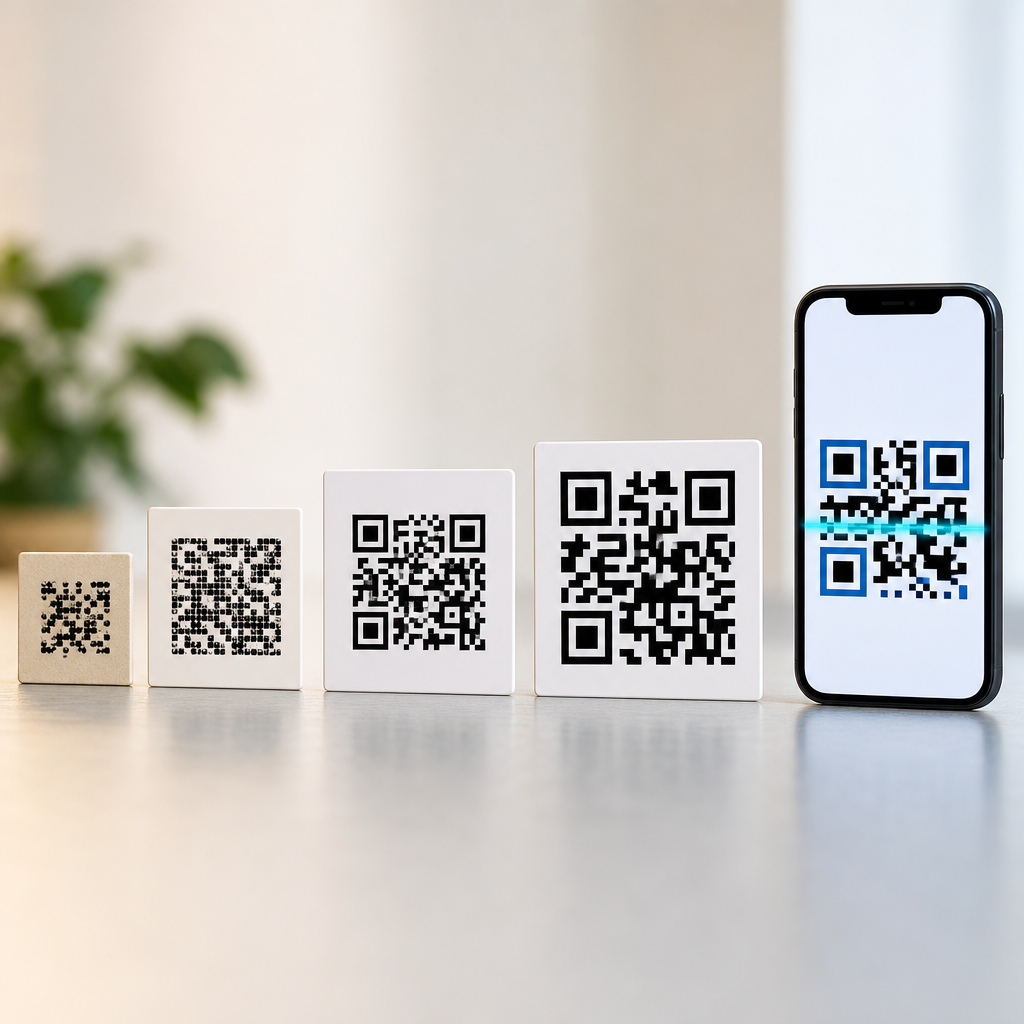
A static QR code is a QR code whose encoded destination or data is fixed the moment it is generated and cannot be edited later. If the code contains a URL, phone number, Wi-Fi credential, email draft, or plain text, that exact payload is permanently embedded in the pattern of black and white modules. I explain this distinction early when advising teams on QR code campaigns because it determines everything that follows: flexibility, analytics, lifespan, printing decisions, and cost. For anyone learning QR code basics, understanding static vs dynamic QR codes is foundational, not optional.
The term QR stands for Quick Response, a two-dimensional barcode format created by Denso Wave in 1994 for high-speed scanning. Unlike a traditional one-dimensional barcode, a QR code can store more data both horizontally and vertically. That extra capacity allows it to hold web links, contact cards, SMS prompts, app links, payment strings, and more. Yet the most practical decision most users face is simpler: should the data live directly inside the code, or should the code point to a managed redirect that can be changed later? That is the core difference between static and dynamic QR codes.
This matters because QR codes often bridge the physical and digital worlds in durable places: packaging, menus, signage, brochures, labels, mailers, business cards, museum placards, and product manuals. Once printed, distributed, or installed, changing them can be expensive or impossible. I have seen organizations print tens of thousands of inserts with a static URL, only to redesign the landing page structure and break campaign attribution. I have also seen small businesses overpay for dynamic tools when a static code would have handled the job perfectly for years. Choosing correctly means matching the code type to the operational reality behind it.
In plain terms, a static QR code is best when the information will not change and when you do not need scan tracking from the QR platform itself. A dynamic QR code is best when you may need to update the destination, collect scan analytics, manage campaigns, rotate links, or disable a code after a promotion ends. This article serves as the central guide for the topic, covering how static QR codes work, where they excel, where they fail, how they compare with dynamic QR codes, and how to decide which approach belongs in your broader QR code strategy.
How a static QR code works
A static QR code directly encodes the final data into the symbol. When a smartphone camera or dedicated scanner reads it, the scanning software decodes the pattern and immediately acts on that embedded payload. If the payload is a URL, the phone opens that URL. If it is text, the phone displays text. If it is a vCard, the phone offers to save contact details. There is no intermediary management layer required to interpret the destination. That directness is the defining operational characteristic of a static QR code.
Several technical features make this possible. Every QR code includes finder patterns in three corners for orientation, alignment patterns for distortion correction, timing patterns to establish the grid, formatting information, and the data modules themselves. Error correction, standardized under ISO/IEC 18004, lets the symbol remain scannable even if part of it is damaged, obscured, or printed on uneven surfaces. The four common error correction levels are L, M, Q, and H, allowing approximately 7%, 15%, 25%, and 30% restoration respectively. Higher error correction improves resilience but increases code density, which can make small prints harder to scan.
Data capacity depends on character set, version, and error correction level. Numeric data fits more efficiently than alphanumeric, and both are typically more compact than byte-mode text or long URLs. This is why a static QR code with a short clean URL usually scans more reliably than one packed with long query strings. When creating static codes for print, I usually recommend shortening the destination URL on a domain the business controls, reducing unnecessary parameters, and testing on both iPhone and Android devices under realistic lighting and distance conditions before approving production.
Static vs dynamic QR codes: the practical difference
The easiest way to compare static vs dynamic QR codes is to ask one question: can the destination change after printing? With a static QR code, the answer is no. With a dynamic QR code, the answer is yes, because the code normally contains a short redirect URL controlled through a platform. Scanning the code sends the user to that short link first, and the platform forwards the user to the current destination. That indirection is what enables editing, analytics, geotargeting, A/B tests, expiration rules, and campaign management.
In real projects, that difference affects budget and risk more than most beginners expect. A restaurant printing table tents for one seasonal menu can use a static QR code if the PDF menu URL is stable. A property manager printing building signage that may need to point tenants to updated forms, emergency notices, or leasing pages should lean dynamic. A manufacturer adding a support code to packaging for a product with changing documentation, firmware notes, and warranty flows almost always benefits from dynamic infrastructure because the destination needs evolve long after the box leaves the warehouse.
| Feature | Static QR Code | Dynamic QR Code |
|---|---|---|
| Editable after creation | No | Yes |
| Built-in scan analytics | No platform analytics | Usually included |
| Ongoing subscription required | Usually no | Often yes |
| Best for permanent information | Excellent | Good |
| Best for campaigns and testing | Limited | Excellent |
| Risk if destination changes | High | Low |
There is also a governance difference. Static QR codes are self-contained assets. Once generated correctly, they do not depend on a vendor dashboard staying active. Dynamic QR codes depend on a service layer. If a subscription expires, a redirect domain is misconfigured, or a provider shuts down, the code may stop working even though the printed symbol is unchanged. That does not make dynamic worse; it means teams must treat dynamic codes like software infrastructure, with ownership, renewal controls, and monitoring. Static codes reduce that dependency but remove the ability to adapt later.
When a static QR code is the best choice
Static QR codes are ideal when the encoded content is truly stable and likely to remain useful for the life of the printed material. Common examples include plain text serial instructions, permanent Wi-Fi credentials in a controlled environment, a business card containing contact information that rarely changes, a stable homepage URL, or a donation page on a domain that the organization controls and intends to maintain long term. For schools, nonprofits, and small businesses with limited budgets, static codes can be a durable, low-maintenance solution.
I often recommend static codes for internal operations where simplicity matters more than reporting. In warehouses, a static QR code can encode a SKU reference, equipment ID, or local network URL used only by staff. In facilities management, a code on a machine can open a fixed PDF manual stored at a permanent path. In event operations, a static code can display emergency contact text or venue Wi-Fi details without requiring internet access to a redirect service first. These are practical deployments where direct encoding reduces points of failure.
Static QR codes also make sense when privacy expectations are high. Because there is no mandatory redirect platform between scanner and destination, a static code can avoid some third-party data collection that comes with managed QR systems. That does not make it anonymous by default; the destination website can still log visits through standard analytics, and the scanning app may have its own behaviors. But if an organization wants to minimize platform dependency and avoid maintaining a vendor-based QR dashboard, static codes are often the cleaner architecture.
Limitations and risks of static QR codes
The biggest limitation of a static QR code is permanence. If the URL changes, the campaign offer ends, the file moves, or the phone number is updated, the printed code becomes outdated. This is not a minor inconvenience when codes are on packaging, storefront windows, product labels, posters in transit systems, or printed instruction manuals. Reprinting can involve design revision, production scheduling, shipping, installation labor, and waste. That operational cost is why many marketing and product teams underestimate the true price of choosing static codes for changing destinations.
Another limitation is measurement. A static QR code cannot, by itself, tell you how many people scanned it, when they scanned, where they were, what device they used, or which creative variation performed best. You can still estimate outcomes by using web analytics on the destination page, UTM parameters in the embedded URL, and unique landing pages for individual placements. I use that approach frequently. However, it is less flexible than having scan-level reporting in a dynamic platform, especially when multiple codes point to the same page or when offline attribution matters.
Static QR codes can also become visually dense if they store too much information directly. Long URLs, full vCard payloads, and complex strings increase symbol complexity. Dense codes are less forgiving when printed small, placed on curved packaging, or reproduced on low-quality materials. Good practice includes using the shortest workable payload, preserving sufficient quiet zone around the code, maintaining high contrast, and sizing the symbol based on expected scan distance. A useful field rule is about ten to one: if the user scans from ten inches away, aim for roughly a one-inch code, then validate with device testing.
How to choose between static and dynamic QR codes
Choose a static QR code when the content is stable, the print run is modest or replaceable, analytics are not essential, and you want the simplest possible deployment. Choose a dynamic QR code when the destination may change, the code will live in the field for months or years, the campaign needs reporting, or multiple stakeholders will manage updates over time. That is the direct answer most searchers need, but the stronger decision framework is to assess lifespan, ownership, measurement, compliance, and reprint cost together.
Start with lifespan. If a code will exist for less than a month on a flyer, static may be enough. If it will remain on packaging for two years, dynamic reduces future risk. Next evaluate ownership. If you control the destination domain, URL structure, and hosting roadmap, a static homepage or evergreen resource may be safe. If another department or external partner controls the destination, expect change. Then review measurement needs. If leadership will ask for scan counts by location, time, or campaign creative, dynamic is usually the right answer from day one.
Finally, consider resilience and governance. Static codes depend on a stable payload; dynamic codes depend on a stable service layer. In enterprise settings, I document both. For static deployments, maintain URL change policies and redirects on your own domain. For dynamic deployments, assign platform ownership, secure account access, renew subscriptions centrally, and monitor redirect health. The best QR code strategy is not about picking one side forever. It is about using static and dynamic QR codes intentionally, based on what the physical asset, the business process, and the user journey actually require.
Best practices for creating static QR codes that last
If you decide a static QR code is appropriate, build it like a durable asset. Use a short destination on a domain you control, not a temporary social profile link or a file hosted in a personal drive. Keep contrast high, usually black on white. Avoid excessive logo intrusion unless testing confirms scan reliability. Export print-ready vector files such as SVG or EPS for large-format production, and use PNG only when raster output is acceptable. Test the final code after placement on the actual material, because glossy lamination, folds, shadows, and curved surfaces can affect performance.
It also helps to design the surrounding experience, not just the code itself. Add a clear call to action such as “Scan for setup guide” or “Scan to view menu” so users know the benefit before scanning. Place the code where a phone can comfortably focus, and avoid mounting it too high, too low, or near visual clutter. For accessibility, consider including a short human-readable URL near the code. A QR code should reduce friction, not create a dead end for users with older devices, poor lighting, or scanning limitations.
Static QR codes remain valuable because they are simple, durable, and cost-effective when used for information that will not change. Dynamic QR codes remain essential when flexibility, reporting, and lifecycle management matter. The smartest teams do not ask which type is universally better; they ask which one fits the operational reality of the asset they are creating. If you are building your QR code basics knowledge, start by mapping each use case to content stability, expected lifespan, and measurement needs, then choose the code type that protects the user experience over time.
The key takeaway is straightforward. A static QR code permanently stores its destination or data inside the symbol, making it ideal for fixed information and low-maintenance deployments. A dynamic QR code adds a management layer that supports edits, analytics, and campaign control, making it ideal for evolving content and long-lived print assets. Understanding static vs dynamic QR codes helps you avoid broken links, wasted reprints, and unnecessary platform costs while improving scan reliability and user trust.
Use this article as your hub for the topic, then apply the framework before generating your next code. If the destination will stay stable, a static QR code may be exactly right. If the destination, ownership, or reporting needs might change, choose dynamic early and manage it properly. Make the decision before anything goes to print, test on real devices, and treat every QR code as part of a broader customer journey rather than a small graphic in the corner.
Frequently Asked Questions
What is a static QR code, and how does it work?
A static QR code is a QR code with fixed information permanently encoded into its pattern at the time it is created. That means the destination or data inside the code cannot be changed later. If the QR code stores a website URL, phone number, email draft, Wi-Fi login, SMS message, or plain text, that exact payload is embedded directly into the black-and-white modules of the code itself. When someone scans it, their device reads that stored data exactly as it was originally generated.
This is the defining difference between static and dynamic QR codes. A static code does not rely on a redirect service or editable dashboard to decide what happens after the scan. Because the content is built into the symbol itself, the code remains simple, durable, and independent of any third-party editing platform. That makes static QR codes especially useful for information that will not need to change over time, such as a permanent homepage URL, contact details, product identifiers, or fixed instructions.
In practical terms, this matters because the choice affects everything else in a QR campaign. Once a static QR code is printed on packaging, signage, menus, business cards, or labels, the destination is locked in. If the URL changes later or the information becomes outdated, the code must be regenerated and reprinted. That permanence is exactly why static QR codes are often chosen for stable use cases and avoided for campaigns that may require updates, scan tracking, or flexible destination management.
Can you edit a static QR code after it has been created or printed?
No. A true static QR code cannot be edited after it is generated because the encoded data is part of the QR code pattern itself. There is no hidden control panel, redirect layer, or remote destination setting that can be swapped out later. If you created a static QR code pointing to a specific URL, phone number, or text string, that exact information is what the scanner will continue to read for the life of the code.
This is why static QR codes require careful planning before printing or mass distribution. If the encoded link contains a typo, if a landing page is moved, if a business phone number changes, or if a Wi-Fi password is updated, the code will not adapt. The only fix is to create a new QR code with the corrected data and replace the old one wherever it appears. For digital placements this may be manageable, but for product packaging, posters, brochures, labels, and signage, reprinting can be expensive and time-consuming.
That said, there is one nuance worth understanding. While you cannot edit the QR code itself, you may be able to change what happens at the destination if the destination remains under your control. For example, if a static QR code points to a webpage URL that you own, you can update the content on that webpage without changing the QR code. However, if the URL itself changes, the static code will still point to the old address. So the code is not editable, but the content behind a stable destination may be.
What are the main advantages and disadvantages of using a static QR code?
The biggest advantage of a static QR code is simplicity. It is straightforward to generate, usually free or low cost, and easy to deploy. Because the data is encoded directly in the QR symbol, there is no dependency on a QR management platform to keep the code functional. This can be ideal for organizations that want a permanent, self-contained code with no ongoing subscription concerns. Static QR codes are often a practical choice for long-term uses such as directing users to a fixed homepage, sharing contact information, linking to a stable PDF, or providing standard Wi-Fi credentials in a controlled environment.
Another benefit is durability. Since there is no redirect server required for the code to function, a static QR code can continue working as long as the encoded destination itself remains valid. In some situations, that makes static codes feel more dependable and transparent. They are also commonly used when advanced campaign features are unnecessary and the goal is simply to connect a scan to a known, unchanging piece of information.
The main drawback is lack of flexibility. Once the code is live, the encoded content cannot be updated. That limitation affects campaigns, print runs, and customer experiences. If anything changes, the code must be replaced. Static QR codes also generally do not include built-in analytics in the way many dynamic QR platforms do. You may still track website visits through analytics tools on your site, but you typically will not get the same scan-level management, destination control, or campaign optimization features that dynamic QR systems provide. In short, static QR codes are strong on permanence and simplicity, but weak on adaptability and measurement.
When should you use a static QR code instead of a dynamic QR code?
You should use a static QR code when the information will remain unchanged and you do not need to edit the destination later. It is a strong fit for evergreen use cases where the content is meant to stay stable for a long period. Common examples include linking to a company homepage with a permanent URL, sharing a fixed vCard or contact record, opening a phone number for customer service, displaying standard Wi-Fi credentials in an office or guest space, or encoding plain text instructions that are unlikely to change.
Static QR codes are also appropriate when cost control and simplicity matter more than campaign flexibility. If you are creating a one-time code for internal operations, product labeling, equipment tags, classroom materials, or basic business collateral, a static QR code can be the most efficient option. There is no need for a management dashboard if your only goal is to store and deliver unchanging data reliably.
By contrast, you should think carefully before using a static QR code for marketing campaigns, seasonal promotions, event materials, restaurant menus, real estate listings, or printed assets that may outlive the destination they reference. In those cases, dynamic QR codes are often the safer choice because they allow updates, redirects, and scan analytics without reprinting the code itself. A simple rule is this: if there is any realistic chance the destination, content, timing, or tracking needs will change, dynamic is usually better. If the data is fixed and intended to stay fixed, static is often exactly right.
Do static QR codes expire, and are they safe for long-term use?
Static QR codes do not inherently expire. Because the encoded data is built directly into the QR code pattern, the code itself can keep working indefinitely. There is no expiration timer built into the format. If someone scans a properly printed static QR code years later, it should still resolve to the same stored information, assuming the code remains readable and the destination is still valid.
However, long-term usefulness depends on more than the QR symbol alone. If the code points to a webpage, that webpage must still exist and use the same URL. If the code contains a phone number, that number must still be active. If it stores Wi-Fi credentials, those credentials must still be correct. In other words, the QR code may not expire, but the real-world value of what it points to can become outdated. This is one of the most important strategic considerations when deciding whether static is the right format for print materials intended to remain in circulation for a long time.
From a safety and reliability standpoint, static QR codes are generally very solid when used correctly. They are best suited to controlled, stable destinations and should be tested thoroughly before distribution. It is wise to confirm that the code scans well across different devices, that the destination is permanent, and that the print quality is high enough for real-world environments. For long-term projects, many teams also prefer to link static QR codes to short, stable URLs they control, so the underlying webpage content can be updated if needed without changing the visible code. That approach helps preserve the long life of a static QR code while reducing the risk of the destination becoming obsolete.