QR codes have become one of the most practical tools nonprofits can use to connect offline attention with digital action. For charities, community groups, schools, museums, and advocacy organizations, a QR code is a scannable bridge that takes a person from a poster, direct mail piece, event sign, or volunteer badge to a donation page, petition, registration form, or impact story in seconds. That speed matters because nonprofit engagement depends on momentum. When someone feels moved by a cause, every extra step lowers the chance they will give, sign up, share, or return.
In nonprofit work, engagement means more than likes or website traffic. It includes donations, volunteer signups, event attendance, petition signatures, newsletter subscriptions, program participation, recurring giving, and donor retention. Fundraising is only one outcome. The stronger objective is sustained relationship building across the entire supporter journey. I have seen organizations spend heavily on print campaigns, gala materials, and community outreach, then lose response because the path from interest to action was clumsy. QR codes solve that specific operational problem when they are tied to clear offers, mobile-friendly landing pages, and measurable follow-up.
The reason this topic matters now is simple: smartphone behavior has changed donor expectations. Most supporters are comfortable scanning codes at restaurants, stores, transit stops, and live events. According to widespread campaign benchmarks reported by marketing platforms, mobile visits regularly account for the majority of nonprofit email and social traffic, and in-person fundraising events often trigger immediate phone-based giving. A well-placed QR code meets that behavior at the exact point of attention. It also helps smaller nonprofits do more with limited staff because one code can automate response tracking, source attribution, multilingual content delivery, and rapid page updates without reprinting every asset.
As a hub topic within QR codes in marketing, nonprofit use cases deserve separate treatment because the economics are different from retail. A purchase is not the only conversion, the decision cycle can be emotional and values-driven, and trust is essential. The best nonprofit QR code strategies support mission communication, campaign measurement, accessibility, and compliance. They can deepen donor confidence when used well, or create friction when used poorly. Understanding where QR codes fit, what they should link to, and how to evaluate results is the difference between a clever tactic and a reliable engagement channel.
Why QR codes work for nonprofit engagement
QR codes improve nonprofit engagement because they reduce the gap between intention and action. In fundraising psychology, that gap is expensive. Someone watching a beneficiary video at a gala may intend to donate, but if they must remember a web address, search for the organization later, or fill out a long desktop form, conversion falls. A QR code removes those micro-barriers. One scan can open a prefilled donation amount, a volunteer interest form tied to the event location, or a campaign page that explains exactly how funds will be used.
They also support channel integration. Nonprofits rarely operate through one medium. They use flyers, annual reports, booths, church bulletins, merchandise, sponsor signage, postcards, museum placards, and social content. QR codes allow every offline touchpoint to feed the same digital ecosystem, whether that is a CRM such as Salesforce Nonprofit Cloud, Bloomerang, Kindful, or Blackbaud Raiser’s Edge NXT; an email platform such as Mailchimp or Campaign Monitor; or a donation system such as Classy, Donorbox, Givebutter, Funraise, or Zeffy. That integration lets teams tag traffic sources and understand which campaigns actually move supporters to act.
Another advantage is adaptability. Dynamic QR codes can redirect after printing, which is valuable when campaign details change. If a walkathon venue moves, a volunteer orientation page is updated, or an emergency appeal evolves from immediate relief to rebuilding, the destination can be revised without replacing banners and brochures. For nonprofits with lean budgets, that flexibility reduces waste and protects brand consistency.
Core nonprofit use cases across fundraising and outreach
The most effective nonprofit QR code programs are built around specific moments of supporter intent. Donation appeals are the obvious use case. Direct mail, event programs, tabletop displays, and street fundraising materials can all include a code that opens a mobile-optimized giving page. The page should match the campaign message, display trust signals such as secure payment icons and impact language, and keep fields minimal. Recurring giving options are especially important because many organizations focus too heavily on one-time gifts even though monthly donors often provide better long-term value and retention.
Volunteer recruitment is another strong fit. A QR code on a community cleanup sign, shelter poster, school partnership flyer, or conference booth can lead to a short form asking about availability, skills, and preferred roles. I have found that response quality improves when the landing page references the exact activity the person just saw. Generic volunteer pages underperform compared with context-specific pages such as “Tutor one hour a week” or “Join Saturday meal packing.”
Events create multiple engagement paths. At galas, auctions, races, concerts, and museum nights, QR codes can handle ticket upgrades, live donations, raffle entry, sponsor recognition, guest surveys, and post-event photo galleries. At educational programs or advocacy briefings, they can capture newsletter signups, legislative action pledges, and requests for follow-up materials. For recurring community events, a single dynamic code can route users to the upcoming date while preserving historical reporting by campaign source.
Programs and services benefit too. A health nonprofit can place QR codes in clinics that link to screening information in multiple languages. A food bank can use them on distribution cards to share eligibility updates and pantry hours. An arts nonprofit can place codes beside exhibits to offer audio interpretation, artist stories, and membership enrollment. In each case, the code is not just a marketing device; it is a service delivery shortcut that improves access.
High-impact campaign formats and where to place them
Placement affects scan rates as much as design. Nonprofits should prioritize locations where supporters have both motivation and enough time to act. Event check-in desks, donation stations, program booklets, direct mail letters, volunteer shirts, podium slides before and after speeches, retail point-of-sale charity partner displays, and outdoor signs near waiting areas generally perform well. A QR code flashed for three seconds at the end of a video often performs poorly because people cannot frame and scan it comfortably.
Print size and contrast matter. A common rule is at least 2 x 2 centimeters for close-range scanning, but larger is safer for posters and banners. Dark code on a light background usually scans best. Quiet space around the code is necessary, and overstyled designs can break readability. Branded frames with action text such as “Donate in 10 seconds,” “Register to volunteer,” or “See your impact” typically outperform unlabeled codes because they answer the user’s first question: why should I scan this?
Context shapes results. A disaster relief appeal on a bus shelter needs a different landing page from a museum membership code placed next to a sculpture. The first should open to a fast donation experience with a clear urgency statement. The second can provide richer content, including exhibit details, benefits, and gift options. Matching the destination to the environment is what turns a scan into meaningful nonprofit engagement rather than empty traffic.
| Use case | Best placement | Ideal landing page goal | Primary metric |
|---|---|---|---|
| Emergency donations | Direct mail, event screens, sidewalk signs | Fast mobile giving form with preset amounts | Donation conversion rate |
| Volunteer recruitment | Community boards, partner venues, staff badges | Short interest form tied to role | Completed signup forms |
| Event engagement | Programs, tables, stage slides, wristbands | Live giving, agenda, auction, feedback | Scans per attendee |
| Advocacy campaigns | Rallies, campus flyers, coalition materials | Petition or legislator contact page | Action completion rate |
| Program access | Clinics, exhibits, service centers | Information, translation, directions, intake | Service page completion |
Measurement, attribution, and optimization
Nonprofits should treat QR codes as measurable campaign assets, not decorative add-ons. Every code should map to a purpose, audience, and reporting plan. Dynamic QR platforms usually provide scans by date, device, and location, but that is only the first layer. Better analysis comes from combining scan data with analytics and CRM outcomes. UTM parameters can identify campaign source, medium, content, and placement in Google Analytics 4 or similar tools. Donation platforms and forms should pass those fields into the CRM so teams can compare not only scans, but completed gifts, average donation amount, recurring conversion, volunteer attendance, or petition completion.
In practice, useful questions include: Which event signs drove the most donations? Did the annual report code generate major-gift inquiries or mostly newsletter signups? Did bilingual codes increase service access in a specific neighborhood? Did the gala table card code outperform the stage slide code? These answers inform future budget allocation. I have seen organizations discover that a modest direct mail insert with a highly specific QR offer outperformed expensive venue signage because the audience had more time and privacy to act.
Optimization should focus on the full journey. If scans are high but conversions are low, the issue is usually the landing page, not the code itself. Common problems include slow load speed, confusing copy, too many form fields, poor wallet support, lack of Apple Pay or Google Pay, weak suggested donation levels, or pages that are not truly mobile responsive. Tools such as Google Analytics 4, Hotjar, Microsoft Clarity, and platform-native reports from Classy or Givebutter can reveal abandonment points.
Trust, accessibility, and compliance considerations
Because nonprofits ask for money, data, and personal commitment, trust is central. The destination URL should use HTTPS, display recognizable branding, and align with the source material. If a flyer for an animal rescue leads to a generic third-party payment page with little context, users may hesitate. A short explanatory line near the code reduces uncertainty. So does using a branded short domain for dynamic redirects.
Accessibility deserves equal attention. QR codes should not be the only path to action. Always provide a readable URL, short text instructions, and alternative methods for people who cannot scan. Landing pages should meet common accessibility practices such as sufficient color contrast, clear labels, keyboard navigability, and compatibility with screen readers. For multilingual communities, route by language or offer visible language selection immediately. Service-focused nonprofits in healthcare, housing, and legal aid should be especially careful here because users may already face barriers related to literacy, disability, or device limitations.
Privacy and compliance matter as well. Donation and volunteer forms may collect names, addresses, payment information, demographics, or consent preferences. Nonprofits should align with applicable requirements, whether that means PCI-compliant payment processing, CAN-SPAM email consent practices, state fundraising registration rules, or regional privacy obligations. QR codes make response easier, but they do not remove governance responsibilities.
Building a nonprofit QR code strategy that scales
A scalable strategy starts with a campaign inventory. List every place supporters encounter the organization offline and ask what the most useful next step is in each setting. Then create distinct QR pathways for fundraising, volunteering, events, advocacy, education, and service access. Standardize naming conventions, UTM structures, landing page templates, and CRM tags so reporting remains clean over time. Staff and volunteers should know when to use each code and how to explain it in one sentence.
Testing is nonnegotiable. Before launch, scan every code on both iPhone and Android, under different lighting conditions, and from realistic distances. Confirm that pages load quickly on cellular data, forms submit correctly, confirmation messages trigger, and records land in the right automation flows. Review performance after each campaign cycle and retire weak variants. Over time, nonprofits can build a library of proven QR code placements, page formats, and calls to action.
QR codes improve nonprofit engagement when they are tied to genuine supporter needs, not novelty. They help organizations convert emotion into action, connect physical materials to measurable digital outcomes, and serve donors, volunteers, advocates, and beneficiaries with less friction. Used strategically, they strengthen fundraising and outreach at the same time. Start with one high-intent use case, measure the full path from scan to outcome, and expand from there with discipline.
Frequently Asked Questions
How do QR codes help nonprofits turn interest into immediate action?
QR codes help nonprofits capture attention at the exact moment a person feels motivated to respond. Instead of asking someone to remember a website URL, search for an organization later, or manually type in a donation page, a QR code removes friction and creates a direct path from offline outreach to online engagement. A supporter can scan a code on a flyer, event banner, mailer, museum placard, school handout, or volunteer badge and instantly arrive at a donation form, event registration page, petition, membership signup, or campaign story. That speed is especially valuable for nonprofits because engagement often depends on emotion and timing. When a person is moved by a mission, a personal story, or a community event, the easier it is to act in that moment, the more likely they are to follow through. QR codes make that response immediate, measurable, and convenient.
They also support a wider range of engagement goals than many organizations realize. A nonprofit can use one QR code to encourage monthly giving, another to recruit volunteers, and another to share a video showing program impact. This flexibility allows organizations to meet supporters where they are in the relationship. Some people are ready to give, while others want to learn, subscribe, register, advocate, or share the cause with friends. By linking each code to a specific action, nonprofits can guide people into the next best step rather than sending everyone to a generic homepage. In practice, that often leads to higher conversion rates because the experience feels focused, relevant, and easy to complete.
Where should nonprofits place QR codes for the strongest engagement results?
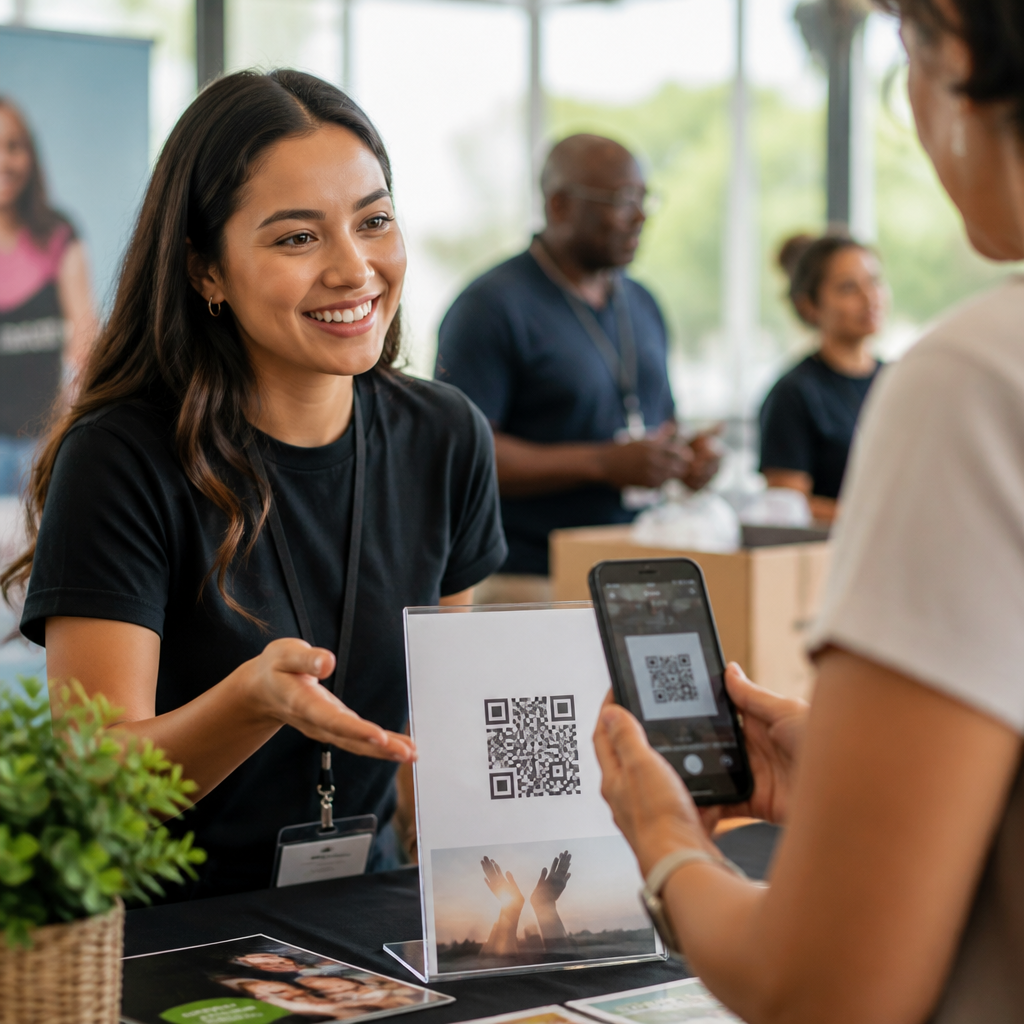
The most effective placements are the ones that match audience attention with a clear opportunity to act. For many nonprofits, that includes direct mail appeals, fundraising event signage, community posters, brochures, table tents, volunteer shirts, annual reports, program materials, newsletters, museum exhibits, classroom handouts, and advocacy materials. A QR code works best when it appears in a context where someone is already engaged with the mission and has enough time to scan. For example, an event attendee standing near a registration table may be highly likely to scan a code to donate, sign up for updates, or view a campaign schedule. A museum visitor may scan a code next to an exhibit to learn more about a program or support a related initiative. A parent receiving a school fundraiser flyer may use a code to contribute immediately instead of setting the paper aside and forgetting later.
Placement strategy should also consider visibility, device access, and message clarity. The code should be large enough to scan comfortably, positioned where lighting and viewing angles are practical, and accompanied by a strong call to action such as “Donate now,” “Register in 30 seconds,” “Read this family’s story,” or “Sign the petition today.” Generic placement without context usually underperforms. Supporters need a reason to scan. It is also wise to tailor destination pages to the environment. Someone scanning a code at a live event may expect a fast mobile donation experience, while someone scanning from a mailed impact report may be more interested in a detailed story or campaign update. The strongest results usually come from pairing thoughtful placement with a highly relevant landing page.
What types of nonprofit campaigns benefit most from using QR codes?
QR codes are especially effective in campaigns that rely on quick response, emotional momentum, or multi-channel outreach. Fundraising campaigns are a natural fit because QR codes make giving easier at galas, community events, worship gatherings, school functions, peer-to-peer campaigns, and print appeals. Instead of asking donors to go home and complete the gift later, the organization can provide an immediate mobile-friendly route to donate while the cause is still top of mind. Volunteer recruitment campaigns also benefit because interested community members can scan and register in seconds. This works particularly well at fairs, campus events, outreach booths, and neighborhood programs where many people are curious but may not take the extra step without a fast and simple process.
Beyond fundraising and volunteering, QR codes are valuable for advocacy, education, awareness, and storytelling. Advocacy groups can place codes on posters or handouts that lead directly to petitions, legislator contact forms, or campaign explainers. Museums and cultural nonprofits can use them to expand exhibit interpretation, share oral histories, or invite membership signups. Schools and youth organizations can use them for parent communication, ticketing, campaign pages, and sponsorship opportunities. Community nonprofits can connect printed materials to food pantry updates, service registration, or emergency response resources. In each case, the real strength of the QR code is not just the technology itself, but its ability to shorten the path between attention and participation. Any campaign that depends on making action easy, fast, and trackable can gain value from it.
How can nonprofits measure whether their QR codes are actually improving engagement?
Measurement starts with defining the purpose of each QR code before it is distributed. A nonprofit should decide whether a code is meant to drive donations, volunteer signups, event registrations, email subscriptions, petition signatures, video views, or resource downloads. Once that goal is clear, performance can be tracked using unique destination URLs, campaign parameters, analytics tools, form completions, and donation reporting. Using separate QR codes for different channels or locations is particularly helpful. For example, one code can be used on a direct mail piece, another on event signage, and another on a poster campaign. This allows the organization to compare which touchpoints generate the most scans, conversions, and completed actions rather than treating all traffic as one general source.
The most useful metrics usually go beyond scan volume alone. A high number of scans is encouraging, but it matters even more whether people complete the desired action after landing on the page. Nonprofits should watch conversion rates, average donation size, volunteer form completion, bounce rate, time on page, and follow-up engagement such as email opens or repeat giving. If many people scan but few finish, the issue may be the landing page, not the QR code itself. A donation form that is too long, a page that loads slowly, or a message that feels disconnected from the original appeal can reduce results. Regular testing helps refine performance. Small adjustments to button text, page speed, call-to-action language, or page design can significantly improve outcomes. When tracked carefully, QR codes give nonprofits a clear and practical way to connect offline outreach with measurable digital engagement.
What are the best practices for creating nonprofit QR code experiences that supporters will trust and use?
Trust, clarity, and convenience are the foundation of a successful QR code experience. Supporters are more likely to scan when they understand exactly where the code will take them and why it is worth their time. That means every code should be paired with a direct call to action and a brief explanation, such as “Scan to donate to our scholarship fund,” “Scan to join our volunteer list,” or “Scan to see how your support changes lives.” Sending people to a generic homepage often weakens trust and lowers conversions because the next step is not obvious. Instead, the destination should match the message on the printed item or sign and should be optimized for mobile devices. Pages should load quickly, be easy to navigate, and require as few steps as possible to complete the intended action.
Design and technical execution also matter. The QR code should be high contrast, large enough to scan from a realistic distance, and tested across multiple smartphones before launch. Branded landing pages can increase confidence by reassuring users that they have reached the correct organization. Secure donation pages, recognizable domain names, and consistent visual identity all help supporters feel safe taking action. It is also smart to think inclusively by offering a short URL near the code for people who prefer to type the link manually. Finally, nonprofits should avoid overusing QR codes where they do not add value. The best use cases are the ones where they simplify a real supporter action. When thoughtfully implemented, QR codes feel less like a technical feature and more like a seamless extension of the nonprofit’s outreach, making engagement easier, faster, and more effective.