QR codes have become one of the most practical tools for increasing attendee engagement at events and conferences because they connect physical spaces to digital experiences in seconds. A QR code, or quick response code, is a scannable two-dimensional barcode that opens a webpage, app, file, form, video, or payment screen when viewed through a smartphone camera. In event marketing, that simple action removes friction at the exact moment an attendee is most interested. Instead of asking people to type a long URL, download materials later, or wait in line for printed information, organizers can deliver content, registration updates, networking tools, and post-session follow-up instantly.
Attendee engagement refers to how actively participants interact with event content, sponsors, speakers, exhibitors, and each other before, during, and after an event. Strong engagement is measurable. It shows up in session attendance, app downloads, survey completion, booth interactions, lead capture, social sharing, repeat visits, and eventual revenue outcomes such as sponsorship renewals or ticket upgrades. I have seen the difference firsthand at trade shows and corporate conferences: when attendees must take multiple steps to access a resource, response rates drop sharply; when a clear QR code is placed at the point of decision, participation rises because the path is immediate.
This matters because events operate under intense pressure to prove value. Organizers need better data, exhibitors need stronger leads, sponsors want measurable visibility, and attendees expect convenience. QR codes support all four goals when they are implemented with a clear journey behind the scan. They are also flexible enough to support nearly every event format, from association conferences and expos to university open days, nonprofit galas, product launches, festivals, and internal company meetings. As a result, QR codes now sit at the center of event operations, audience experience, and marketing measurement.
For the broader topic of QR codes in marketing, events and conferences are one of the strongest use cases because engagement happens in a controlled physical environment. Every sign, badge, booth panel, agenda slide, lanyard insert, table tent, or stage backdrop can become a response point. This article serves as a hub for industry-specific event and conference applications, showing how QR codes improve check-in, wayfinding, content delivery, networking, sponsor activation, lead retrieval, feedback collection, and post-event nurturing. If you are building an event strategy, understanding these use cases helps you create campaigns that are easier to use and easier to measure.
Why QR codes work so well in live event environments
QR codes enhance attendee engagement because they reduce the gap between interest and action. At a live event, attention is limited and distractions are constant. People are moving between sessions, answering messages, meeting peers, and scanning the room for what matters. A QR code lets an organizer capture that moment of curiosity before it disappears. When someone sees a speaker slide offering a workbook, a booth promising a demo, or a sign advertising a networking lounge, the scan becomes the bridge to immediate participation.
There is also a strong behavioral advantage. Most attendees already know how to use smartphone cameras, so the learning curve is minimal. Since Apple and Android integrated native QR recognition years ago, scanning no longer feels technical. That ease changes response patterns. At one expo activation I worked on, replacing a printed shortlink with a large QR code on a kiosk doubled the number of resource downloads during the first day because visitors no longer had to stop, type, and troubleshoot. The technology was not the main win; friction removal was.
Another reason QR codes perform well at conferences is their adaptability. Static codes can point to permanent pages such as an event homepage, while dynamic QR codes can be updated without reprinting signage. That matters when room assignments change, session links need revision, or sponsors swap offers at the last minute. Platforms such as Bitly, Beaconstac, QR Code Generator Pro, and Flowcode also provide analytics like scan volume, time of day, location trends, and device type, which gives organizers evidence for future planning.
Core attendee engagement use cases across the event journey
The most effective event QR code strategy maps scans to the full attendee journey rather than treating codes as isolated assets. Before the event, QR codes on email signatures, direct mail, social graphics, and print ads can drive registration, early agenda planning, or pre-booked meetings. During the event, they support entry, personalized schedules, live polling, presentation downloads, exhibitor engagement, food ordering, and prize participation. After the event, the same codes or follow-up variants can send attendees to on-demand recordings, certificate requests, sponsor offers, and feedback surveys.
Registration and check-in are often the first high-impact examples. QR-enabled tickets speed entry because staff can scan confirmation codes from phones instead of searching names manually. That shortens queues, lowers staffing pressure, and creates a better first impression. Many event platforms, including Cvent, Eventbrite, Bizzabo, and Swapcard, already support barcode or QR-based check-in workflows. In practice, faster entry does more than save time; it improves attendance flow into opening sessions, reduces crowding at the front entrance, and gives organizers a cleaner attendance record.
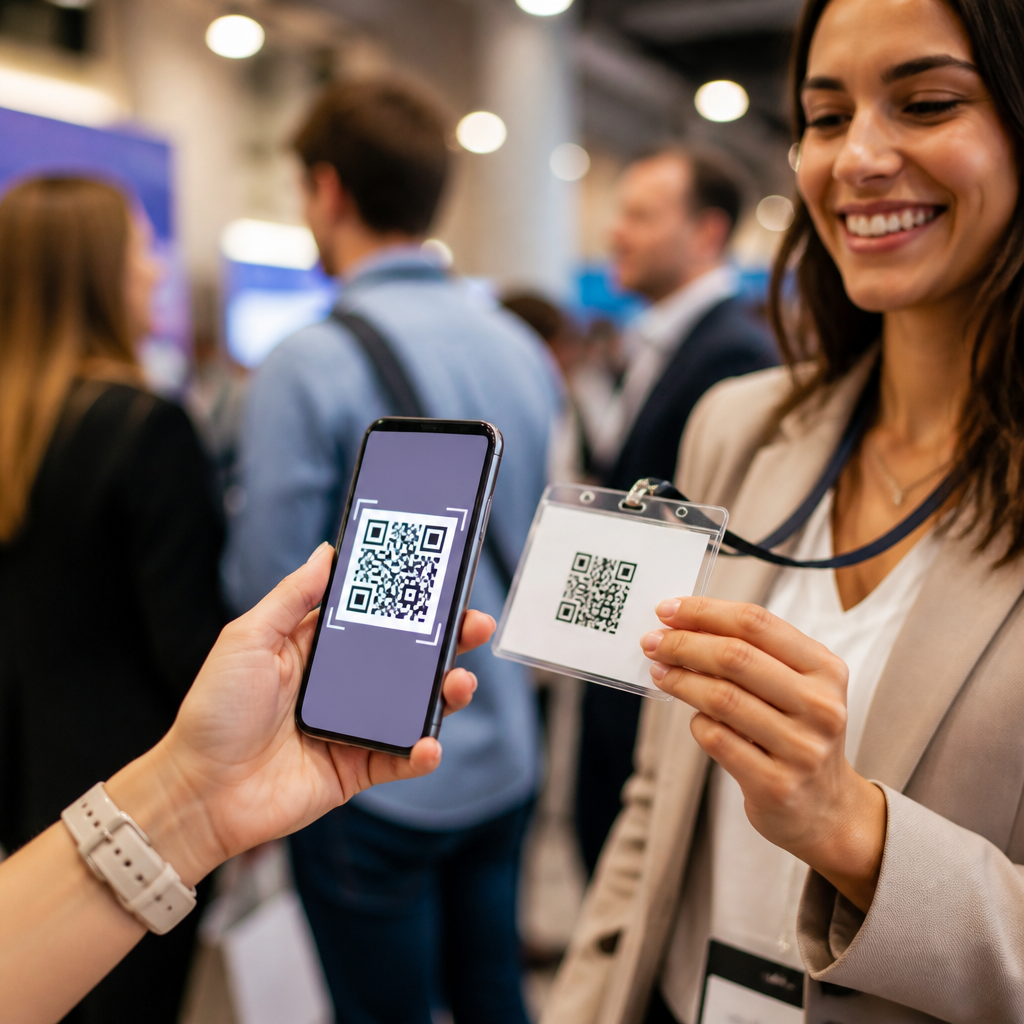
Session engagement is another major category. Speakers can place QR codes on opening and closing slides to share deck downloads, reading lists, case studies, live Q&A forms, or continuing education materials. This is especially valuable for content-heavy sessions where attendees would otherwise photograph slides or request files later. Networking also benefits. QR codes printed on badges can link to digital profiles, LinkedIn pages, appointment booking forms, or in-app contact exchange. For busy conferences, this can replace stacks of business cards with structured, trackable interactions.
| Event touchpoint | How QR codes are used | Primary engagement benefit |
|---|---|---|
| Registration | Mobile tickets, self check-in kiosks | Faster entry and lower queue abandonment |
| Sessions | Slide links, polls, Q&A forms, downloads | Higher participation and better content retention |
| Exhibit hall | Product demos, lead forms, giveaway entries | More measurable booth interactions |
| Networking | Badge links, profile exchange, meeting booking | Quicker contact sharing and more meetings |
| Post-event | Surveys, recordings, certificates, offers | Longer engagement after the event ends |
Industry-specific use cases for events and conferences
Different event types use QR codes in different ways, and that is where engagement strategy becomes more sophisticated. At trade shows, exhibitor ROI depends on lead quality and follow-up speed. QR codes on booth displays can route attendees to product selectors, specification sheets, demo requests, pricing calculators, and scheduled consultations. Instead of collecting a pile of unqualified badge scans, exhibitors can let visitors self-identify interests by choosing a product category or use case after scanning. That creates better segmentation for sales teams.
At professional conferences and association meetings, education is often the main value driver. Here, QR codes can support accreditation workflows by linking to attendance verification forms, assessment quizzes, or certificate claim pages. They can also extend session life by connecting attendees to speaker bios, white papers, standards documents, and chapter resources. Medical, legal, and engineering conferences benefit especially from this model because attendees often need access to source material, citations, or compliance-related documentation after sessions conclude.
Corporate events use QR codes differently. Internal sales kickoffs, partner summits, and user conferences often prioritize alignment, training, and pipeline acceleration. QR codes on stage screens can launch product knowledge checks, branch-specific scoreboards, and internal content portals. At customer events, they can direct users to feature adoption guides, support communities, or roadmap voting pages. Nonprofit events and fundraisers commonly use QR codes for mobile donations, auction access, volunteer sign-up, and storytelling content that reinforces mission impact during the event itself.
Higher education events, campus tours, and recruitment fairs can turn QR codes into a guided discovery tool. Prospective students scan campus markers to watch department videos, compare majors, book counselor meetings, or request scholarship information. Festivals and public events use them for interactive maps, artist schedules, food menus, and cashless payment. In each case, the strongest engagement results come from matching the code to a real attendee need in context, not from placing codes everywhere without a reason to scan.
Best practices for implementation, design, and measurement
Successful event QR codes are not just generated and printed; they are designed as part of a conversion path. Start with one question: what should the attendee do immediately after scanning? The destination must load quickly, display well on mobile, and offer a single clear action. If a scan opens a cluttered desktop page, a PDF that is difficult to read on a phone, or a form with too many fields, engagement drops. I recommend mobile landing pages with concise copy, visible buttons, and tracking parameters tied to event source, location, and campaign objective.
Placement matters as much as destination. Codes should appear where intent is highest: outside session rooms, beside product demos, on badge backs, at café tables, near sponsor activations, and on slides during the exact moment the audience is invited to respond. Size and contrast are critical. Dark code on a light background remains the most reliable choice, and testing from realistic scanning distances is essential. A code that works from one foot away may fail completely when mounted on a stage screen viewed from row ten.
Measurement should go beyond raw scan counts. A high scan number is encouraging, but completion metrics tell the real story. Track scans to registrations completed, downloads opened, surveys submitted, meetings booked, leads qualified, and revenue influenced. Use UTM parameters with analytics platforms such as Google Analytics 4, and align scan data with CRM or event platform records when possible. Dynamic QR codes help because they allow edits, A/B tests, and destination changes mid-event without reprinting assets. They also make governance easier if multiple sponsors or departments are involved.
There are limitations to acknowledge. Not every attendee wants to scan, connectivity can be inconsistent in convention centers, and overuse creates fatigue. Accessibility also matters. Always provide a short backup URL, ensure sufficient color contrast, and avoid placing important information behind a scan-only wall. Privacy must be handled transparently, especially when codes collect personal data. The best programs respect consent, explain what will happen after the scan, and store information according to applicable standards. When these basics are handled well, QR codes become a dependable engagement layer rather than a gimmick.
How to build a scalable hub strategy for event and conference QR content
Because this page sits within a larger QR codes in marketing framework, it should function as the central reference point for event and conference use cases. The smartest approach is to treat this hub as the parent resource, then support it with focused pages on topics such as QR code check-in systems, exhibitor lead generation, conference networking, event signage best practices, post-event survey optimization, and sponsor activation ideas. That structure helps readers find answers quickly and signals topical depth across the broader subject.
From an editorial perspective, each supporting page should solve one clear problem with examples, tools, and implementation guidance. For example, an article on event check-in can compare staffed versus self-serve scanning; a page on exhibitor QR codes can explain lead qualification forms and CRM routing; a guide on speaker session QR codes can cover slides, handouts, polls, and CE credit claims. Interlinking these resources creates a stronger knowledge base for planners, marketers, exhibitors, and venue teams who may enter the topic from different questions but share the same operational goal.
For organizers, the business case is straightforward. QR codes improve attendee engagement by making interactions faster, more convenient, and more measurable across the full event lifecycle. They reduce friction at registration, increase participation in sessions, help exhibitors capture better leads, support networking, and extend value after attendees leave the venue. The strongest results come from deliberate planning: clear scan prompts, mobile-first destinations, dynamic management, solid analytics, and context-specific use cases tailored to the event type.
If you are building or improving an event program, start with three or four high-intent touchpoints and measure what happens after each scan. Then expand into deeper event and conference applications with dedicated guides for check-in, booth engagement, content delivery, and follow-up. Used thoughtfully, QR codes turn passive attendance into active participation, and that is what every successful event is trying to achieve.
Frequently Asked Questions
How do QR codes improve attendee engagement at events and conferences?
QR codes improve attendee engagement by making it easier for people to take action in the exact moment their interest is highest. At an event, attention is limited and distractions are everywhere, so anything that reduces effort can dramatically increase participation. A QR code lets attendees instantly access digital content from signs, booths, badges, screens, printed programs, product displays, presentation slides, and event handouts without needing to type a web address or search for information later. That immediacy helps bridge the gap between curiosity and action.
In practical terms, QR codes can direct attendees to schedules, session details, speaker bios, exhibitor pages, live polls, downloadable resources, maps, registration forms, contests, surveys, social media pages, networking tools, and follow-up offers. Because the interaction happens in seconds, attendees are more likely to explore content while they are still engaged with the speaker, brand, or activity in front of them. This creates a more interactive event experience instead of a passive one.
They also support personalized engagement. Different QR codes can be placed in different locations or tied to different campaigns, helping organizers tailor calls to action based on context. For example, one code may invite attendees to join a breakout session waitlist, while another encourages them to download a presentation deck or book a demo. When used strategically, QR codes turn physical touchpoints into measurable digital entry points that increase participation, extend conversations, and keep attendees involved before, during, and after the event.
What are the most effective ways to use QR codes during an event?
The most effective uses of QR codes are tied to clear attendee needs and specific moments in the event journey. One of the strongest applications is simplifying access to event information. QR codes on welcome signage, registration counters, and printed agendas can link directly to live schedules, venue maps, speaker updates, and important announcements. This helps attendees find what they need quickly and reduces confusion, especially at large conferences with multiple tracks or frequent schedule changes.
Another high-performing use is interactive participation. QR codes can connect attendees to live Q&A forms, polls, feedback surveys, session evaluations, gamification tools, and prize entries. These experiences encourage active involvement and give organizers useful real-time data about what attendees are responding to. For exhibitors and sponsors, QR codes are especially effective for lead capture, product education, appointment booking, brochure downloads, and post-event follow-up. Instead of handing out only printed material, brands can provide richer digital experiences such as demo videos, case studies, coupons, or signup forms.
Networking is another major opportunity. QR codes can link to digital business cards, contact forms, LinkedIn profiles, community platforms, or attendee directories. This makes connections easier to start and easier to maintain after the event ends. The key is to match each code with a single, obvious purpose and place it where the attendee naturally wants more information. Strong placement, a clear call to action, mobile-friendly destinations, and fast-loading content are what turn QR codes from a novelty into a reliable engagement tool.
Are QR codes better than printed materials for sharing event information?
QR codes are not always a full replacement for printed materials, but they are often more flexible, efficient, and engaging for sharing event information. Printed materials are useful for visibility and quick reference, but they are limited by space, difficult to update, and often become outdated the moment schedules change or room assignments shift. QR codes solve that problem by connecting attendees to live digital content that can be updated instantly without reprinting anything. That makes them especially valuable for conferences, trade shows, festivals, and corporate events where details can change in real time.
They also allow organizers to share much more information than a printed flyer or program ever could. A single QR code can open an agenda, speaker links, downloadable resources, exhibitor offers, FAQs, venue maps, accessibility details, and emergency updates. This creates a cleaner physical environment while still giving attendees deep access to content. From a user experience standpoint, QR codes reduce the need for people to carry extra paper or manually type in long URLs, which removes friction and increases the likelihood of engagement.
That said, the best strategy is usually a hybrid approach. Printed materials still play an important role in directing attention and serving attendees who prefer offline information. The strongest event experiences often use concise printed prompts paired with QR codes that unlock more detailed, dynamic digital content. In that model, print becomes the entry point and the QR code becomes the action tool. This combination improves convenience, supports sustainability goals by reducing paper waste, and gives organizers the added benefit of tracking scans and measuring engagement in ways traditional print cannot.
What should event organizers include on a QR code landing page to keep attendees engaged?
A QR code landing page should be designed for speed, clarity, and immediate value. When attendees scan a code, they should arrive at a mobile-friendly page that loads quickly and makes the next step obvious. The most important element is relevance. The landing page should match the attendee’s expectation based on where they scanned the code. If the code is displayed outside a breakout room, the page should show that session’s details, speaker information, downloadable materials, and perhaps a feedback form or live question submission tool. If the code appears at a sponsor booth, the page should focus on the product, offer, demo booking, or lead capture form.
Strong landing pages usually include a concise headline, a brief explanation of the value being offered, and one primary call to action. Depending on the context, that action might be to view the schedule, download a guide, watch a video, join a giveaway, submit a question, claim an offer, or connect with a representative. Too many competing options can lower conversions, so the page should stay focused. Visual consistency with the event or brand is also important because it reassures users that they are in the right place and builds trust.
To deepen engagement, organizers can add interactive elements such as polls, social sharing buttons, calendar add links, note-taking resources, and related content recommendations. Contact information and simple navigation are helpful, but the page should avoid unnecessary clutter. It is also wise to make forms short and mobile-friendly, since long form fields can discourage completion. Ultimately, the best QR landing pages do not just deliver information; they guide attendees into a meaningful next step that extends the event experience and keeps momentum going.
Can QR codes help measure attendee engagement and event performance?
Yes, QR codes can be extremely useful for measuring attendee engagement and overall event performance because they create trackable digital interactions from physical event environments. Every time an attendee scans a QR code, organizers can learn something about interest, timing, placement effectiveness, and content performance. Depending on the platform being used, scan analytics may show total scans, unique scans, device types, time of day, geographic data, and which locations or campaigns generated the most activity. This makes QR codes a practical analytics tool as well as an engagement tool.
For example, if one session QR code receives significantly more scans than others, that may indicate stronger topic interest, better signage placement, or more compelling calls to action. If booth-specific QR codes are used across an expo floor, sponsors and exhibitors can compare engagement by product line, content offer, or staff outreach strategy. Organizers can also connect QR interactions to downstream actions such as form completions, app downloads, survey responses, demo bookings, content downloads, or purchases. That provides a much clearer picture of attendee behavior than relying only on foot traffic estimates or anecdotal feedback.
This data can help improve both live decision-making and future event planning. During the event, organizers can identify underperforming touchpoints and adjust messaging, placement, or incentives. Afterward, they can analyze which sessions, exhibitors, resources, and experiences generated the highest engagement. The key is to use distinct QR codes for specific purposes and track each one through a well-organized reporting system. When implemented thoughtfully, QR codes do more than increase convenience. They provide measurable insight into what attendees value most, allowing event teams to optimize experiences and demonstrate stronger return on investment.