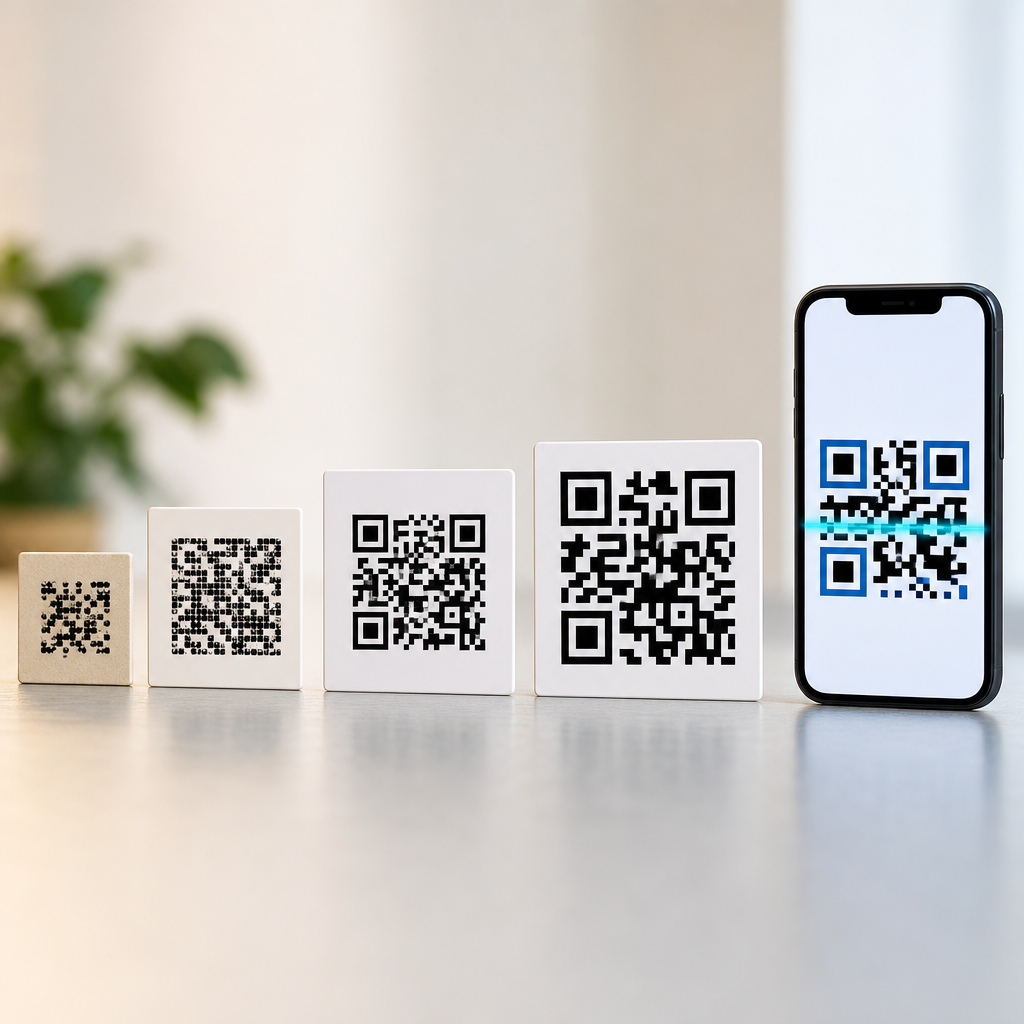
QR code versioning is the standardized system that defines a QR code’s physical matrix size, data capacity, and placement of functional patterns as the symbol grows from simple to highly dense forms. In practice, a version is the numbered blueprint behind the black-and-white square, telling scanners how many modules appear on each side and telling creators how much information can fit before readability starts to decline. For anyone building, printing, buying, or managing QR campaigns, versioning matters because it directly affects scan reliability, available content space, label size, design flexibility, and compliance with the ISO/IEC 18004 standard that governs QR code structure.
I have seen teams treat every QR code as interchangeable, then wonder why one code scans instantly on packaging while another fails on a poster viewed from several feet away. Versioning is usually the reason. A Version 1 QR code is a 21 by 21 module symbol, and each version adds four modules per side, all the way to Version 40 at 177 by 177 modules. That progression is not cosmetic. It changes encoding capacity, error correction overhead, the number and position of alignment patterns, and the minimum practical print size. Understanding QR code versioning is the foundation for choosing the right symbol for URLs, vCards, payment payloads, product labels, inventory tags, event tickets, and industrial tracking.
As the hub for QR Code Technology and Standards, this guide explains what a version is, how versions scale, how they interact with data modes and error correction, and why version selection should happen early in any QR implementation. It also connects the technical rules to real use cases in plain language. If you want QR codes that are standards-based, efficient, and easy to scan across phones and dedicated readers, versioning is one of the first concepts to master.
How QR code versions are defined in the standard
A QR code version is a fixed matrix specification in the standard model QR family. The version number ranges from 1 to 40. Version 1 contains 21 modules on each side. Every step up adds four modules horizontally and vertically, so Version 2 is 25 by 25, Version 3 is 29 by 29, and so on until Version 40 reaches 177 by 177. A module is the smallest black or white square in the symbol. Scanners do not read the image as art; they interpret those modules according to a strict layout that includes finder patterns, timing patterns, quiet zone, format information, version information on Version 7 and above, alignment patterns, and the encoded data area.
That structure explains why versioning is not just about “bigger code, more data.” As the symbol grows, more space becomes available, but more structure is also required to keep the code readable under distortion, printing variation, and perspective skew. Finder patterns sit in three corners and help the scanner locate the symbol quickly. Alignment patterns become more numerous in larger versions because higher-density symbols need more geometric correction. Version information appears in larger symbols so the reader can resolve the matrix accurately. When I audit poorly performing QR deployments, the issue is often not the scanner app but a mismatch between version, print conditions, and intended scan distance.
Micro QR and rMQR exist as related standards for special use cases, but when most businesses say “QR code,” they mean the standard model with versions 1 through 40. That distinction matters because software may offer multiple symbol families. If your workflow spans point-of-sale, logistics, pharmaceutical labeling, or consumer marketing, you should confirm which family your generator supports and whether your scanners are configured for it.
How versioning affects capacity, density, and usability
The practical purpose of versioning is capacity management. Higher versions can hold more data, but they do so by increasing module count, which also increases visual density. Capacity depends on three variables working together: version, error correction level, and encoding mode. Numeric mode is most efficient for digits, alphanumeric mode supports a limited character set efficiently, byte mode handles general text and URLs, and Kanji mode compresses eligible double-byte characters. The same Version 5 symbol can hold very different amounts of data depending on which mode is used and whether error correction is set to L, M, Q, or H.
More capacity is not always better. Dense symbols are harder to print cleanly at small sizes and harder to scan at long distances or on curved surfaces. In packaging, I usually aim for the smallest version that comfortably fits the payload with an appropriate error correction level, because lower density typically improves scan speed. A short dynamic URL may fit in a low version and outperform a large static URL stuffed into a higher version. That is one reason marketers often use redirect-based QR platforms: not because the standard requires them, but because shorter payloads reduce symbol complexity while preserving campaign flexibility.
| Version | Matrix Size | Typical Use Case | Practical Consideration |
|---|---|---|---|
| 1 | 21 × 21 | Short numeric IDs or very short URLs | Fast scanning when printed cleanly with enough quiet zone |
| 5 | 37 × 37 | Common landing-page links, app links, simple contact data | Good balance of capacity and readability for consumer print |
| 10 | 57 × 57 | Longer URLs, richer contact payloads, some payment data | Needs more physical space to maintain module size |
| 20 | 97 × 97 | Industrial, document-heavy, or multi-field encoded data | Can become challenging on small labels or low-resolution printers |
| 40 | 177 × 177 | Maximum-capacity edge cases | Rarely ideal for consumer-facing print because density is high |
The key usability rule is simple: choose the lowest version that safely supports the payload and environment. A warehouse shelf label viewed up close with a rugged scanner can tolerate more density than a restaurant window decal scanned through glare with a phone camera. Versioning gives you a controlled way to balance those realities instead of guessing.
Versioning, error correction, and encoding modes
QR codes use Reed-Solomon error correction, which allows a damaged or partially obscured symbol to remain readable. The four standard levels are L, M, Q, and H, commonly associated with roughly 7 percent, 15 percent, 25 percent, and 30 percent recovery capability. The tradeoff is direct: more error correction consumes more codewords, reducing net data capacity. That often forces a higher version if the payload stays the same. Designers sometimes increase error correction to accommodate logos, but the smarter move is to test whether the logo is necessary and whether the symbol can remain in a lower version by shortening the data.
Encoding mode matters just as much. A numeric payload packs more efficiently than a byte-mode payload. For example, a long product serial containing only digits may fit several versions lower than a full URL with mixed characters. I have repeatedly reduced required version size by normalizing URLs, removing unnecessary tracking parameters, and converting static contact payloads into short landing links. That is not a hack; it is good symbol engineering. Lower versions typically improve robustness, especially in constrained print environments such as thermal labels, corrugated packaging, direct part marking, and small-format brochures.
The standard also supports structured append, ECI for extended character interpretation, FNC1 for GS1 applications, and mask patterns selected to optimize module distribution. These features are important in specialized deployments. In retail and supply chain settings using GS1 Digital Link, the encoded string may be carefully structured and standardized, which can increase payload length. Version planning then becomes part of broader data architecture, not just graphic design. If your organization is moving from simple web links to standards-based product identification, versioning should be reviewed alongside scanner capability, printing resolution, and data governance.
Real-world version selection for print, packaging, and screens
Version choice becomes real when the code leaves the generator and enters a physical or digital environment. On print, the most important variable is module size, not just overall symbol size. If a high-version code is squeezed into a tiny space, each module becomes too small for reliable capture. The exact minimum depends on printer resolution, substrate, contrast, and scanner quality, but the principle is universal: as version rises, the symbol needs more space to preserve module clarity. A clean Version 3 printed larger will often outperform a cramped Version 8 containing the same business intent in a longer payload.
Packaging introduces additional complications. Curved bottles distort modules. Flexible film can wrinkle. Matte and glossy finishes change contrast. Quiet zone violations are common when marketing teams place decorative elements too close to the code. In these conditions, a lower version with moderate or high error correction usually performs better than a dense symbol chasing maximum data capacity. On screens, refresh rate, brightness, moire effects, and viewing distance matter. A code on a self-checkout screen may scan easily because brightness and contrast are controlled, while a dark-mode mobile wallet code with low contrast can fail despite using a technically valid version.
Industrial use cases raise the bar further. Manufacturing lines may use high-speed imagers that read small symbols well, but print quality can vary on thermal transfer labels or laser-marked components. Healthcare settings often need durable scanning through handling wear, making error correction and contrast critical. Event operations need fast scan throughput, so lower density can speed line movement. In each case, versioning is not an isolated setting. It is a deployment decision linked to optics, materials, workflows, and user behavior.
Common mistakes and how to avoid them
The most common mistake is encoding too much data directly. People paste entire URLs with tracking strings, contact records with every optional field, or long text blocks that should live on a web page. That pushes the symbol into a higher version unnecessarily. A better approach is to encode only what must be local to the symbol and move everything else behind a short, stable link. Another frequent mistake is choosing high error correction by default, adding a centered logo, and then shrinking the finished symbol to fit a layout. Those three choices combine to create dense, fragile codes.
I also see confusion between version and size in millimeters. Version defines module count; physical size determines how large those modules are when printed or displayed. A Version 6 symbol can be excellent or terrible depending on whether it is rendered at an appropriate size with a proper quiet zone. Generator defaults are another trap. Some tools auto-select version, mask, and error correction, which is useful, but teams sometimes export whatever appears without reviewing capacity or scan conditions. Good practice means testing across multiple devices, lighting conditions, and distances before production.
Finally, standards compliance matters. Use reputable generators and validation tools. Test with native smartphone cameras and, if relevant, dedicated scanners from vendors such as Zebra, Datalogic, or Honeywell. Verify that the code remains readable after compression in design software, upload to CMS platforms, or conversion by print vendors. A valid QR code on your laptop can become unreliable after one careless production step.
How this technology standard connects to the broader QR ecosystem
QR code versioning sits at the center of QR Code Technology and Standards because it touches almost every adjacent topic. Error correction levels influence version requirements. Data encoding modes determine how efficiently payloads fit. Quiet zone, contrast ratio, and print resolution affect whether a chosen version remains scannable in the real world. Dynamic versus static QR strategy often hinges on reducing payload length to stay in a lower version. Specialized standards such as GS1 Digital Link, payment specifications, and ticketing formats can force larger payloads and therefore larger versions.
This is also where future planning starts. If you expect to add analytics, localization, campaign routing, or product metadata later, do not assume you can keep the same printed symbol unless the encoded payload stays stable. Teams that understand versioning plan for flexibility from day one. They decide whether the symbol should carry raw data, a resolver URL, or an application-specific identifier. They test before mass printing. They document chosen settings for regeneration and quality control. That discipline saves money and prevents field failures.
In short, QR code versioning is the structural logic behind a QR symbol’s size, capacity, and scan behavior. Learn the version scale, understand the capacity tradeoffs created by error correction and encoding mode, and select the lowest practical version for the environment. That approach produces cleaner symbols, better scan rates, and fewer surprises across packaging, signage, documents, and digital displays. If you are building out your QR Code Basics and Education library, use this page as the starting point, then map your next reading to encoding modes, error correction, print guidelines, dynamic QR strategy, and standards-based industry implementations.
Frequently Asked Questions
What does “QR code version” actually mean?
A QR code version is the standardized size level of a QR symbol. It defines how many tiny square modules appear across and down the code, which directly affects how much data the code can hold and how dense the final pattern becomes. In the QR code standard, versions begin at Version 1 and increase step by step up to Version 40. A Version 1 QR code is a 21 x 21 module grid, and each higher version adds 4 modules per side, making the symbol physically larger and more data-capable.
Just as importantly, versioning is not only about size. It also determines how the code’s structural elements are arranged as the symbol grows. These elements include finder patterns, alignment patterns, timing patterns, and other functional areas that help scanners detect orientation, read the grid correctly, and decode the content reliably. In other words, the version acts like a blueprint: it tells the scanner what the symbol should look like at that size and tells the creator how much data can reasonably fit before the code becomes too dense for comfortable scanning.
For businesses and creators, understanding versioning matters because it influences real-world performance. A larger version can store more information, but it also creates a more complex pattern that may be harder to scan if printed too small, placed on curved packaging, or shown in poor lighting. That is why QR code versioning is a practical planning tool, not just a technical label.
How do QR code versions affect data capacity and scanability?
QR code versions have a direct impact on both data capacity and readability. As the version number increases, the matrix gains more modules, which creates more room for encoded data. This means higher versions can hold longer URLs, larger amounts of text, more numeric data, or more complex content structures. However, that added capacity comes at a cost: the pattern becomes denser, and denser codes are generally less forgiving in real-world scanning conditions.
Scanability depends on more than the version alone, but version is one of the biggest drivers. A low-version code with simple data usually has larger, cleaner module blocks and is easier for smartphone cameras and industrial scanners to capture quickly. A high-version code, by contrast, packs much more information into the same basic square shape, which means each module may need to be printed smaller if the overall symbol size is constrained. If those modules become too tiny, blurred, distorted, or low-contrast, scan performance can suffer.
Error correction also plays a role here. Higher error correction levels improve resilience if the code is scratched, branded, or partially obscured, but they reduce available data capacity and may push the symbol into a larger version. This creates a balancing act between the amount of information stored, the durability required, and the intended print or display environment. In practice, the best-performing QR code is usually the smallest version that can comfortably hold the needed content while maintaining strong contrast, adequate quiet zone spacing, and a suitable physical size for the expected scanning distance.
How is a QR code version chosen when creating a code?
In most cases, the version is selected automatically by the QR code generator based on the amount and type of data being encoded, along with the chosen error correction level. Numeric-only content is more space-efficient than alphanumeric or byte-based content, so two codes with the same number of characters may end up using different versions depending on what those characters are. Similarly, adding more error correction increases redundancy, which can force the code into a larger version even if the visible content appears relatively short.
Good QR generation tools usually optimize for the smallest possible version that still supports the content and error correction setting. This is ideal because smaller versions tend to scan more reliably, especially in print. For example, a short dynamic URL may fit into a very compact version, while a long static URL with tracking parameters could require a much larger one. The user may not always notice the technical difference, but the scanner certainly will.
There are situations where version selection may be managed more intentionally. A designer preparing packaging, signage, labels, tickets, or direct mail might want to keep the symbol at a lower version to preserve larger module size and stronger scan performance. In those cases, shortening the data, using a dynamic QR code, or simplifying the encoded payload can reduce the required version. The key point is that version choice is not arbitrary. It is the result of data length, encoding method, error correction needs, and the practical conditions in which the code will be used.
Why do higher QR code versions include more functional patterns?
As QR codes become larger, scanners need more structural guidance to read them accurately. That is why higher versions include additional functional patterns, especially alignment patterns. These patterns help the scanner compensate for distortion caused by angled viewing, uneven surfaces, lens effects, print imperfections, or image warping. In a small QR code, the basic finder patterns and timing patterns are often enough to establish the grid. In larger, denser symbols, more reference points are needed to maintain decoding accuracy across the entire matrix.
Alignment patterns are especially important because they help the scanner understand local positioning within the code. Without them, a large symbol printed on flexible packaging, curved bottles, folded paper, or textured surfaces would be much harder to interpret consistently. The placement of these patterns is governed by the QR code standard and changes according to the version. This is one reason versioning is considered a blueprint: it specifies not just the overall dimensions, but also where these functional elements belong.
For the average user, these structural details are easy to overlook, but they are essential to reliable scanning. They allow high-version QR codes to remain usable even as their content density increases. The tradeoff is that functional patterns occupy some of the available matrix space, which is another reason capacity calculations depend on the version and not just on the outer dimensions alone. In practical terms, these built-in reference features are what make larger QR codes viable in real-world applications rather than merely bigger boxes of data.
What should businesses know about QR code versioning before printing or launching a campaign?
Businesses should treat QR code versioning as a performance decision, not just a technical specification. The version affects how much information the code can hold, how dense it appears, how large it must be printed for dependable scanning, and how well it will perform in everyday environments. If a company encodes too much data directly into the symbol, the QR code may jump to a higher version, making it more complex and potentially harder to scan from a phone camera at speed or from a distance.
This is why many marketers and operations teams prefer dynamic QR codes for campaigns, packaging, product labeling, menus, and customer engagement programs. A dynamic QR code usually stores a shorter redirect URL, which keeps the symbol simpler and often allows for a lower version. That lower version can improve scan reliability, especially on small print surfaces or in environments where lighting, motion, or placement are less than ideal. It also leaves more room for design flexibility without compromising readability.
Before printing at scale, businesses should test the code under realistic conditions: final size, actual material, intended viewing distance, expected lighting, and the devices most people will use. A QR code that scans perfectly on a designer’s monitor may perform very differently on matte labels, corrugated boxes, restaurant tables, storefront windows, or outdoor signage. Understanding versioning helps decision-makers avoid preventable issues such as over-dense codes, undersized print, poor contrast, or excessive branding overlays. In short, if a QR code is part of a customer experience or operational workflow, versioning should be part of quality control from the beginning.