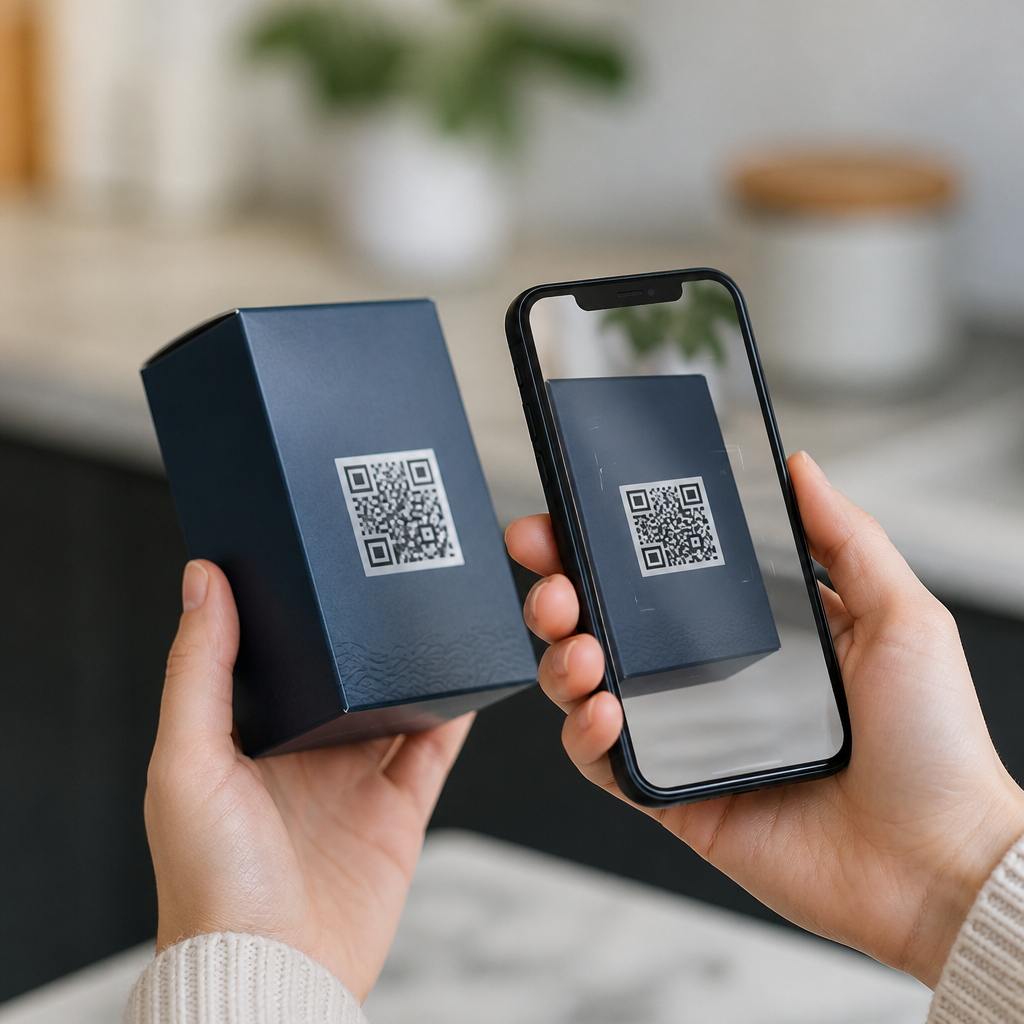
Product packaging used to do one job: protect the item, display compliance details, and persuade a shopper before purchase. Today, it can do much more. With a well-placed QR code, packaging becomes a post-purchase channel that extends the customer relationship after the sale, when attention is highest and intent is strongest. For brands trying to improve retention, reduce support costs, increase repeat orders, and measure offline engagement, that shift is strategically important.
A QR code, or Quick Response code, is a two-dimensional barcode that a smartphone camera can scan to open a digital destination instantly. That destination can be a setup guide, loyalty landing page, video tutorial, warranty form, reorder page, survey, or personalized experience. Post-purchase channel means any communication path a brand uses after a customer buys, receives, or opens a product. Email and SMS are common post-purchase channels, but they require opt-in and accurate customer data. Packaging is different because it is already in the customer’s hands. The scan creates the bridge from physical product to digital interaction without adding friction.
I have seen this work best when packaging is treated as media, not just materials. In practice, the highest-performing QR programs answer the customer’s first question at the exact moment it appears. A supplement bottle can link to dosage guidance and ingredient sourcing. A furniture box can open assembly videos specific to the SKU. A cosmetics carton can launch shade tutorials, care instructions, and replenishment reminders. The code works because it meets intent in context. That is the core reason QR codes work in marketing: they collapse the gap between curiosity and action.
This matters because customer acquisition costs remain high across paid search, social, marketplaces, and retail media. Many brands spend heavily to earn the first order, then underinvest in the moment immediately after purchase, when trust is fresh and product usage is beginning. Packaging reaches every buyer, including gift recipients and retail customers a brand may not know by email address. It also supports measurable offline-to-online behavior. When each product line, retailer, campaign, or batch uses a distinct dynamic code, scans reveal where engagement happens, when it happens, and what content drives downstream actions.
As the hub for why QR codes work in marketing, this article explains the mechanics behind performance, the conditions that make scans likely, and the business outcomes brands can expect. It also covers limits and implementation choices, because QR codes are not magic. Poor placement, weak calls to action, irrelevant destinations, and static experiences reduce results quickly. Used well, though, QR codes turn product packaging into a persistent digital touchpoint that improves education, attribution, loyalty, service, and lifetime value.
Why QR codes perform so well in marketing
QR codes perform because they remove steps. Before smartphone-native scanning became standard in iOS and Android camera apps, customers had to download a separate reader, which suppressed adoption. That barrier is gone. A customer sees a code, opens the camera, taps the prompt, and lands exactly where the brand wants them. In conversion terms, that is a low-friction path from physical stimulus to digital action.
They also work because they are intent-driven. A scan is not passive exposure like an impression on a billboard or a display ad. It is an active signal that the customer wants something now: instructions, verification, inspiration, support, or an offer. In analytics, those scans often represent higher-quality engagement than top-of-funnel social traffic because context qualifies the action. Someone holding the package has already crossed a meaningful threshold of interest or ownership.
Another reason is flexibility. A dynamic QR code can redirect to different destinations over time without changing the printed packaging. That is operationally significant. A brand can point a code to onboarding during launch, seasonal content during peak gifting, recall information if needed, or a reorder page once the expected consumption window arrives. Print stays fixed; destination strategy stays agile.
Finally, QR codes are measurable in a way many offline assets are not. Scan counts, unique visitors, device type, time of day, location patterns, downstream conversions, and A/B tested landing pages can all be tracked through platforms such as Bitly, Flowcode, QR Code Generator Pro, Adobe Analytics, and Google Analytics 4. That turns packaging from a cost center into an observable media channel.
How packaging becomes a post-purchase channel
Packaging becomes a post-purchase channel when the QR code is designed around ownership moments rather than pre-purchase messaging. The customer has already bought, received, or opened the item, so the questions change. Instead of “Why should I choose this?” the customer asks “How do I use this correctly?” “How do I register it?” “What if I have a problem?” “How do I get more value from it?” and “When should I reorder?”
Those questions map directly to high-value post-purchase functions. Education reduces returns and misuse. Registration improves first-party data capture. Tutorials increase product adoption. Community or loyalty pages support retention. Replenishment flows shorten the path to repeat purchase. Support content lowers call-center volume. Authenticity pages combat counterfeits in categories such as beauty, luxury, alcohol, and electronics.
In deployment, the packaging touchpoint can exist on the outer box, an insert, a label, the inner flap, or even the product itself. Each placement serves a different moment. Outer packaging is best for immediate setup or unboxing guidance. Inserts are effective for loyalty enrollment and referrals. On-product labels are useful for reorders or recurring instructions after the box has been discarded. I generally recommend matching placement to the timing of the customer need, then testing scan rates by format.
The strongest programs also segment destinations. One code across every SKU wastes context. Distinct destinations by product family, size, retailer, or geography make the experience more relevant. A coffee roaster, for example, can send one bag to brew recipes for pour-over, another to cold brew instructions, and a subscription offer only after the customer has had time to consume the first bag.
What customers actually scan for after purchase
Post-purchase scans usually cluster around a small set of customer needs. In home goods, setup and assembly dominate. In beauty and personal care, usage instructions, tutorials, and ingredient transparency drive engagement. In food and beverage, recipes, sourcing stories, nutrition explainers, and reorder options perform well. In electronics, warranty registration, troubleshooting, and accessory recommendations are common. In regulated categories, customers often scan for proof of authenticity, lot information, or safety guidance.
The practical lesson is simple: the landing experience should answer the first obvious question better than the printed package can. If a skincare serum requires a specific order of application, the QR destination should show that visually and concisely. If a DTC cookware brand knows customers often ask whether pans are induction compatible, the scan should answer it above the fold. If a pet brand wants to reduce feeding errors, the code should open a weight-based feeding calculator instead of a generic homepage.
When I audit underperforming campaigns, the most common failure is sending people to the main website navigation. That creates work for the customer and destroys scan intent. A QR code should feel like a shortcut, not a detour. The second common failure is using the code only for a discount. Offers can work, but utility usually outperforms pure promotion after purchase because it builds trust first and monetizes second.
Where QR codes create measurable business value
The commercial value of packaging QR codes is broad but concrete. The table below summarizes the main use cases, why they work, and the metric each one should influence.
| Use case | Why it works | Primary metric |
|---|---|---|
| Setup and onboarding | Delivers help at the moment of first use, reducing confusion and abandonment | Activation rate, return rate, support tickets |
| Warranty and registration | Captures first-party data from owners, including retail buyers the brand cannot reach by email | Registrations, CRM growth, opt-in rate |
| Loyalty enrollment | Turns the package into a membership gateway while excitement is highest | Enrollments, repeat purchase rate |
| Replenishment and subscription | Shortens the path back to purchase with SKU-specific reorder flows | Repeat orders, subscription conversion |
| Education and tutorials | Improves product usage, satisfaction, and perceived value | Engagement time, product reviews, return reduction |
| Authentication and traceability | Builds trust in high-risk categories and supports compliance communication | Verification scans, counterfeit reports |
| Surveys and feedback | Collects insight close to the usage moment, when memory is fresh | Response rate, NPS, issue detection speed |
These outcomes are not theoretical. Consumer brands routinely use packaging codes to drive onboarding videos, recipe libraries, care guides, refill programs, and post-purchase referrals. The measurable gain comes from relevance plus timing. Because the customer already has the product, the scan is anchored in real use rather than abstract interest.
Design and placement factors that increase scan rate
Scan performance depends heavily on execution. The first rule is visibility. Codes hidden in seams, on reflective curves, or beside dense legal copy are missed. A quiet zone around the code, sufficient size, strong contrast, and a flat printable area improve reliability. In most packaging environments, black on white remains the safest choice. Stylized designs can work, but error correction is not a substitute for readability.
The second rule is motivation. Customers need a reason to scan, stated in plain language next to the code. “Scan for setup video,” “Scan to register your product,” and “Scan for refill reminders” outperform generic prompts such as “Learn more.” Specificity sets expectations and pre-qualifies interest.
The third rule is destination fit. Mobile-first landing pages should load quickly, avoid forcing app downloads, and present the promised answer immediately. If the page requests data, the value exchange must be obvious. Asking for an email before providing basic instructions is a conversion killer. I advise giving utility first, then inviting the opt-in once trust is established.
Testing matters as well. Brands should compare code placement, CTA wording, landing formats, and timing windows. A code inside the box may outperform one on the exterior if the content is ownership-focused. A video may beat text for assembly, while a calculator may beat video for dosage or sizing. Packaging is physical, but optimization should be as disciplined as any landing page program.
Data, attribution, and first-party insight
One of the strongest strategic arguments for QR codes in marketing is data capture without excessive friction. When a retail buyer scans packaging, the brand can finally observe a digital interaction that would otherwise remain invisible. Even if the customer never purchases direct, the brand learns which products trigger scans, which retailers produce the most engaged owners, and which content leads to registration or repeat purchase.
To make that data useful, taxonomy matters. Use structured naming conventions by channel, retailer, SKU, geography, and campaign. Connect the code platform to analytics and customer data systems where possible. Add UTM parameters, event tracking, and server-side measurement when needed. In regulated environments, store only the data you truly need and disclose usage clearly. Good governance protects trust and keeps the program sustainable.
Dynamic QR infrastructure also supports operational flexibility. If a landing page changes, inventory in the field remains valid. If a market needs localized language, the destination can detect geography or route by code variant. If a support issue emerges, the brand can update guidance instantly. That responsiveness is one reason QR programs age well compared with fixed print messages.
Limits, risks, and when QR codes underperform
QR codes are effective, but they are not universal. They underperform when the customer has no clear incentive, when internet access is poor, when the target audience has low comfort with scanning, or when the destination is slow and irrelevant. They also fail when brands treat the code as decoration rather than a functional interaction point.
Security is another consideration. Consumers are increasingly aware that malicious codes can redirect to unsafe sites. Brands should use recognizable domains, branded landing pages, and concise explanations of what the scan will open. In high-trust categories, that reassurance can materially improve response.
There are production realities too. Print quality, substrate choice, curvature, ink spread, and packaging damage affect readability. Teams should test codes on real production samples, not only on-screen proofs. Standards from GS1 are also shaping the future of product identification and scanner-enabled commerce, especially as retailers prepare for broader 2D barcode adoption at point of sale. That evolution makes packaging QR strategy more relevant, not less, because it aligns consumer experience with supply-chain and retail infrastructure.
Most importantly, brands should not expect a code alone to solve retention. The code is an access mechanism. The value comes from the experience behind it: useful content, clean flows, credible data handling, and a post-purchase journey tied to genuine customer needs.
QR codes turn product packaging into a post-purchase channel because they connect a physical ownership moment to an immediate digital action. That connection works for a simple reason: the customer already has the product in hand and already wants something specific, whether that is setup help, proof of authenticity, replenishment, or a better way to use what they bought. When the code answers that need quickly, marketing stops feeling like interruption and starts functioning like service.
For brands, the upside is practical and measurable. Packaging QR codes can increase activation, capture first-party data from otherwise unknown retail buyers, lower support friction, improve loyalty enrollment, and accelerate repeat purchase. They also make offline packaging measurable through scan analytics, landing-page testing, and destination control. That is why QR codes work in marketing more broadly: they reduce friction, align with intent, and create a trackable bridge between physical touchpoints and digital outcomes.
The best results come from disciplined execution. Put the code where the need occurs. Use a clear call to action. Send scanners to a mobile page that fulfills the promise immediately. Track performance at the SKU and channel level. Update dynamic destinations as products, seasons, and customer questions change. If you are building a QR Codes in Marketing Strategy program, start with packaging, map the top post-purchase questions by product line, and launch one high-utility experience that customers will actually thank you for.
Frequently Asked Questions
How do QR codes turn product packaging into a post-purchase channel?
QR codes extend the role of packaging beyond the shelf and into the ownership experience. Instead of packaging serving only as a protective layer and a place for regulatory or branding information, it becomes a direct gateway to digital content after the product has been opened and used. When a customer scans a code on the box, label, insert, or bottle, the brand can deliver setup instructions, onboarding flows, care guides, warranty registration, FAQs, replenishment options, loyalty offers, and personalized recommendations exactly when that information is most relevant.
This is what makes packaging a post-purchase channel: it creates a measurable, interactive touchpoint after the sale has already happened. At that stage, the customer’s attention is highly valuable because they already own the product and are actively engaging with it. A well-designed QR experience helps brands answer questions before they become support tickets, encourage successful product adoption, and create a natural path to repeat purchases. In practical terms, the package stops being the end of the transaction and starts becoming the beginning of an ongoing customer relationship.
What kind of content should a brand link to with a packaging QR code?
The best destination depends on the product, customer journey, and business goal, but the most effective QR code experiences usually focus on usefulness first. For many brands, that means linking to quick-start instructions, video tutorials, product registration pages, troubleshooting help, ingredient or material details, authenticity verification, and product care guidance. If the product has any learning curve, packaging is the ideal place to connect the customer to educational content that reduces confusion and increases satisfaction.
Beyond support and onboarding, QR codes can also drive retention and revenue. Brands often use them to link to subscription enrollment, refill ordering, accessories, complementary products, loyalty programs, review requests, referral offers, and reorder pages. The key is to match the landing experience to the customer’s likely intent in the moment. Someone opening a product for the first time may need assembly help, while someone scanning an empty container may be ready to reorder. The strongest strategy is not simply sending every scan to a homepage, but designing a purpose-built mobile experience that feels like a natural continuation of the product experience.
How can QR codes on packaging reduce customer support costs?
Packaging QR codes can reduce support costs by resolving common questions before customers reach out to a service team. Many post-purchase issues are predictable: setup confusion, missing instructions, maintenance questions, returns information, compatibility concerns, or uncertainty about how to get the best results from a product. When a QR code routes customers to clear, mobile-friendly help content at the moment they need it, the brand can deflect avoidable support contacts and improve the customer experience at the same time.
This approach is especially effective because it is contextual. Customers do not need to search a website, dig through email, or call a support line. The answer is attached to the product they are holding. That immediacy matters. It shortens time to resolution, lowers frustration, and creates a sense that the brand anticipated the customer’s needs. Over time, brands can study which packaging scans lead to support article views, video completions, or follow-up actions and refine content around the most common friction points. The result is a smarter self-service system that lowers service volume while still helping customers feel supported.
Can brands measure offline engagement through packaging QR codes?
Yes, and that is one of the biggest strategic advantages of using QR codes on packaging. Packaging has traditionally been difficult to measure once a product leaves the shelf or warehouse. A QR code changes that by creating a trackable bridge between a physical product and a digital interaction. Brands can measure scan volume, time of scan, device type, location at an aggregate level, landing-page behavior, conversions, repeat visits, and downstream actions such as registrations, sign-ups, purchases, or review submissions.
These insights help brands understand what happens after delivery or purchase, not just before it. For example, a company can learn whether customers are scanning immediately after unboxing, whether onboarding content is being used, whether support content is doing its job, and whether post-purchase offers are driving repeat orders. Dynamic QR codes make this even more valuable because the destination can be updated without changing the printed packaging, allowing teams to test campaigns, rotate content, and adapt messaging over time. In short, QR-enabled packaging gives brands a practical way to make offline engagement visible, measurable, and optimizable.
What are the best practices for adding QR codes to product packaging?
Successful packaging QR codes combine clear intent, thoughtful placement, and a strong mobile destination. First, the code should have a specific job. A generic scan experience often underperforms, while a focused call to action such as “Scan for setup,” “Scan to register your product,” or “Scan to reorder” sets expectations and improves response rates. Placement also matters. The code should appear where it aligns with the user’s moment of need, whether that is on the outer box for onboarding, inside the packaging for loyalty activation, or near the usage area for replenishment and care instructions.
Design and usability are equally important. The code should be large enough to scan easily, printed with sufficient contrast, and tested across devices and lighting conditions. The landing page must load quickly, be optimized for mobile, and deliver immediate value rather than forcing users to hunt for information. It is also wise to use dynamic QR codes so the linked content can evolve over time as products, promotions, and support resources change. Finally, brands should treat packaging scans as part of a broader customer journey. That means connecting scan behavior to analytics, CRM, support content, and retention campaigns so the packaging experience is not isolated, but integrated into a larger post-purchase strategy.