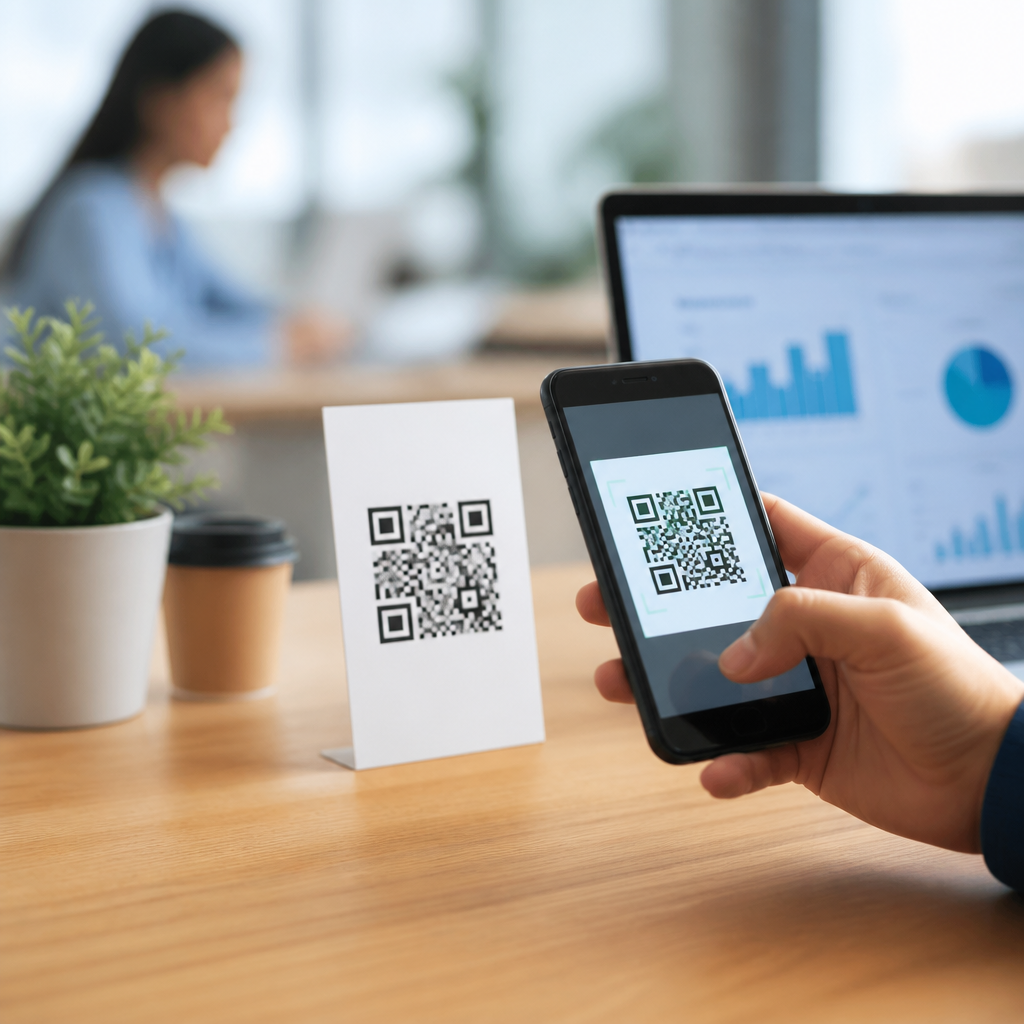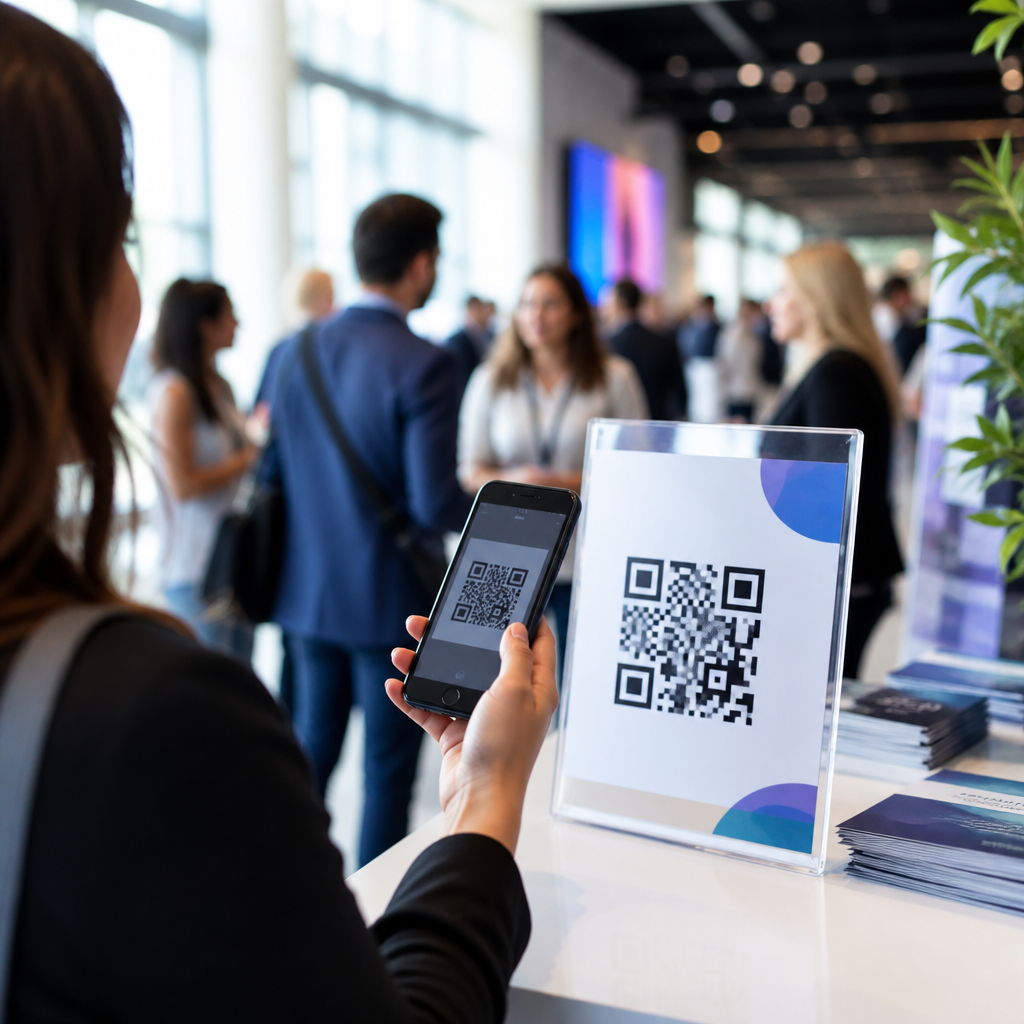
QR code marketing for events and conferences turns a small scannable square into a measurable bridge between physical experiences and digital action. In practical terms, a QR code is a two-dimensional barcode that opens a URL, file, form, ticket, menu, or app prompt when scanned with a smartphone camera. Event marketing includes every tactic used before, during, and after a gathering to drive registrations, attendance, engagement, sponsorship value, and follow-up revenue. When these two ideas are combined well, organizers gain a low-friction way to move attendees from signs, badges, booths, screens, and printed materials into trackable digital journeys.
This matters because events are full of attention gaps. A keynote slide flashes by. A sponsor handout gets folded into a bag. A networking moment ends before someone types a long web address. I have worked on conference campaigns where a single well-placed dynamic QR code doubled brochure response compared with printed vanity URLs, largely because scanning required almost no effort. The best results came when every code had a clear purpose, a mobile-first landing page, and a measurable next step such as session registration, lead capture, feedback, or content download.
For event teams, QR code marketing is not just about convenience. It improves attribution across the attendee journey. A code on an email confirmation can lead to calendar adds and mobile wallet tickets. A code on venue signage can pull up maps, agendas, and room changes without reprinting materials. A code on a sponsor display can send visitors to a gated demo request form tied to CRM scoring. Because dynamic QR platforms record scans by time, device, and location context, they also help organizers understand what messages and placements actually worked.
The hub value of this playbook is breadth. It covers the strategic decisions behind QR code marketing playbooks, from campaign planning and code creation to placement, analytics, sponsor execution, and post-event optimization. If you manage conferences, trade shows, user summits, association meetings, internal sales kickoffs, or community events, this article gives you the core framework you need before going deeper into individual tutorials. It is designed to answer the practical questions teams ask first: what should each QR code do, where should it appear, how do you measure performance, and what mistakes reduce scans?
Build a QR code strategy around the attendee journey
The most effective QR code marketing playbook starts by mapping codes to stages: pre-event, on-site, and post-event. Pre-event codes usually support registration completion, ticket access, app downloads, travel details, and agenda planning. On-site codes support check-in overflow, wayfinding, live polling, exhibitor engagement, presentation downloads, networking sign-ups, and feedback. Post-event codes push attendees toward recording libraries, certificate claims, surveys, sales consultations, and next-event waitlists. When every scan has a stage-specific intent, the program feels useful rather than gimmicky.
In practice, I recommend giving each code one primary action only. Multi-option landing pages often underperform because they create decision friction on mobile screens. A badge QR code might be for lead retrieval, while a booth display QR code goes to a product comparison page, and a session slide QR code opens the speaker deck. Keeping actions separate also protects measurement quality. If one code has one job, scan data is easier to interpret, and optimization decisions become obvious.
Audience segmentation also matters. First-time attendees need orientation resources, returning attendees may want schedule shortcuts, sponsors care about qualified leads, and speakers need simple distribution of materials. Create QR campaigns for each stakeholder instead of deploying one generic event code everywhere. For example, an association conference can use separate dynamic codes for member renewals, exhibitor prospectus downloads, certification enrollment, and chapter sign-up. The physical environment may be shared, but user intent is not.
Create codes that scan quickly and lead to mobile-first destinations
Not all QR codes perform equally. Use dynamic QR codes whenever possible because they let you update the destination after printing, which is essential if room assignments, schedules, or offers change. Dynamic platforms such as Bitly, QR Code Generator, Beaconstac, and Flowcode also provide analytics, UTM support, and management features across campaigns. Static codes are acceptable for permanent destinations with no need for scan reporting, but event teams usually benefit more from flexibility.
Scanning reliability depends on technical setup. Maintain strong contrast, usually black on white, preserve the quiet zone around the code, avoid over-stylizing finder patterns, and test across iPhone and Android devices under real venue lighting. Destination pages must load fast on cellular networks and should not require pinch-zoom. If the landing page contains a form, reduce fields to the minimum needed. At conferences, every extra tap lowers conversion because attendees are walking, talking, or standing in crowded halls.
Clear instructions increase scan rate. Pair every code with a concise call to action that tells people exactly what they get: “Download session slides,” “Enter giveaway,” “Book a demo,” or “View live agenda.” Vague labels like “Scan me” underperform because they hide the benefit. File type matters too. Sending users directly to a PDF can work for one-page handouts, but a responsive landing page usually performs better because it can frame the resource, track engagement, and offer the next step.
Use high-impact placements across event touchpoints
Placement determines whether a code is noticed, reachable, and scannable. Strong positions include registration confirmations, tickets, email signatures, event websites, social graphics, airport welcome signs, check-in counters, directional signage, lanyard inserts, table tents, expo booth walls, product demo stations, printed programs, presentation slides, and exit signage. The best placements match dwell time. People waiting in lines or sitting before a session starts are more likely to scan than people rushing between rooms.
Distance and size are practical variables many teams overlook. A common rule is that larger viewing distances require proportionally larger codes; a tiny code on a ballroom screen will fail for attendees beyond the first rows. Angle, glare, and movement also matter. A code placed on a curved banner stand or glossy floor decal may technically exist but still be hard to scan. I have seen simple matte reprints outperform expensive branded assets because the new version respected scan ergonomics.
Different placements should support different goals. A keynote slide code works for downloading the presentation or submitting questions. A hallway sign is better for maps or schedule updates. A booth code should focus on product interaction, pricing guides, or lead capture. Exit signs can drive surveys or registration for next year. This is why a hub-style QR code marketing playbook matters: placement strategy is not decoration; it is conversion design tied to attendee context.
| Touchpoint | Best QR Code Goal | Recommended Destination | Main Metric |
|---|---|---|---|
| Registration email | Reduce no-shows | Ticket wallet pass or agenda page | Open-to-scan rate |
| Check-in desk | Speed support | Venue map or help page | Scans per arrival hour |
| Session slide | Content distribution | Speaker deck landing page | Scans per attendee |
| Expo booth | Lead generation | Demo request form | Form completion rate |
| Exit signage | Feedback and retention | Survey or next-event waitlist | Submission rate |
Design sponsor, exhibitor, and networking campaigns that produce measurable value
QR codes are especially powerful when tied to sponsor outcomes. Exhibitors often want more than foot traffic; they want attributable intent. A well-built booth campaign can send visitors to a short qualification form, interactive product selector, case study library, or meeting scheduler. Instead of collecting a bowl of business cards, the exhibitor receives structured data connected to campaign source. For premium sponsors, offer unique QR placements in breakout rooms, lounges, badge inserts, or hosted networking zones and report scans alongside traditional lead totals.
Lead quality improves when the scan experience matches booth conversation. If a visitor asks about enterprise pricing, the code should open an enterprise-focused page rather than the generic homepage. If a sponsor is giving away merchandise, the redemption page can include an opt-in checkbox for future contact and a hidden UTM set identifying the specific booth asset. This keeps the experience smooth for attendees while giving the sponsor usable attribution inside HubSpot, Marketo, Salesforce, or another CRM stack.
Networking campaigns also benefit from QR mechanics. Attendee badges can include vCard downloads, LinkedIn follow prompts, or meeting-booking pages, though privacy and consent should guide execution. Community events often use QR signs at topic tables so people can join a Slack channel, WhatsApp group, or discussion thread tied to their interest area. For hosted buyer events, codes can open meeting preference forms or matchmaking portals. The principle is consistent: remove friction from the next relationship-building step while preserving clean data.
Measure performance with disciplined analytics and governance
Effective QR code marketing for conferences depends on analytics discipline. Every destination URL should use UTM parameters aligned with your event naming convention, such as source, medium, campaign, content, and term where relevant. Dynamic QR dashboards show scan volume, but scan count alone is not enough. Track downstream actions in Google Analytics 4, Adobe Analytics, or your marketing automation platform: registrations completed, assets downloaded, meetings booked, surveys submitted, pipeline created, and revenue influenced.
Governance prevents data chaos. Set naming rules before assets are produced, including event acronym, year, audience, placement, owner, and objective. A code labeled “2026_userconf_boothA_demo_cta1” is far easier to manage than “final-final-new.” Maintain a master inventory with destination URLs, print deadlines, owners, creative references, and deactivation dates. This becomes critical when multiple teams are involved, including design, field marketing, sponsors, agencies, and venue operations.
Testing should happen before, during, and after the event. Before launch, test scan speed, landing page rendering, form submission, CRM sync, and fallback behavior if Wi-Fi is weak. During the event, monitor scan spikes by hour so you can reallocate signage or update CTAs. Afterward, compare placements by conversion rate, not just volume. A booth wall may generate many scans but few qualified leads, while a session slide may produce fewer scans and more demo requests. Optimization requires outcome-based judgment.
Common mistakes, compliance issues, and practical fixes
The most common mistake is sending users to a non-mobile page or homepage instead of a specific destination. Other frequent errors include printing codes too small, placing them where people cannot stop to scan safely, using low-contrast colors, overbranding the code, or failing to explain the benefit of scanning. Another avoidable problem is using one code for too many purposes, which muddies reporting and weakens message relevance. Good QR code marketing playbooks are intentionally narrow at the asset level and broad at the program level.
Privacy, accessibility, and security deserve equal attention. If a QR code leads to lead capture, disclose how contact data will be used and comply with regulations such as GDPR or CAN-SPAM where applicable. If codes appear in public spaces, provide a short fallback URL for users who cannot scan. For accessibility, pair codes with readable text, meaningful labels, and sufficient visual contrast. For security, use reputable domains, avoid unexplained redirects, and monitor for broken links. Attendees are more cautious than they were a few years ago, and trust affects scan behavior.
Finally, treat QR codes as part of the event content system, not as decorative add-ons. Every code should have an owner, a measurement plan, and a retirement plan. If a destination expires, redirect it to a useful archive rather than letting it fail. If a sponsor page changes, update the dynamic target and document it. Small operational details determine whether QR code marketing becomes a repeatable event growth channel or a collection of disconnected experiments.
A strong QR Code Marketing Playbook for Events and Conferences gives teams a repeatable way to connect physical moments with digital outcomes. The core principles are straightforward: map each code to a stage of the attendee journey, give it one clear job, place it where scanning is realistic, send users to fast mobile destinations, and measure results beyond raw scan counts. When those basics are handled well, QR codes improve attendee convenience, sponsor value, and organizer insight at the same time.
As the hub for QR Code Marketing Playbooks within a broader QR code resources library, this article establishes the foundation for more specialized guides on creation, design, analytics, lead generation, and event operations. The main benefit is control. Instead of hoping printed materials or signage drive action, you can build intentional pathways with attribution built in. Review your next event touchpoints, identify the highest-friction attendee actions, and deploy a small set of purpose-built dynamic codes that solve them clearly.
Frequently Asked Questions
1. How can QR codes improve event and conference marketing before, during, and after the event?
QR codes are effective because they connect offline touchpoints to immediate digital actions with almost no friction. Before an event, they can be placed on flyers, direct mail, posters, sponsor promotions, social graphics, badges, and print ads to drive registrations, agenda views, speaker announcements, hotel booking pages, or early-bird offers. Instead of asking someone to type a long web address, the code gets them directly to the right destination in one scan, which often increases response rates and reduces drop-off.
During the event, QR codes become even more useful because they support real-time engagement. Organizers can use them for check-in, session sign-ins, live polls, feedback forms, interactive maps, exhibitor directories, presentation downloads, networking signups, menu access, gamification, and lead capture. A code on stage can direct attendees to session resources, while codes at booths can help sponsors collect qualified leads or distribute product information instantly. This makes the attendee experience more convenient and gives organizers measurable insight into what people actually engage with.
After the event, QR codes continue to support follow-up and revenue generation. They can drive attendees to replay libraries, post-event surveys, certification forms, future event registration pages, sponsor offers, and sales consultations. Because scans can be tracked, marketers can measure which placements, sessions, or sponsor activations drove the most action. In that sense, a QR code is not just a convenience tool—it is a measurable bridge between physical event experiences and digital conversion paths across the full event lifecycle.
2. What are the best uses for QR codes at live events and conferences?
The best uses are the ones that solve a real attendee need quickly. Registration and check-in are among the most common applications because QR codes can speed entry, reduce lines, and improve the first impression of the event. Session-specific codes are also highly effective, giving attendees instant access to presentation slides, speaker bios, learning materials, continuing education forms, or live Q&A tools without requiring them to search manually.
Wayfinding and information access are another strong category. QR codes placed at entrances, hallways, and signage can open floor maps, exhibitor lists, schedules, room changes, and venue updates. This is especially useful at larger conferences where attendees often need help navigating. Organizers can also use codes to distribute food menus, Wi-Fi instructions, emergency information, and accessibility resources in a fast and contactless format.
For sponsors and exhibitors, QR codes work best when tied to a clear value exchange. Instead of simply linking to a homepage, a sponsor code should lead to something relevant such as a giveaway entry, product demo, pricing guide, case study, free trial, or meeting booking page. For attendee engagement, QR codes can power scavenger hunts, voting, contests, community boards, and social participation campaigns. The most successful deployments are intentional, easy to scan, clearly labeled, and connected to a landing page or form designed specifically for event traffic.
3. How do you create an effective QR code campaign for an event without hurting the attendee experience?
A successful campaign starts with strategy, not design. First, define the goal for each code. One code might be meant to increase registrations, another to capture sponsor leads, and another to collect session feedback. When every QR code has a single purpose, the experience is clearer for attendees and the performance data is easier to interpret. It is also important to match the destination to the context. A code on a keynote slide should lead to something immediate and mobile-friendly, while a code on a sponsor banner can support a deeper offer or meeting request.
Usability matters just as much as strategy. The code should be large enough to scan easily, placed at a practical height and distance, and printed with strong contrast. Avoid cluttered backgrounds, tiny placements, or distorted designs that make scanning unreliable. Just as important, always include a short call to action near the code so people know what they will get by scanning. Phrases like “View the agenda,” “Download slides,” “Enter to win,” or “Book a demo” consistently outperform unlabeled codes because they set clear expectations.
On the technical side, use mobile-optimized landing pages, short forms, fast-loading content, and trackable links. Dynamic QR codes are especially helpful because they allow you to update the destination without reprinting materials, which is useful if a session room changes or a sponsor offer needs to be revised. Finally, do not overload the environment with too many codes competing for attention. A smaller number of well-placed, clearly explained QR activations will usually perform better than scattering codes everywhere and creating confusion.
4. How can event marketers measure the success of QR code marketing at conferences?
Measurement begins with identifying what success means for each use case. For a registration campaign, the key metrics might be scans, completed registrations, and cost per signup. For an exhibitor activation, the focus might be scans, form completions, qualified leads, and meetings booked. For in-event content access, marketers may look at scans by session, engagement time, resource downloads, and post-session survey participation. Tying each code to a specific objective makes reporting far more meaningful than just counting total scans.
To get accurate data, create distinct QR codes for different placements, audiences, and campaign stages. For example, use separate codes for posters, badges, booth displays, direct mail, and presentation slides rather than sending all traffic through one generic destination. This reveals which channel or physical location is producing the strongest response. Adding UTM parameters, analytics events, CRM integrations, and marketing automation workflows helps teams connect scan behavior to downstream outcomes such as pipeline, sales conversations, renewals, or repeat attendance.
It is also important to look beyond vanity metrics. A high scan count is useful, but it does not necessarily mean the campaign was successful. The more valuable questions are whether people completed the intended action, how quickly they converted, which audience segments engaged most, and whether the activation created sponsor value or attendee satisfaction. Reviewing performance after the event can inform future design, placement, messaging, and follow-up strategies. In mature event programs, QR code analytics become part of a broader attribution model that links physical experiences to measurable business results.
5. What are the most common QR code mistakes event organizers should avoid?
One of the biggest mistakes is using QR codes without a clear purpose. If a code does not lead to something useful, timely, or relevant, people will stop trusting them. Sending attendees to a generic homepage is a common example of wasted opportunity. Another frequent problem is poor mobile experience. If the page loads slowly, the form is too long, the file is difficult to view on a phone, or the destination is not optimized for smaller screens, even interested attendees may abandon the action.
Physical execution issues also hurt performance. Codes that are too small, placed too high, printed on glossy surfaces with glare, hidden in low-light areas, or crowded by visual noise can be difficult to scan. Organizers should also avoid relying on weak calls to action. A QR code by itself is not a message. People need to know why they should scan and what benefit they will receive. Clear instructions and immediate value make a major difference in engagement.
Another common mistake is failing to test and track. Every code should be tested on multiple phone types, in the real venue environment, and under expected lighting and distance conditions. Broken links, expired pages, access restrictions, and untracked destinations can undermine both attendee experience and campaign analysis. Finally, organizers should not overlook privacy and transparency, especially when using codes for lead capture or attendee data collection. Explain what users are opting into, collect only necessary information, and make sure sponsor and organizer follow-up aligns with consent expectations. Good QR code marketing feels helpful, fast, and intentional—not intrusive or confusing.