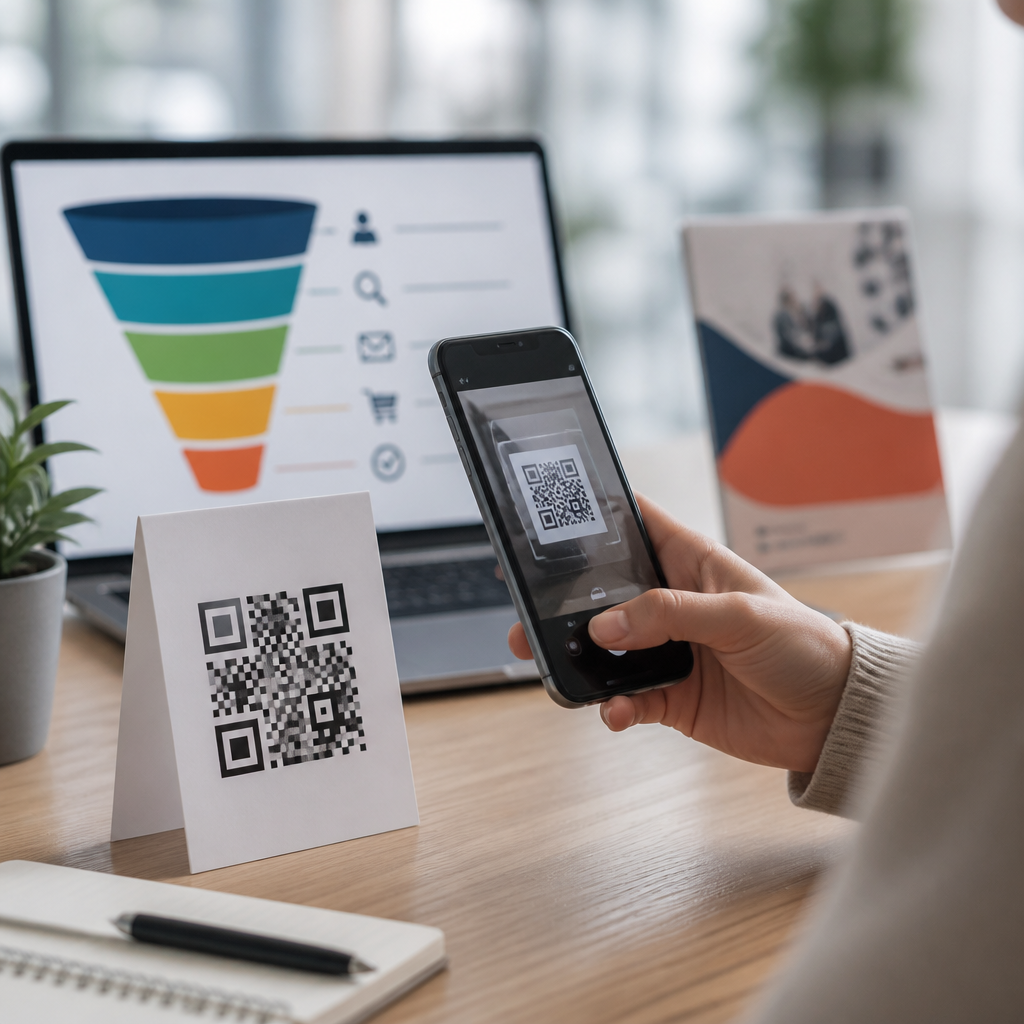
QR codes have moved from novelty to core marketing infrastructure because they connect physical touchpoints to digital actions with almost no friction. In a marketing funnel, that matters: every extra click, search, or form field reduces response rates. A quick response code removes those steps by sending a prospect from packaging, direct mail, signage, events, or product inserts straight to a landing page, video, coupon, chat flow, app download, or checkout experience. When I have implemented QR code campaigns for retail promotions, B2B trade shows, and local service businesses, the strongest results came when the code was treated not as a design add-on but as a measurable conversion path tied to funnel stages, traffic sources, and revenue outcomes.
To integrate QR codes into your marketing funnel, you need to understand both parts of that equation. A marketing funnel is the structured journey from awareness to consideration, conversion, retention, and advocacy. Integration means assigning a clear role to each QR code within that journey, building a destination matched to user intent, and tracking what happens after the scan. Static QR codes point to a fixed destination and cannot be changed after printing. Dynamic QR codes use a short redirect URL, allowing you to update destinations, add tracking parameters, and monitor scan data without reprinting materials. For almost every serious campaign, dynamic codes are the better choice because they support testing, attribution, and optimization.
This topic matters because offline and online marketing are no longer separate systems. A product label can capture first-party data. A poster can launch an appointment booking flow. A restaurant table tent can trigger loyalty enrollment. A real estate sign can deliver a listing video and lead form. Marketers who map QR codes to funnel objectives gain cleaner attribution, lower acquisition friction, and better continuity between channels. They also avoid common failures such as sending all scans to a homepage, printing untrackable codes, or using the same destination for prospects at very different levels of intent. The companies getting the most value from QR codes are the ones building them into the funnel deliberately, stage by stage.
Map QR codes to each stage of the funnel
The first step is assigning a job to the QR code based on where the audience is in the buying journey. Awareness-stage QR codes should educate, not sell aggressively. Good destinations include a short explainer video, a campaign landing page, a lookbook, a local offer, or a store locator. For example, a fitness studio placing codes on community flyers usually performs better by offering a class schedule and first-visit pass than by sending users directly to a long membership checkout form. At this stage, the scan is a signal of interest, and your goal is to capture attention and move the visitor into a known audience segment.
Consideration-stage QR codes should help prospects evaluate options. In practice, that means linking to case studies, comparison pages, demos, menus, pricing explainers, testimonial reels, or FAQs. At trade shows, I have seen B2B software teams lift lead quality by using booth QR codes that open a tailored product page with industry-specific proof points rather than a generic corporate homepage. The visitor scans because they want more detail now. Your destination should answer likely questions immediately: What does it do? Is it credible? Is it right for my use case? What is the next step?
Conversion-stage QR codes are the most direct. They belong on product packaging, shelf talkers, point-of-sale displays, sales sheets, invoices, and retargeting mailers, where purchase intent is stronger. Effective destinations include checkout pages, booking forms, limited-time coupons, financing applications, consultation scheduling, or cart recovery flows. A home services company can place a QR code on door hangers that launches a quote request page prefilled with the campaign source. A consumer packaged goods brand can add a code to an in-store display that opens a mobile coupon redeemable that day. The principle is simple: if the user is ready to act, remove every avoidable step.
Retention and advocacy matter just as much. After the sale, QR codes can direct customers to onboarding guides, setup videos, care instructions, warranty registration, referral offers, review requests, or loyalty enrollment. A skincare brand can put separate codes on packaging inserts: one for how-to content, another for subscription reorder. A SaaS company can include a code in event handouts that opens a customer training hub. These post-purchase uses improve activation and retention while creating new measurable touchpoints. In a complete marketing funnel, QR codes should not stop at acquisition; they should support the customer lifecycle from first impression through repeat purchase and referral.
Build destinations that match scan intent
The landing experience determines whether a scan becomes a conversion. People scan QR codes in highly specific contexts, often on mobile, often while standing, walking, shopping, or talking to someone. That means the destination must load quickly, present one primary action, and reflect the promise made by the surrounding creative. If a printed sign says “Scan for today’s menu,” the code should open the menu, not a homepage where the user has to search. If direct mail offers a free consultation, the code should lead straight to a booking page with available times, not a general services overview. Relevance is the single biggest driver of post-scan performance.
In practice, high-performing QR landing pages are narrow, not broad. Use a clear headline, a short supporting explanation, visible trust markers, and one obvious button or form. For e-commerce, that may mean a product page with a discount automatically applied. For healthcare, it may mean a compliant appointment request page with location-specific details. For restaurants, it may mean a menu segmented by meal type and dietary options. Marketers often fail by overloading the page with every possible action. A QR code scan is usually a micro-moment. Design for speed and clarity, not navigation depth.
Mobile usability is nonnegotiable. Test the page on different devices, browsers, and connection speeds. Compress images, minimize scripts, and avoid interstitial pop-ups that obscure the main action. If the campaign serves multilingual audiences, route visitors to language-appropriate pages based on context or allow instant switching. Accessibility also matters: sufficient contrast, readable font sizes, descriptive button text, and video captions improve usability for everyone. In regulated sectors such as finance, insurance, and healthcare, include required disclosures without burying the primary action. A frictionless experience does not mean an incomplete one; it means giving users exactly what they need to proceed confidently.
Use dynamic QR codes, campaign structure, and measurement
QR code integration becomes real when scans can be measured against business outcomes. Dynamic QR codes are the foundation because they let you change destinations, create separate codes for each placement, and collect scan-level data such as timestamp, device type, and approximate location. Pair that with analytics tags so every scan carries campaign, medium, source, content, and term data into your web analytics and CRM. Google Analytics 4, Adobe Analytics, HubSpot, Salesforce, and Marketo can all support this workflow when the redirect and landing URLs are planned correctly.
A reliable naming convention prevents reporting chaos. I recommend structuring codes by funnel stage, channel, audience, asset, location, and offer. For example, a direct mail piece for dormant customers might use a destination tagged as retention, mail, past-customers, spring-offer, zip-cluster-a. That level of specificity lets you answer practical questions later: Did packaging inserts outperform event badges? Did store window scans convert better than shelf scans? Did the code on the sales brochure drive qualified demos or just top-of-funnel traffic? Without distinct codes and disciplined tagging, all those insights disappear into “direct” traffic or generic campaign buckets.
| Funnel Stage | Typical Placement | Best Destination | Primary KPI |
|---|---|---|---|
| Awareness | Posters, packaging, outdoor signage | Explainer page, video, store locator | Unique scans, engaged sessions |
| Consideration | Trade show booth, brochure, print ad | Case study, demo page, product comparison | Lead submissions, demo requests |
| Conversion | POS display, direct mail, sales sheet | Checkout, booking form, coupon page | Purchases, appointments, revenue |
| Retention | Receipt, insert, welcome kit | Onboarding, loyalty signup, reorder page | Repeat orders, activation rate |
Measurement should go beyond scan counts. A high-scan code can still be underperforming if bounce rate is high, forms are abandoned, or assisted revenue is low. Evaluate the full chain: scan rate by impression, landing page engagement, conversion rate, cost per acquisition, average order value, lead quality, and downstream retention. In brick-and-mortar environments, compare scan data with store traffic, redemptions, and POS records. In B2B, connect scans to pipeline stages and closed-won revenue. This is where QR codes stop being a tactic and start functioning as a channel with accountable performance.
Place and design QR codes for real-world scanning
Even the best funnel strategy fails if the code is hard to notice or scan. Placement should reflect user behavior, distance, lighting, and available dwell time. A code on a countertop can be smaller because the user is close. A code on transit signage needs much greater size and simpler supporting copy because the scan must happen quickly. Maintain strong contrast, preserve the quiet zone around the code, and avoid warping or printing on reflective, curved, or textured surfaces that interfere with camera recognition. Error correction helps, but it does not rescue poor production choices.
Supporting copy matters more than many brands assume. Users need a reason to scan and a clear expectation of what happens next. “Scan to book a free estimate,” “Scan for ingredient details,” and “Scan to watch setup in 60 seconds” outperform vague prompts like “Learn more.” In stores, I have repeatedly seen response rates improve when the code is paired with a specific incentive or utility rather than generic brand messaging. Contextual relevance also increases trust. A code beside a product benefit, menu item, or event session description feels purposeful. A floating code with no explanation often gets ignored.
Branding should aid recognition without compromising readability. Most modern generators allow custom colors and logo overlays, but function must come first. Test every version on multiple devices before production and after placement. Use a shortened redirect managed by a reputable platform, secure the destination with HTTPS, and avoid suspicious-looking URLs in nearby copy. If the audience may be cautious about scams, especially in payments or public spaces, reinforce legitimacy with your brand name, a visible domain, and a concise privacy reassurance where appropriate. Trust is part of conversion design.
Connect QR codes to CRM, automation, and lifecycle marketing
The highest ROI appears when QR scans trigger follow-up, not when they end at a single session. Connect landing forms, coupon claims, and bookings to your CRM so each scan can become a known contact, customer record update, or audience membership change. In HubSpot, for example, a QR-driven form can stamp the contact source, lifecycle stage, campaign ID, and sales owner automatically. In Salesforce, scans linked through Marketing Cloud or Pardot can enter nurture tracks based on product interest or event source. This is where physical media starts behaving like digital performance marketing.
Segmentation should reflect both context and intent. Someone who scans a product comparison code from a brochure is different from someone who scans a reorder code on packaging. Build automations that respect that difference. Awareness scanners may receive educational email sequences or retargeting audiences. Consideration scanners may get case studies, webinar invites, or sales outreach. Conversion scanners may trigger abandoned-cart reminders, booking confirmations, or SMS follow-up. Retention scanners may enter loyalty flows, replenishment reminders, or review requests. The code itself can be the first-party signal that determines what happens next.
This approach also improves attribution across channels. A retail brand can compare QR scans from in-store displays with paid social traffic to the same product and see which produces better assisted conversions. A university can track whether campus signage codes generate more qualified applications than search ads for specific programs. A manufacturer can identify which distributor handouts lead to registrations and support requests. Once scans are tied to contact records and revenue events, marketers can make budget decisions based on actual funnel contribution rather than surface engagement alone.
Avoid common mistakes and optimize continuously
The most common mistake is sending every scan to the homepage. The second is printing one code everywhere, which destroys source clarity. Others include using static codes for long-running campaigns, failing to test on mobile, placing codes where there is no signal or time to act, and neglecting analytics governance. I have also seen teams launch QR promotions without training frontline staff, which matters more than it seems. In stores, at events, and in service settings, employees often influence whether customers notice, trust, and use the code. A two-sentence script can materially improve scan rates.
Optimization should be structured. Test one variable at a time: call-to-action copy, incentive, destination format, form length, or placement height. Compare a coupon offer against an educational offer. Test whether a video-first landing page outperforms a static product page for top-of-funnel placements. Review device mix, load speed, and drop-off points. If scans are high but conversions are low, the issue is usually the destination or offer. If impressions are high but scans are low, the issue is usually placement, visibility, or motivation. QR performance can be diagnosed clearly when the funnel is mapped and the data is clean.
Compliance and privacy should be built in from the start. Disclose data collection where required, honor consent preferences, and avoid capturing more information than the use case justifies. For healthcare campaigns in the United States, review HIPAA implications before routing users to forms containing protected health information. For audiences in Europe, assess lawful basis and cookie consent obligations under GDPR. Good governance does not slow growth; it protects campaign durability and brand trust.
Integrating QR codes into your marketing funnel works when each code has a defined purpose, a context-matched landing experience, and measurable downstream outcomes. The strongest programs map codes to funnel stages, use dynamic redirects, tag every campaign consistently, and connect scans to CRM and automation systems. They also respect the realities of mobile behavior: people want speed, clarity, and a direct path to the next action. Whether your touchpoint is packaging, direct mail, trade shows, storefront signage, receipts, or product inserts, the principle stays the same. A QR code should reduce friction at a specific moment and move the user one step closer to value.
As a hub topic within a broader QR code marketing strategy, this subject touches campaign design, analytics, conversion optimization, retention, and attribution. Treat QR codes as operational assets, not decorative elements. Create separate codes for separate intents. Match every scan to a tailored destination. Measure beyond scans to leads, sales, activation, and repeat purchase. Then improve the system through testing. Brands that do this well turn ordinary physical surfaces into accountable funnel entry points and customer lifecycle triggers.
Audit your current funnel, list every offline and on-product touchpoint, and assign one QR code opportunity to each stage. Then launch with dynamic tracking, mobile-first landing pages, and a clear follow-up workflow. That is how QR codes become a reliable growth channel instead of a missed opportunity.
Frequently Asked Questions
1. Where should QR codes fit into a marketing funnel?
QR codes can support every stage of the marketing funnel when they are tied to a clear next step rather than used as a generic link. At the top of the funnel, they work well on packaging, out-of-home signage, event booths, print ads, and direct mail to drive awareness traffic to a landing page, explainer video, giveaway, or lead magnet. In the middle of the funnel, they can move interested prospects into higher-intent actions such as booking a demo, reading case studies, comparing products, joining an email list, or starting a chat flow. At the bottom of the funnel, they are especially effective for sending people directly to a product page, limited-time offer, checkout page, app install, or coupon redemption experience. Post-purchase, they can also improve retention by linking to onboarding guides, referral programs, review requests, reorder pages, loyalty enrollment, and customer support resources.
The key is to match the code to buyer intent at the moment it is scanned. Someone scanning a QR code from a trade show banner is in a very different mindset than someone scanning a product insert at home. If you want QR codes to strengthen the funnel, build each destination around context, urgency, and relevance. A code on retail packaging should not dump users onto a generic homepage. It should take them to the exact action most likely to continue momentum. That is what makes QR codes valuable: they remove friction between attention and action, which is exactly what a well-designed funnel is supposed to do.
2. What makes a QR code campaign actually convert instead of just generating scans?
A scan by itself is not the goal. Conversion happens when the destination experience is tightly aligned with the promise of the physical touchpoint. If a flyer offers a discount, the QR code should open directly to the offer, with the code applied or clearly displayed. If a product label invites people to learn more, the page should immediately explain benefits, answer objections, and present a next step. The biggest conversion mistake is creating unnecessary friction after the scan, such as sending traffic to a homepage, forcing people to hunt for the offer, or presenting too many choices at once. The moment after a scan is high intent but fragile, so the landing experience has to be fast, mobile-friendly, and singular in purpose.
Strong QR code conversion also depends on copy, design, and trust signals around the code itself. People are more likely to scan when they understand exactly what they will get, why it matters, and what happens next. A short call to action like “Scan to get 15% off,” “Scan to book your consultation,” or “Scan to watch the 2-minute demo” usually outperforms a bare QR code with no explanation. On the landing page, reinforce confidence with recognizable branding, concise messaging, proof points, testimonials, and minimal form fields. In many cases, the best-performing flow is one that asks for the least information possible upfront, then captures additional data later as engagement grows. That is how scans turn into leads, customers, and repeat buyers.
3. How can I track QR code performance across different channels and funnel stages?
Tracking starts with treating each QR code as a distinct campaign asset rather than using one code everywhere. If the same code appears on direct mail, packaging, in-store signage, and event materials, it becomes much harder to understand which touchpoint is driving results. A better approach is to create channel-specific or placement-specific destination URLs with campaign parameters so you can attribute scans, visits, conversions, revenue, and downstream behavior accurately in your analytics platform. Dynamic QR codes are often the best choice because they let you change the destination without reprinting the code and give you centralized reporting on scans by location, device, and time.
To measure true funnel impact, go beyond scan volume. Track metrics such as landing page conversion rate, form completion rate, coupon redemption, app installs, purchases, assisted conversions, customer acquisition cost, and lifetime value from QR-driven traffic. If you use a CRM and marketing automation platform, connect the scanned visit to lead records so you can see how QR-originated contacts move through nurture sequences and sales stages. It is also smart to compare QR performance against other call-to-action formats in the same campaign. In many cases, the strongest insight is not just that a QR code was scanned, but that it shortened the path to conversion compared with manual URLs, search behavior, or traditional print response methods.
4. What are the most common mistakes brands make when using QR codes in marketing?
One of the most common mistakes is using QR codes without a defined purpose. When a code leads to a generic homepage or an unfocused page with multiple competing actions, response rates usually suffer. Another frequent issue is placing codes in environments where scanning is inconvenient, such as on moving vehicles, high above eye level, behind reflective surfaces, or in low-light conditions. Size, contrast, spacing, and testing matter more than many marketers expect. If the code is hard to scan or the page loads slowly, you lose the moment. Poor mobile experience is another major problem, because nearly all scans happen on phones and users expect immediate, seamless interaction.
Brands also make strategic mistakes by ignoring context and audience readiness. A QR code on product packaging should not ask for the same commitment as a code on a lead-generation mailer. Similarly, failing to explain the value of scanning can suppress engagement. People need a reason. Security perception can matter too; users are more cautious if the brand is unfamiliar or the call to action is vague. Finally, many campaigns underperform because they are never tested. High-performing QR programs usually involve experimentation with CTA wording, destination page design, incentive strength, placement, timing, and follow-up sequences. The technology itself is simple, but the execution determines whether the QR code becomes a conversion tool or just a decorative square on printed material.
5. Should I use static or dynamic QR codes, and which is better for long-term funnel optimization?
For most marketing funnel use cases, dynamic QR codes are the better option because they provide flexibility and better measurement. A static QR code points directly to a fixed URL, which can be fine for permanent content with no expected changes. However, if the landing page needs to be updated, a promotion ends, tracking parameters change, or you want to redirect traffic to a different experience based on campaign timing, a static code becomes limiting. Dynamic codes solve that problem by letting you edit the destination after the code has been printed or deployed. That makes them especially valuable for packaging, signage, inserts, and other materials with a longer shelf life.
Dynamic QR codes are also better for optimization because they support testing and iteration. You can route traffic to different landing pages, update offers seasonally, pause underperforming experiences, and maintain cleaner analytics across campaigns. This is important in a funnel environment where messaging evolves and customer intent differs by source. For example, the same printed insert might first promote onboarding content, then later switch to a loyalty offer or reorder page without changing the physical asset. The main consideration is choosing a reliable platform so links remain active and data remains accessible over time. If QR codes are becoming part of your marketing infrastructure rather than a one-off tactic, dynamic codes usually provide the control, reporting, and adaptability needed to improve funnel performance over the long term.