IoT-driven marketing with QR codes turns ordinary packaging, displays, and products into connected media channels that can identify context, trigger digital experiences, and generate measurable first-party data. In this context, the Internet of Things means physical objects embedded with software, sensors, identifiers, and network connectivity, while QR codes act as the low-friction bridge that lets a customer move from a printed surface to a live digital environment with one scan. Smart packaging describes packs, labels, or inserts that do more than contain a product: they authenticate items, surface usage instructions, launch loyalty journeys, collect consented engagement data, and connect purchase behavior to post-purchase actions. I have worked on packaging rollouts where a simple static code delivered modest scan rates, then doubled engagement after we tied the destination to batch data, inventory status, and regional offers. That is why this topic matters. Brands are under pressure to reduce dependence on third-party cookies, prove campaign attribution, improve traceability, and create durable customer relationships after the sale. QR codes connected to IoT systems solve several of those problems at once because they can be printed cheaply, updated dynamically, and linked to cloud platforms that interpret device, location, time, and product metadata in real time. For a sub-pillar focused on smart packaging and IoT integration, the central idea is practical: every package can become a measurable touchpoint across manufacturing, retail, consumer use, and service.
Used well, connected QR experiences help marketing teams coordinate with operations, product, and customer support instead of running isolated campaigns. A beverage label can launch a freshness story tied to production date, a cosmetics carton can verify authenticity and explain safe use, and an appliance insert can activate registration, troubleshooting, and replenishment reminders from one code architecture. GS1 Digital Link standards are increasingly important here because they allow web addresses to carry structured product identifiers such as GTIN, serial number, lot, and expiration data in a format that supports both commerce and consumer engagement. The result is not just a landing page strategy but a connected product strategy. Brands that understand this build QR code programs as infrastructure: dynamic URL management, event tracking, content rules, CRM integration, and packaging governance. Those that do not usually end up with fragmented codes, dead links, inconsistent analytics, and missed compliance requirements. Smart packaging and IoT integration therefore sit at the intersection of marketing performance, product transparency, and operational intelligence.
What IoT-driven marketing with QR codes actually includes
At a practical level, IoT-driven marketing with QR codes combines four layers: the physical code, the digital identity behind that code, the rules engine that decides what the visitor sees, and the analytics pipeline that records what happened. The physical layer may be on-pack print, a tamper-evident seal, an in-store shelf talker, or a connected device screen. The identity layer maps each code to a SKU, campaign, market, or even an item-level serial number. The rules layer determines whether the destination changes based on scan time, geography, language, stock status, weather, or customer segment. The analytics layer collects scan events, conversion steps, and downstream actions such as registration, reorder, review submission, or support case creation. When marketers ask what makes this different from a normal QR campaign, the answer is that the code is not just a shortcut to a URL. It is an access point into a live data system.
That system can also connect to sensors or device telemetry. For example, a cold-chain food shipment may include temperature monitoring through an IoT platform, while the outer pack QR code exposes freshness information and handling guidance. A home air purifier can display a QR code on the device itself, linking each scan to filter status, product registration, firmware notes, and replenishment offers. In both cases, the scan becomes more useful because it reflects the state of the product or the supply chain. Consumers get relevance, and brands get consented first-party interaction data tied to a specific object or product family. This is why smart packaging matters more than basic print-to-web execution.
How smart packaging creates measurable consumer journeys
Smart packaging works because it reaches the customer at the moment of possession, which is usually a stronger context than a social impression or display click. Once someone is holding a product, the probability of interest is already high. The job of the QR code is to reduce friction from curiosity to action. Effective journeys usually answer the immediate question first, then present the next-best action. On food packaging, that first question might be ingredients, sourcing, allergy information, or recipe ideas. On supplements, it may be dosage and safety guidance. On electronics, it is often setup, warranty registration, and support. The best programs avoid generic homepages and instead send the scanner to a product-specific experience that loads fast, is mobile-first, and contains localized content.
I have seen this work especially well in categories where trust affects repeat purchase. A premium olive oil brand can place a code on the bottle neck that verifies origin, shows harvest details, and explains tasting notes. That scan path supports authenticity, education, and retention in one flow. A pharmaceutical leaflet replacement can reduce paper while giving patients the latest instructions, adverse event contacts, and refill options. A beauty brand can use one carton code to deliver shade-matching tutorials, ingredient transparency, and loyalty enrollment. In each case, scan behavior becomes a measurable signal of interest after purchase, when most traditional media tracking ends. That gives marketers a clearer view of product engagement, not just ad engagement.
Core integration models for packaging, devices, and data platforms
Most successful implementations fall into three models. The first is campaign-linked packaging, where a dynamic QR code routes scanners to seasonal offers, contests, or content experiences. This is easier to launch because it does not require item-level serialization, but it offers less traceability. The second is product-linked packaging, where each SKU or batch has a persistent digital identity connected to PIM, ERP, and analytics systems. That supports richer use cases such as region-specific instructions, inventory-aware promotions, and lot-level recalls. The third is item-linked identity, where each unit has a unique serial number and often a tamper-evident or secure print element. This is the most complex model, but it enables strong anti-counterfeit programs, ownership transfer, warranty activation, and circular economy tracking for resale or recycling.
Technology choices should reflect business goals. A fast-moving consumer goods brand focused on engagement and couponing may only need dynamic code management plus CRM and analytics integration. A regulated manufacturer may need GS1-compatible identifiers, audit trails, role-based access control, and content versioning. Teams often use QR management platforms, customer data platforms, tag managers, marketing automation, and cloud warehouses together. The most common architecture I recommend starts with a dynamic resolver, passes parameters into analytics, stores structured product metadata centrally, and exposes content through APIs so packaging experiences stay current without reprinting packs. This reduces operational risk and makes connected packaging scalable across markets.
| Integration model | Typical use case | Data depth | Operational complexity | Example |
|---|---|---|---|---|
| Campaign-linked | Promotions, sweepstakes, video content | Low to moderate | Low | Snack brand code leading to a summer contest page |
| Product-linked | Instructions, localization, recalls, loyalty | Moderate to high | Medium | Coffee pack code showing roast date and brew guides by market |
| Item-linked | Authentication, warranty, resale, service history | High | High | Luxury accessory code verifying serial number and ownership |
Personalization, context, and real-time decisioning
The reason marketers pair QR codes with IoT systems is context. A single code can behave differently based on who scans, where they are, and what the product state indicates. Real-time decisioning can switch language automatically, suppress promotions for out-of-stock items, direct users to the nearest retailer, or present service guidance if a device has known firmware issues. On connected appliances, scan events can be joined with device telemetry so the owner sees maintenance content matched to actual usage rather than generic instructions. On reusable packaging, repeated scans can indicate refill behavior and trigger sustainability rewards. This is where connected packaging becomes more than content delivery; it becomes adaptive lifecycle marketing.
Personalization must be balanced with privacy and usability. Not every scan should demand login, and not every experience should ask for personal data. The strongest programs earn consent gradually by giving immediate value first. For example, a sports nutrition brand may let anyone scan for ingredient sourcing and how-to-use content, then offer optional account creation for personalized training plans and replenishment reminders. That sequence respects user intent and typically converts better than gate-first flows. From a measurement standpoint, it also separates anonymous engagement from authenticated customer actions, which makes reporting cleaner.
Operational requirements: printing, governance, and analytics
Execution quality determines whether a connected packaging program succeeds. Print specifications matter because low contrast, curved surfaces, varnish glare, and tiny quiet zones can destroy scan performance. Codes should be tested across devices, lighting conditions, and packaging materials before full production. Dynamic redirects need uptime monitoring, redirect limits should be controlled to protect page speed, and destination pages must be responsive because most scans happen on mobile networks in imperfect environments. Governance matters too. Someone must own code naming conventions, campaign expiration rules, localization workflows, and change approval. Without that discipline, brands accumulate orphaned destinations and misleading analytics.
Measurement should go beyond total scans. Useful key performance indicators include unique scans, repeat scans, scan-to-registration rate, scan-to-purchase rate, dwell time, content completion, retailer locator usage, coupon saves, and support deflection. In service contexts, I also track whether QR-assisted self-service reduced call center volume or shortened mean time to resolution. For packaged goods, cohorting by batch, region, and retailer can reveal where packaging placement or merchandising improved response. The most mature teams connect scan data to CRM, commerce, and support systems so they can estimate customer lifetime value impact rather than reporting vanity metrics.
Trust, compliance, and anti-counterfeit applications
Connected QR codes can strengthen trust, but only if brands handle security and compliance carefully. In regulated categories such as food, healthcare, chemicals, and infant products, digital content must align with labeling laws, accessibility expectations, and market-specific disclosure rules. If a QR code replaces or supplements printed instructions, legal review and version control are essential. For anti-counterfeit programs, static visible codes alone are rarely enough. Stronger approaches combine unique identifiers, secure serialization, anomaly detection, and packaging features such as tamper evidence or hidden authentication layers. A counterfeit network can copy a visible code, but it is much harder to fake one-time activation logic tied to item-level records.
Consumer trust also depends on transparency. If a scan collects location or personal data, say so clearly and explain the benefit. If content changes by market, ensure the user can switch language manually. If the product is recalled, the QR experience should prioritize safety information over promotional content immediately. These details matter because the package is often perceived as the brand’s most trustworthy surface. Misusing it damages confidence quickly.
Building a scalable hub strategy for smart packaging and IoT integration
As a sub-pillar hub, this topic should guide readers to adjacent advanced strategies while remaining complete on its own. The strongest content architecture branches into detailed pages on dynamic QR code infrastructure, GS1 Digital Link implementation, anti-counterfeit serialization, connected product onboarding, QR code analytics, privacy and consent design, recall communications, and loyalty journeys from packaging. That internal linking structure helps users and also mirrors how teams actually deploy these systems: one capability builds on another. A brand rarely starts with item-level serialization on day one. It usually begins with dynamic codes on packaging, adds analytics and CRM integration, then expands into authentication, service, and circularity use cases as maturity grows.
The business case becomes clearer when stakeholders see shared value. Marketing gains measurable engagement and first-party data. Operations gain traceability and updateable product information. Customer support gains self-service entry points. Compliance gains better control of digital disclosures. Sustainability teams gain proof points for reuse, refill, and recycling participation. That cross-functional payoff is why IoT-driven marketing with QR codes has moved from novelty to infrastructure.
Smart packaging and IoT integration give brands a practical way to connect physical products with digital intelligence at scale. QR codes are the visible trigger, but the real advantage comes from the system behind them: structured identifiers, dynamic routing, context-aware content, analytics, and governance. When those elements work together, every package can support discovery, education, authentication, service, and retention across the product lifecycle. The result is better customer experience and better data, achieved through a format consumers already understand and use.
The key takeaway is straightforward. Do not treat packaging QR codes as isolated campaign assets. Treat them as connected product infrastructure. Start with high-intent use cases such as setup, authenticity, sourcing transparency, or replenishment. Build on standards where possible, especially structured product identifiers. Design mobile experiences that answer the user’s first question immediately. Then connect scan events to the systems that matter: CRM, commerce, support, and supply chain data. That is how smart packaging becomes measurable, trustworthy, and scalable.
If you are developing a QR Code Advanced Strategies roadmap, use this hub as your foundation for smart packaging and IoT integration. Audit existing packaging codes, map the data sources behind them, identify one post-purchase journey to improve, and launch with governance in place from the start. The brands that do this well turn a printed square into a long-term growth channel.
Frequently Asked Questions
1. What is IoT-driven marketing with QR codes?
IoT-driven marketing with QR codes is a strategy that connects physical products, packaging, retail displays, and other real-world touchpoints to digital experiences that can adapt in real time. In this model, the Internet of Things refers to connected objects that may include software, sensors, unique identifiers, and network access, while the QR code serves as the simplest customer-facing entry point. A shopper scans a code on a package, sign, label, or product, and that scan opens a live digital destination that can reflect context such as location, time, device type, campaign source, or product batch.
What makes this approach especially powerful is that it transforms static media into interactive, measurable media. Instead of printing a package once and losing visibility after distribution, brands can use dynamic QR codes tied to connected systems to update content without changing the printed asset. That means one code can lead to product education, loyalty enrollment, personalized offers, authentication tools, reorder flows, how-to videos, sustainability information, or post-purchase support. At the same time, each interaction can generate first-party data that helps marketers understand engagement patterns, campaign performance, and customer behavior across the product lifecycle.
In practical terms, IoT-driven marketing with QR codes sits at the intersection of packaging, commerce, analytics, and customer experience. It gives brands a low-friction way to bridge the gap between offline and online environments while making everyday objects part of a connected marketing ecosystem.
2. How do QR codes support IoT marketing campaigns on packaging and in-store displays?
QR codes support IoT marketing campaigns by acting as an immediate, familiar bridge between a physical surface and a connected digital system. On smart packaging, a QR code can link a customer to a product-specific landing page, ingredient traceability record, setup guide, promotional offer, warranty registration form, or loyalty experience. On in-store displays, the same mechanism can trigger product comparisons, immersive brand storytelling, videos, limited-time promotions, or localized inventory and store information. Because scanning requires no special hardware beyond a smartphone camera, QR codes remove much of the friction that often limits participation in connected experiences.
When tied to IoT infrastructure, the value goes beyond simple redirection. A code can be associated with a unique SKU, serial number, region, distributor, or campaign instance, allowing marketers to serve highly relevant content based on where and how the scan occurs. For example, a beverage brand might use one printed code format across millions of labels, but route users to different promotions depending on market, season, or retail partner. A consumer electronics company might place QR codes on packaging and point-of-sale displays that launch onboarding flows after purchase, but educational content before purchase. This ability to manage content dynamically is one of the biggest advantages of combining QR with connected systems.
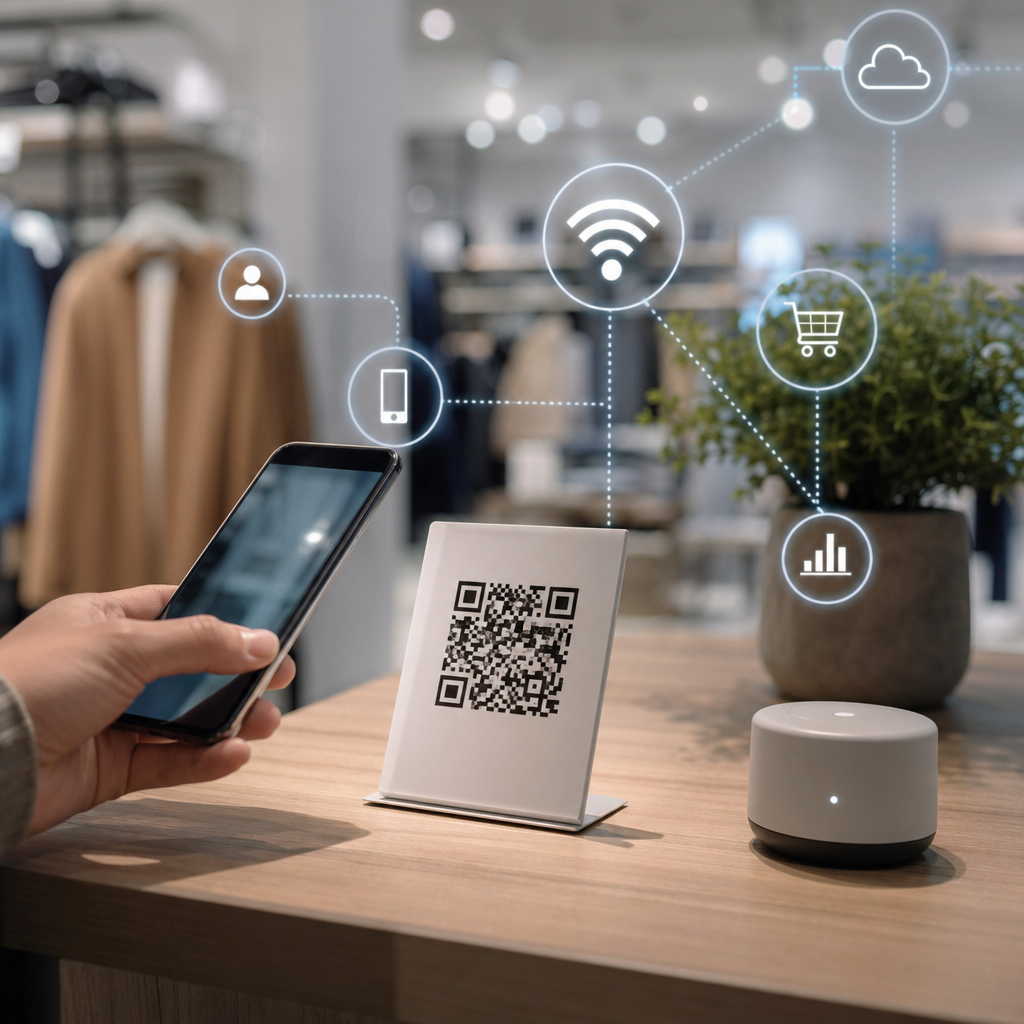
In-store, QR-enabled IoT campaigns can also help unify retail and digital measurement. Brands can see which displays generate scans, which locations outperform others, what time of day engagement peaks, and what types of content lead to conversion. That creates a feedback loop that improves merchandising, creative strategy, and media planning. Instead of treating packaging and displays as passive assets, marketers can treat them as active, data-generating media channels.
3. What kind of first-party data can brands collect through IoT-enabled QR code interactions?
Brands can collect a wide range of first-party data through IoT-enabled QR code interactions, especially when customers voluntarily engage with branded digital experiences after scanning. At a basic level, marketers can capture interaction data such as scan volume, timestamp, device type, operating system, approximate location, referral source, campaign identifier, and landing-page engagement. This alone can reveal where products are being scanned, which packaging versions drive the most activity, and how physical touchpoints perform across channels and regions.
With clear consent and a well-designed experience, brands can also gather declared and behavioral first-party data. Declared data may include email addresses, loyalty sign-ups, preferences, survey responses, product interests, purchase intent, and registration details. Behavioral data can include which content a user views, whether they watch videos, click through to product pages, redeem offers, register warranties, reorder items, or interact with support tools. Over time, these signals help build a more accurate picture of customer needs and lifecycle stage, from discovery and consideration to onboarding, usage, replenishment, and advocacy.
One important advantage of QR-based data collection is that it often originates from a direct customer interaction with a physical product or environment. That can make the data especially valuable for attribution and customer journey analysis. For example, a scan on packaging after purchase may indicate ownership, while a scan on a shelf display may indicate active consideration. However, the most effective brands approach this opportunity responsibly. They provide transparent consent language, explain the value exchange, and implement data governance practices that align with privacy laws and customer expectations. The goal is not simply to collect more data, but to collect useful, permission-based data that improves the customer experience and strengthens long-term trust.
4. What are the main benefits of using smart packaging and connected products in marketing?
Smart packaging and connected products offer several major marketing benefits, starting with greater interactivity. Traditional packaging has limited space and static messaging, but connected packaging can extend the brand story far beyond the label. A single scan can unlock tutorials, recipes, product origin details, brand campaigns, rewards programs, user communities, customer support, and personalized recommendations. This helps brands continue the conversation after the product leaves the shelf, which is especially important in competitive categories where differentiation often depends on experience rather than product features alone.
Another major benefit is real-time adaptability. Because QR codes can connect to dynamic destinations, marketers can change content, creative, calls to action, and offers without reprinting materials. This allows campaigns to stay current and responsive. A package printed months earlier can still promote a new seasonal initiative, route to a market-specific experience, or display updated compliance or sustainability information. That flexibility increases asset longevity and improves campaign efficiency.
Measurement is equally important. Smart packaging turns physical distribution into a measurable channel. Brands can track scan rates, engagement depth, offer redemption, and downstream conversion, giving them insight into what happens after the product is seen, purchased, opened, or used. This visibility can inform media optimization, packaging design, channel strategy, and product development. Connected experiences can also support retention by helping brands deliver post-purchase education, troubleshooting, replenishment reminders, and cross-sell recommendations at the moments they matter most.
Finally, smart packaging and connected products can strengthen trust and transparency. They can support product authentication, anti-counterfeit efforts, traceability, sustainability disclosures, and access to usage or care instructions. For consumers, that creates convenience and confidence. For marketers, it creates more opportunities to provide value rather than just push messaging. When done well, connected packaging becomes a service layer that improves both brand performance and customer satisfaction.
5. What are best practices for building a successful IoT-driven marketing campaign with QR codes?
A successful IoT-driven marketing campaign with QR codes starts with a clear objective. Brands should decide whether the primary goal is awareness, engagement, conversion, registration, loyalty growth, education, authentication, or post-purchase support. That goal should shape everything from QR code placement and landing-page design to analytics and follow-up automation. Without a defined purpose, it is easy to generate scans without creating meaningful business outcomes.
Placement and usability matter just as much as strategy. QR codes should be easy to find, large enough to scan quickly, and accompanied by a clear call to action that tells people why they should engage. “Scan for setup help,” “Scan to unlock rewards,” or “Scan to verify authenticity” tends to perform better than a code presented with no explanation. The mobile experience must also be fast, relevant, and friction-light. If a customer scans from a package in a store aisle or at home during product use, the destination should load quickly and deliver immediate value.
From a technical perspective, dynamic QR codes are usually the better choice because they allow destination updates, testing, segmentation, and richer reporting. Campaigns should be integrated with analytics platforms, CRM systems, marketing automation tools, and where appropriate, product databases or IoT platforms. This allows brands to connect scan behavior with customer journeys, product identifiers, support interactions, and campaign performance. A robust measurement framework should include not only scan counts, but also engagement quality, conversion actions, repeat interactions, and retention indicators.
Privacy, security, and trust should be built in from the beginning. Brands need transparent consent practices, secure data handling, and clear explanations of what customers gain from participating. If packaging or products connect to sensitive workflows such as ownership registration or personalized services, authentication and data protection become even more important. Finally, the best campaigns are iterative. Brands should test calls to action, landing-page experiences, incentives, timing, and segmentation rules, then refine based on real-world behavior. IoT-driven marketing with QR codes works best when it is treated not as a one-time gimmick, but as an ongoing connected channel that evolves with the customer relationship.