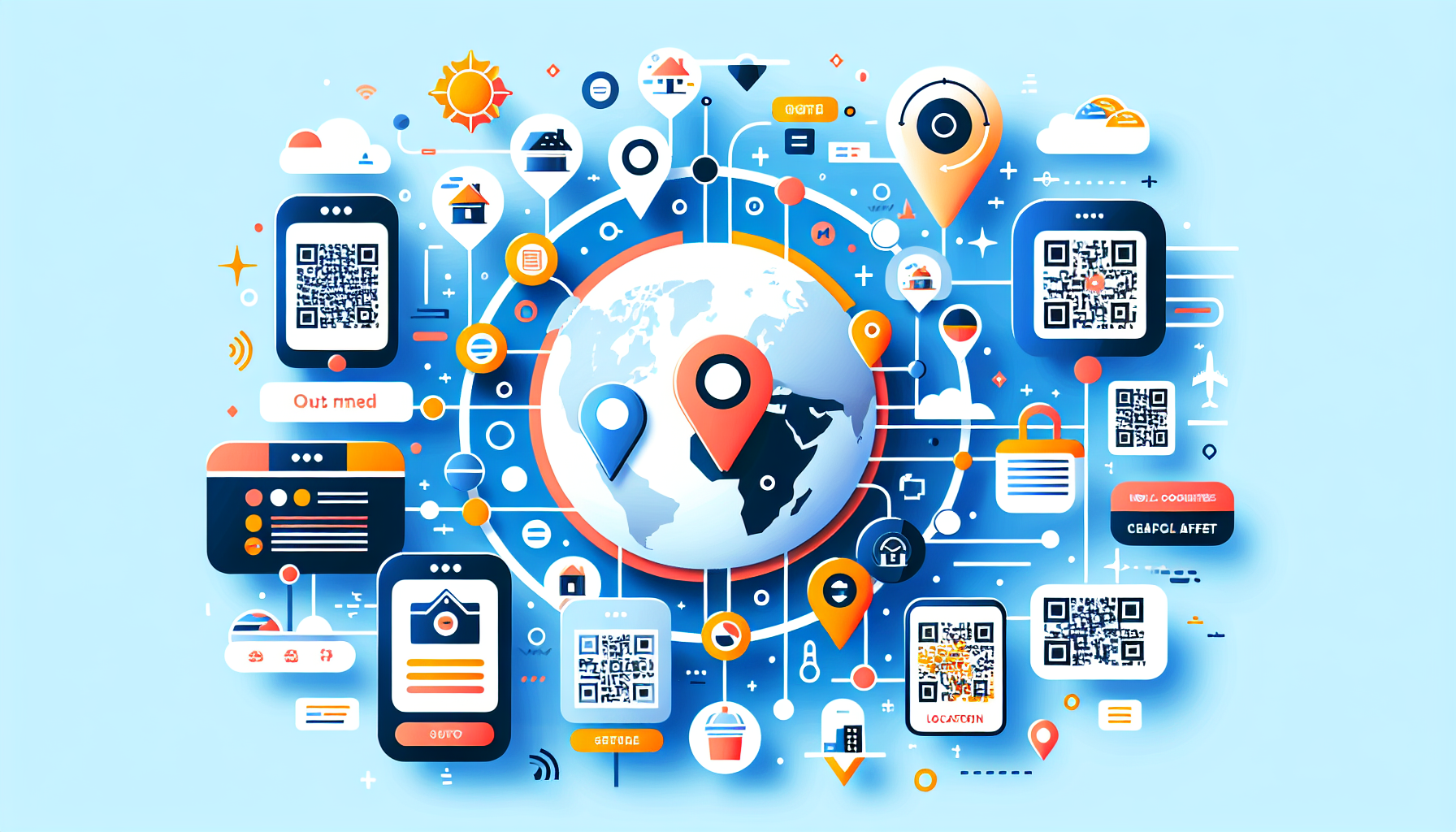
Location-based QR marketing lets brands change an offer, message, or destination page according to where a customer scans a code, turning one printed asset into a flexible channel for local relevance. In practice, that means a restaurant chain can place the same dynamic QR code on window posters nationwide, then route New York users to a lunch special, airport travelers to a grab-and-go menu, and suburban families to a weekend bundle. I have used this approach in retail rollouts, event campaigns, and franchise systems, and the pattern is consistent: personalized offers based on location increase scan-to-conversion rates because the customer sees something immediately useful instead of a generic landing page.
To personalize offers based on location with QR codes, you need three core pieces: a scannable code, a rules engine that detects or infers location, and destination content tailored to that place. Location can come from GPS permission on a mobile landing page, IP-based geolocation, scan-point placement, store selection, or geofenced app behavior. The offer can be a coupon, menu, appointment slot, loyalty reward, event schedule, product assortment, or local inventory message. The QR code itself is usually dynamic rather than static, because dynamic QR codes let you edit the destination, attach tracking parameters, test variants, and collect analytics after print production.
This matters because local intent is often the hidden driver behind scans. Someone scanning a code in a hotel lobby is solving a different problem than someone scanning the same code in a stadium concourse. Search, maps, and paid media have trained consumers to expect relevance by place; QR campaigns should meet the same standard. For teams managing multilocation businesses, location-based QR marketing also reduces operational friction. Instead of printing separate codes for every city, you can centralize governance, standardize branding, and still deliver neighborhood-level personalization. As the hub page for location-based QR marketing within advanced QR strategy, this article explains the models, tools, measurement methods, and implementation choices that make localized QR offers work at scale.
How location-based QR marketing works
Location-based QR marketing is the practice of using a QR scan as the trigger for geographically relevant content. The simplest version uses scan-point context: a code placed in Store A sends users to Store A’s landing page. More advanced setups combine a dynamic QR platform with geolocation logic. When the user scans, the short URL resolves through a redirect service that evaluates signals such as GPS permission, IP address, device language, time zone, campaign parameters, and referrer, then serves the best local experience. Platforms such as QR Code Generator PRO, Bitly, Beaconstac, Flowcode, and Uniqode support dynamic routing, while landing pages are commonly built in Shopify, HubSpot, WordPress, or custom CMS environments.
There are five common location models. First, fixed-placement localization ties each printed code to a known venue, shelf, table, or poster. Second, geolocation routing changes the destination based on the user’s current location at scan time. Third, regional segmentation groups users into city, state, ZIP code, or country audiences for broader offers. Fourth, nearest-location routing sends the user to the closest store finder result or service point. Fifth, geofenced conversion logic detects whether the user later entered a target area, useful when the scan occurs at home but redemption happens in store. Each model solves a different business need, and many mature campaigns use more than one.
The key advantage is adaptability. A static QR code is locked to one destination forever, which limits local relevance. A dynamic QR code acts more like a traffic controller. You can pause an expired promotion, redirect weather-affected regions to a substitute offer, or prioritize stores with excess inventory. During a quick-service restaurant test I supported, stores near business districts promoted weekday lunch combos, while suburban stores promoted family meals after 5 p.m. The packaging artwork stayed identical, but the QR experience changed by geography and time, which improved redemptions without increasing print complexity.
Choosing the right data source for location personalization
The most important implementation decision is how you determine location, because accuracy, privacy, and user friction vary by method. GPS-based location from the browser is the most precise, often within a few meters outdoors, and ideal for nearest-store routing or hyperlocal offers. The tradeoff is permission. If users deny location access, you need a fallback path. IP geolocation is automatic and usually accurate enough for country, state, and city-level personalization, but it can misclassify users on corporate networks, VPNs, and mobile carriers. For many campaigns, IP is sufficient to localize a hero image, currency, weather-related message, or store list, while GPS is reserved for directions and exact nearest-site results.
Scan-point location is often underused and highly reliable. If a code is physically installed in a specific venue, then the placement itself is the location signal. This is common in out-of-home advertising, in-store displays, hotel room cards, museum labels, and table tents. Because the marketer controls where the code appears, the destination can be personalized without asking the user for anything. This method also helps when privacy rules or browser limitations reduce geolocation accuracy. I recommend assigning each placement a unique campaign ID even when the visible artwork looks identical, because that preserves clean reporting by site, region, and asset type.
Declared location is another practical option. A landing page can ask users to choose a store, enter a ZIP code, or confirm a suggested city. While self-selection adds a click, it can outperform automatic detection when precision matters, such as local inventory, appointment booking, or age-restricted fulfillment. Strong campaigns combine methods in layers: infer location automatically, present the nearest store, and allow manual correction. That balance reduces errors and builds trust. If you claim a deal is valid “at your nearest location,” the routing logic must be credible, especially for franchises where each operator may have different participating offers or redemption rules.
Offer design strategies that convert by place
Personalizing offers by location is not just swapping a city name into a headline. The best localized QR offers reflect real local conditions: store format, inventory levels, climate, commuter patterns, tourism, language, event calendars, and neighborhood economics. A pharmacy can promote allergy relief in high-pollen regions and cold-weather remedies during a winter surge. A fitness chain can advertise class times that match commuter traffic around downtown clubs, while suburban clubs emphasize childcare hours and weekend sessions. When the offer mirrors local reality, scans feel useful rather than intrusive.
The most effective local offer structures usually fall into a few categories:
| Offer type | Best use case | Example | Main caution |
|---|---|---|---|
| Nearest-store discount | Driving foot traffic | “10% off today at our Union Square location” | Store participation must match the landing page |
| Local inventory message | Retail availability | “In stock now at Oak Brook” | Inventory feeds must refresh frequently |
| Regional menu or assortment | Chains with varied products | Different seasonal items by climate zone | Creative governance can become complex |
| Event-based promotion | Sports, concerts, festivals | Postgame meal bundle near a stadium | Timing windows need strict controls |
| Service-area booking | Home services and clinics | Appointment page for the nearest branch | Coverage maps must be accurate |
Urgency and redemption mechanics should also fit the local context. A commuter hub can justify a same-day mobile coupon. A furniture retailer with longer consideration cycles may use the QR code to offer a localized showroom appointment, financing incentive, or “available this week in your area” message. Restaurants often benefit from daypart logic layered onto location. Retailers should tie local promotions to inventory systems where possible, because “available near you” claims drive response only when they are true. Clear terms, store eligibility, expiration dates, and one-tap redemption paths consistently outperform clever copy.
Building the landing page and routing logic
A location-personalized QR campaign succeeds or fails on the destination experience. The landing page should confirm relevance in the first screen: city or store name, offer details, proof of validity, and a direct next action such as redeem, order, book, call, or navigate. If you need location permission, ask after showing value, not before. A simple sequence works best: identify the brand, explain the benefit, request optional location to find the nearest participating location, and provide a manual fallback. This approach raises permission acceptance because the request feels tied to a useful outcome rather than data collection for its own sake.
Routing logic should be explicit and documented. Start with the campaign objective, then define rules. Example: if GPS is granted, route to the nearest participating store within 25 miles; if GPS is unavailable, use IP city; if confidence is low, show a store selector; if inventory feed shows out of stock, switch to a rain-check or alternate product; if the local store is closed, offer online ordering or tomorrow’s pickup window. These rules sound operational because they are. Location-based QR marketing is part creative, part decision tree, and the teams that write down the rules before launch avoid most customer-facing errors.
Page speed and link durability matter more than many marketers expect. QR scans happen in imperfect environments: sidewalks, transit stations, arenas, and stores with weak signals. Use compressed images, minimal scripts, and a reliable redirect domain with HTTPS. Add UTM parameters for analytics, but keep the visible QR destination hidden behind a branded short link to avoid clutter. Test on iPhone and Android native camera apps, not only third-party scanners. I also recommend preserving a generic backup destination so that if any geolocation service fails, the user still lands on a functioning page rather than an error state.
Measurement, attribution, and compliance
To evaluate location-based QR marketing, track more than raw scan volume. The metrics that matter are scan rate by placement, location-detection success rate, store-selection rate, offer view rate, redemption rate, assisted conversion rate, and lift versus a nonlocalized control. For physical campaigns, compare regions with localized offers against matched regions with generic messaging. In one retail test, a dynamic QR code campaign tied to local inventory messaging delivered fewer total scans than a national discount creative, but it generated stronger revenue per scan because shoppers arriving on the landing page were closer to purchase intent. That is the right tradeoff.
Attribution should reflect the fact that scans often start one journey and finish another. A customer may scan in a bus shelter, browse products on mobile, then buy later on desktop or redeem in store. Use platform analytics, web analytics, POS coupon codes, CRM capture, and where available, store visit data from ad platforms or mobile measurement partners. Named tools such as Google Analytics 4, Adobe Analytics, Shopify reports, HubSpot, Segment, and Snowflake can connect the path if campaign parameters are standardized. Maintain a taxonomy for region, placement, creative, offer type, and store ID from the beginning; retrofitting naming conventions after launch usually produces broken reporting.
Privacy and compliance cannot be treated as an afterthought. If you collect precise location, explain why, obtain permission where required, and avoid retaining exact coordinates longer than necessary. Laws differ by jurisdiction, but transparent notice, limited retention, secure handling, and vendor due diligence are baseline expectations. For children’s products, healthcare, financial services, and alcohol promotions, location-personalized QR campaigns may trigger additional compliance reviews. Even outside regulated sectors, trust affects performance. Users are more willing to share location when the value exchange is obvious and the brand does not overreach.
Common mistakes and how to scale this subtopic across your QR strategy
The most common mistake is confusing localization with personalization. Changing a headline to “Hello, Chicago” is not enough if the inventory, pricing, hours, or redemption rules still point somewhere else. Another frequent failure is overengineering. Brands try to launch city-level, weather-level, event-level, and loyalty-level routing in one release, then struggle to debug edge cases. Start with one high-value layer such as nearest-store routing or regional offers, prove the uplift, and expand only after the data pipeline is stable. This is especially important for franchise systems, where operator approval and local participation often determine whether the campaign is operationally sound.
Scaling location-based QR marketing across a broader QR code advanced strategy requires reusable infrastructure. Build a hub-and-spoke content model: this hub explains the full practice, while supporting articles can go deeper on dynamic QR codes, store locator UX, local inventory feeds, geofencing, franchise governance, restaurant daypart campaigns, event activations, and analytics setup. On the execution side, standardize redirect domains, parameter naming, landing page modules, consent language, and QA checklists. The objective is controlled flexibility. Local teams should be able to tailor offers, but central marketing should still enforce brand standards, approved legal language, and measurement consistency.
When done well, personalized offers based on location with QR codes make physical media as adaptable as digital media. One code can speak differently to a tourist, commuter, local resident, or nearby shopper without changing the printed asset. The essential steps are straightforward: choose the right location signal, connect it to a dynamic QR workflow, design offers that reflect real local conditions, build fast landing pages with clear fallback logic, and measure outcomes beyond scans. If you manage a multilocation brand, start with a pilot in a few regions, document the routing rules, and use the results to build your location-based QR marketing playbook.
Frequently Asked Questions
How do location-based QR codes personalize offers without requiring different printed codes for every market?
Location-based QR marketing works by using a dynamic QR code instead of a static one. A static QR code always sends every scanner to the same fixed destination, but a dynamic QR code points to a redirect layer that can make decisions in real time. That redirect can use scan location, device signals, time of day, campaign rules, or audience logic to determine which page, offer, or message to show. The result is that one printed code on packaging, posters, in-store signage, direct mail, or event displays can serve different experiences depending on where the customer scans it.
For example, a restaurant chain can print one QR code across all store windows nationally and still deliver locally relevant outcomes. A customer scanning in Manhattan might see a quick lunch combo designed for office traffic, while someone scanning near an airport could be directed to a fast grab-and-go menu, and a family in a suburban shopping center could land on a weekend meal bundle. The physical asset stays the same, but the digital experience adapts to the context of the scan. That makes campaigns faster to deploy, easier to update, and far more efficient than reprinting materials for every region or store group.
This flexibility is especially valuable in retail rollouts, franchise systems, seasonal promotions, and event campaigns where timing and local nuance matter. Instead of treating every audience the same, brands can align the destination with local demand patterns, weather, foot traffic, regional inventory, or nearby store priorities. In practical terms, that means higher relevance, better conversion rates, and less waste in both production and campaign management.
What types of offers work best when personalizing QR code destinations by location?
The strongest location-based QR offers are the ones that reflect immediate customer intent and local conditions. That usually includes store-specific promotions, regionally relevant product bundles, localized menus, event-based specials, limited-time discounts, and landing pages that help people act quickly based on where they are. If someone scans a code while standing outside a storefront, at a transit hub, in a stadium, or at a trade show booth, the best offer is usually one that matches that environment and shortens the path to conversion.
In food and hospitality, this often means changing the menu, bundle, or call to action by neighborhood or venue type. Urban locations may prioritize speed and convenience, while suburban locations might highlight family packs or weekend promotions. In retail, city-center stores may emphasize new arrivals or pickup availability, while outlet locations may focus on clearance, local stock, or store-only deals. At events, a QR code can direct attendees to location-specific schedules, exhibitor offers, giveaway entries, or post-session content depending on which booth, hall, or city they are in.
The most effective offers also account for operational realities. If a location has excess inventory, the QR destination can spotlight those products. If a store is testing a local promotion, the code can support that test without changing the printed creative. If weather conditions differ by market, the landing page can shift from cold-weather gear to summer essentials. In other words, the best location-personalized QR experiences are not just geographically different for the sake of being different; they are tailored to local demand, store objectives, and the reason the customer is scanning in that specific place.
What do businesses need to set up a successful location-based QR code campaign?
At a minimum, businesses need a dynamic QR code platform, clear routing rules, localized landing pages or offers, and a measurement plan. The dynamic QR platform is the core technology because it enables the destination to change without changing the printed code itself. From there, the business defines how scans should be routed. That can be based on GPS-derived scan location, IP-based approximations, geofences, store regions, city groups, event venues, or other campaign logic. The more organized the routing framework is upfront, the easier it becomes to scale across multiple markets.
Landing page readiness is just as important as the code itself. If a brand wants to personalize by city, store type, or region, it needs destination pages that reflect those variations. That could be as simple as swapping in localized headlines, pricing, menus, and calls to action, or as advanced as building full market-specific experiences with maps, inventory, booking options, and localized social proof. It is also important to create fallback destinations for cases where location data is unavailable or inaccurate. A good user experience should never depend on perfect signal quality.
Operationally, teams should align marketing, design, analytics, and local operations before launch. That means deciding who owns updates, how quickly offers can be changed, what approvals are needed, and how performance will be reported. It also means testing the campaign in multiple physical locations before broad rollout. In my experience with retail and event deployments, the brands that perform best are the ones that treat dynamic QR personalization as an ongoing optimization channel, not a one-time print project. They build a repeatable system for local relevance, measure what happens by region, and refine the offer mix over time.
How can brands measure whether location-based QR personalization is actually improving results?
Measurement should go beyond total scan volume. Scans are useful, but the real question is whether localized experiences drive better engagement and conversion than generic ones. Brands should track scan-to-visit rate, landing page engagement, click-through rate, redemption rate, purchase completion, store actions, form fills, app downloads, and any other meaningful next step tied to the campaign objective. These metrics should be segmented by location, venue type, campaign asset, and offer version so teams can identify where local personalization is making a measurable difference.
A strong approach is to compare performance across localized variants and against a non-personalized control experience. For example, a restaurant group might test a city-specific lunch promotion against a generic national offer. A retailer might compare QR scans routed to store-specific product highlights versus a standard category page. If the localized version produces higher conversion, longer engagement, or better in-store redemption, the business has clear evidence that local relevance is adding value. This kind of structured testing turns QR personalization from a creative idea into a data-backed strategy.
It is also important to connect QR analytics to broader business systems whenever possible. If scan data can be paired with POS data, CRM records, campaign tagging, or location performance reporting, brands gain a much clearer picture of revenue impact. They can see which geographies respond to discounting, which areas convert better with convenience messaging, and which venue types generate stronger repeat behavior. Over time, this helps refine not only QR code routing, but also merchandising, media planning, local promotions, and store-level decision-making. The biggest gains usually come from repeated optimization rather than a single launch.
Are there privacy, accuracy, or customer experience concerns with location-based QR code personalization?
Yes, and smart brands plan for all three. On the privacy side, businesses should be transparent about what data is being used and avoid collecting more than they need. In many cases, location-based QR personalization can be handled through general scan-location logic without asking users to provide sensitive personal information. If more precise location permissions are involved, the experience should clearly explain why that data is helpful and what the customer receives in return. Compliance with privacy regulations and platform policies should be built into the campaign from the beginning, not added later.
Accuracy is another practical concern because scan location is not always perfect. Depending on the method used, a system may identify a nearby area rather than an exact point. That is why good campaign design uses sensible geographic groupings and fallback logic instead of relying on hyper-precise assumptions. If someone scans near a market boundary, the offer should still feel relevant even if it is not customized down to the exact block. The goal is local relevance, not technical perfection. Brands should test in real-world conditions, especially in dense cities, airports, large venues, and multi-tenant retail environments where signal interpretation can be more complex.
Customer experience matters just as much as data and targeting. A personalized QR destination should feel helpful, not confusing. The landing page should load quickly, match the promise of the signage, and make the next action obvious. If a user is shown an offer that does not match the local context, confidence drops immediately. On the other hand, when the code delivers a timely and relevant experience, customers perceive it as convenience rather than marketing. That is the standard brands should aim for: use location to reduce friction, increase usefulness, and make one printed QR code feel intelligently local wherever it appears.